
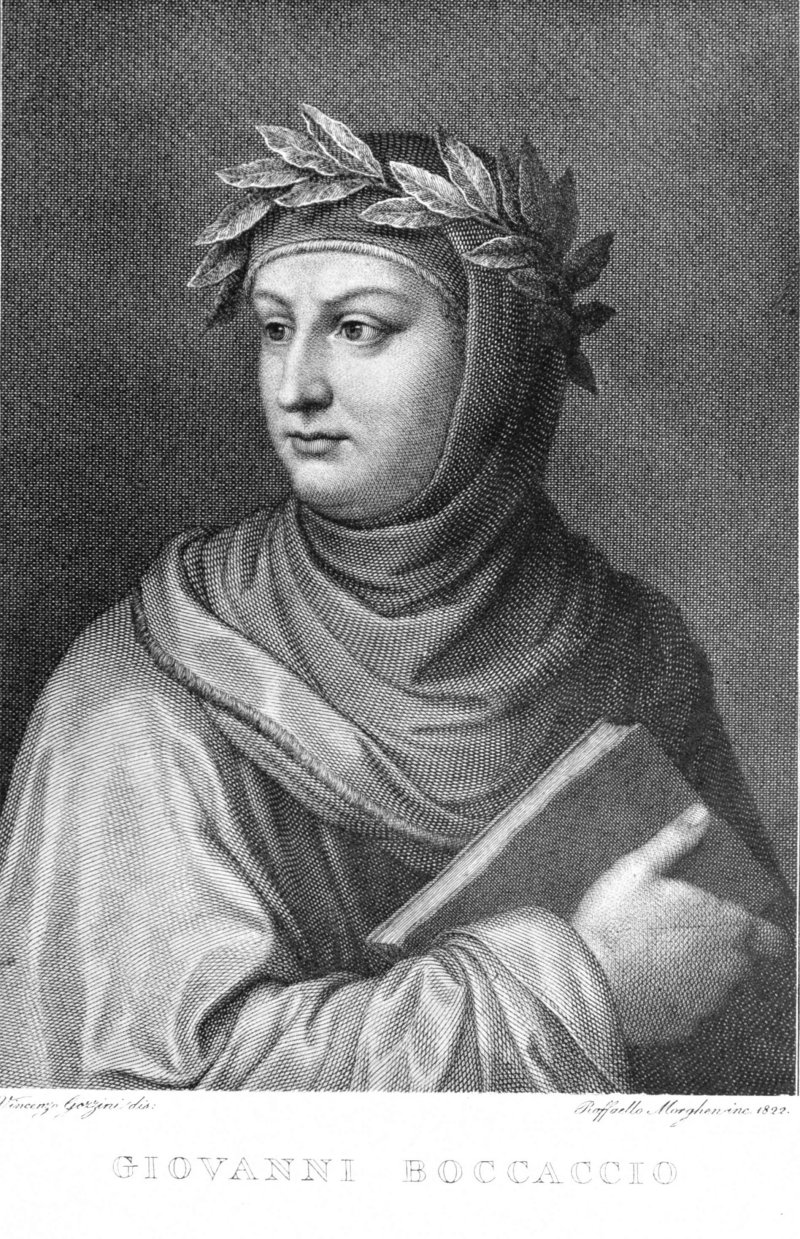
One of the world’s great books is The Decameron, written by Giovanni Boccaccio (1313-1375). He is one of the iconic ‘Three Crowns’ of Italian literature. His life largely overlapped with that of Petrarch (1304-1374), and just barely overlapped with that of Dante (1265-1321). Their combined brilliance shines forth over seven centuries, more than that of anyone else alive from that era. This book explores, in part, how Boccaccio cemented the reputations of his two fellow Italians.
Our author is Brenda Deen Schildgen, Professor Emerita at the University of California. She tells us “Boccaccio’s commitment to promoting Dante as the apogee of Italian vernacular literary glory was a perennial Vocation.” Boccaccio worked on three separate copies of Dante’s Divine Comedy. Besides writing notes in each, he “also wrote a literal summary for each canticle in verse, with rubrics for each canto.” Although he was not the first to write such rubrics, which “are literal props for the readers, they make reading canto by canto easier for less erudite readers.”
However, the key question is why did Dante write in the version of Italian he used (Tuscan), rather than Latin? “The answer Boccaccio gives goes to the heart of the sociolinguistic revolution that the Commedia represents. First was to make his poem easily available for his fellow citizens and also for other Italians. Second, Boccaccio claimed that Dante actually started writing it Latin “but stopped,” in the words of Boccaccio “thinking that it was futile to try to stuff bread into the mouths of those who were still sucking milk.” A pithy comment indeed, worthy of Yogi Berra.
Boccaccio’s attention to Petrarch is no less exacting (they first met in 1350, and corresponded for years). He declared “Petrarch as equal or superior to the ancient poets…reviewing Petrarch’s range of style and genres and how they match the achievements of the ancients… Boccaccio without hesitation or spiritual conflict demonstrates his commitment to the secular poetic tradition.” His praise, writes Schildgen, “stands out as a ‘humanist manifesto’ that bridges the ancient pagan past to the Christian present through Petrarch, a modern reincarnation of Virgil.” Schildgen characterizes his comparison of both Dante and Petrarch with the ancients as bold and audacious.
While Boccaccio had no spiritual qualms, the same cannot be said for Petrarch. Schildgen gives us great insight into how he regarded “the differences between the Christian and the secular literary traditions.” In a letter from around 1360, “Petrarch pours forth his deep affection for Cicero and Virgil, for Plato and Homer.” But he also “appears to reject the secular Greco-Roman legacy as he famously asserts his recent decision that ‘Now my orators shall be Ambrose, Augustine, Jerome and Gregory, my philosopher shall be Paul and my poet David.’”
Our author divines that by “Imitating the zealous style of Jerome, Petrarch joins him in a flamboyant renunciation of the pleasure of ancient secular letters.” He argues that it is one’s motive for reading the ancient authors “that makes them efficacious or dangerous.” Jerome famously claimed to have abandoned the ancient writers. This inspired Petrarch, who “makes Jerome’s challenge the foundation for a defence of poetry and classical letters in which Augustine serves as his prime authority.”
Schildgen literally takes us into the mind of Petrarch via his work known as Secretum, written about 1350. In this work “he appears to use the Augustinian conversion pattern as a prop whereby he addresses his own inner turmoil…An intellectual and spiritual conversation with ‘his’ Augustine, the Secretum displays eloquence and rhetorical skill in a flyting match in which citation of the ancient becomes the effective method of contest…The Secretum appears almost an exercise in debate where the ability of the speaker to cite an ancient source gives him power over his opponent.”
In this brilliant work, in Latin, “Petrarch’s use of Augustine emerges as a ploy for his own failure to conform to the traditional conversion pattern.”
“The argument proposed in this study,” writes Schildgen, “is that the affective aspect of poetry, that is, how it affects readers, constitutes the link that connects all literature to the myths of the ancients.”
Ultimately, Boccaccio “argues that the poet, unlike the philosopher, works in solitude, uses art and metrical form to imitate nature and in some sense to transform nature through words. Finally, he insists, and this is essential to his defense of the pagan legacy, poetry is the handmaiden of philosophy.”
A very insightful and important book – on many levels – this book deserves a place on the bookshelf of every scholar.
The beauty of this book is blemished only by its Index. It is ‘off’ by a page or two for virtually every entry. For example, Thomas Hobbes is on 119, not 120 as the Index states. Peter Damian is on 76 and 79, not 77 and 78. Brossano is on 83, not 85. A total shambles.
Image: Portrait of Giovanni Boccaccio by Raffaello Morghen, c. 1822
Boccaccio Defends Literature is by University of Toronto Press. It lists for $90.