
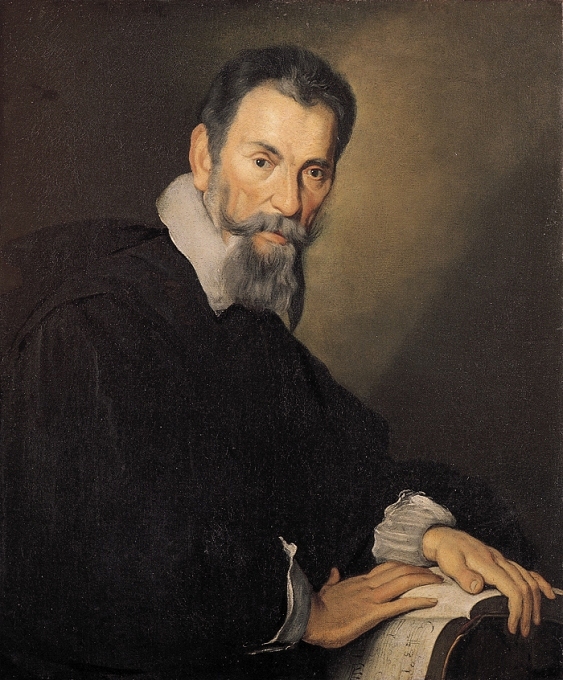
Image: Monteverdi
This important contribution to Homeric studies is entitled The Choice of Odysseus. Due to reasons I will explain below, I added Penelope to the title in my headline. This book is written by Dr. Sarah Van der Laan (Indiana University).
For those who follow the scholarly study of Homer’s Ulysses [also called Odysseus), this book’s title will ring a bell of familiarity. In 1992, Susanne Wofford wrote a book entitled The Choice of Achilles. In some sense, these books complement one another; how the reader with interpret their causal relationship will depends on one’s scholarly attainment on the subject.
Unlike the Iliad (where Achilles appears in relation to the Trojan War), the Gods do not meddle much in the Odyssey – they are remote. Their direct presence is felt quite a few times in Iliad, but in Odyssey they stay aloft. “The gods of the Odyssean cosmos,” Van der Laan, “watch, judge, and when necessary assist, but they demand that each human merit that intervention by using his or her own powers to the utmost.”
This is not to say, however, that the gods are absent. Indeed, we can see in the description given by Wofford in her book an area of mutuality, much like circles in a Venn diagram sharing some space.
The gods, writes Wofford, “represent an idealized audience, an abstracted version of the original audience without its mortality. By presenting the gods as watchers [just as Van der Laan noted], as if in a theatre, Homer suggests that they may resemble this original audience. Like the imagined audience of the poem, they view the spectacle of heroic action as a fiction or drama…They lend their authority to the system of values expressed in the poem, seeing most fully the larger context of values expressed in the poem.”
I have quoted Wofford at some length as it sets the stage – quite literally – for my analysis of the book under review.
First, I want to emphasise the words ‘theatre’ and ‘spectacle.’ Both words are closely associated the opera. Van der Laan devotes an entire chapter (the finest in the book) to a study of Monteverdi’s opera The Return of Ulysess. Dating from 1640, this Italian-language creation is considered the first ‘modern’ opera.
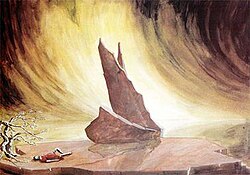
In Act one, first the god Neptune, and then Jupiter himself stride onto the stage. Contrary to their wishes, a people known as the Phaecians have brought an unconscious Ulysses on shore. To punish them, the gods turn both them and ship to stone [an illustration of how this dramatic effect could be realised in the opera house is shown below]. By this act they “lend their authority to the system of values expressed in the poem,” as described by Wofford when analysing the Iliad. And it is a spectacle for the audience! How the transformation into stone is expressed is quite dramatic in the 2022 staging of the Monteverdi opera by the Baroque music ensemble Les Arts Florissants, which I watched after reading the relevant chapter in Van der Laan’s book. While the Gods in Homer’s Odyssey may be remote, Monteverdi thought it best for dramatic action to put them centre stage. Act 1 also includes a face-to-face meeting between Ulysses and Minerva (Athena), who tells him of “the unchanging constancy of the chaste Penelope,” the wife he has not seen for close to 20 years. The Gods certainly view the action in the opera as a drama; one might even think they enjoy being part of the action, for the rapt audience to witness!
Van der Laan goes into great detail about how the opera itself was created. Monteverdi used as inspiration “an adaptation of the Odyssey into a 1573 chivalric romance by Lodovico Dolce. There are 12 extant manuscripts of the opera’s text, which differ substantially from a single 17th century manuscript that distorts the image of Penelope. “Monteverdi’s score tempers the misogynistic resonances of the libretto to present a more sympathetic characterization of Penelope and a more equal view of her marriage to Odysseus,” writes Van der Laan.
At the outset of the opera, the personification of Fate mocks human frailty. “Despite the opera’s title, Ulysseus’ homecoming disappears altogether” in the prologue. His eventual homecoming “is a work of Fate, not the result of heroism.” For anyone who had placed Ulysses on a heroic pedestal, this opera is a shattering reinvention how Homer’s work had been widely interpreted for centuries. This is conveyed to the real-life audience when Ulysses sings in musical keys of frailty and love [d and a respectively, for those with a musical background]. Instead of the strong, bellowing man of heroism we anticipate, we first see Ulysses crawling on the sand and singing like a woman. By this device, Monteverdi solidifies “Odyssey’s claims for marriage as epic subject and epic telos.”
So how is Penelope depicted in the opera? Monteverdi cut Penelope’s lament nearly in half from the original text by a fellow named Badoaro. The resulting lament is divided into three sections. The last one “deals with eternity and the relationship of humankind to the cosmos…Penelope considers her situation through a deeply unhappy but logical progression of ideas, from the personal to the universal.” Instead of rambling emotion, Van der Laan writes, Penelope gives us “an intellectual response to her situation and plea for Ulysses’ return.”
As Penelope is granted greater eloquence than her husband possesses, Ulysses is thereby reduced. He is “anything but the resourceful and crafty hero of tradition.” The choice of Ulysses becomes the choice of Penelope, as it is her heroism, not his, that charts the course of action.
All this is in the context of ancient times, but in Paradise Lost, “Milton transforms Homer’s epic into the stuff of divine revelation.” Van der Laan explores this with intensity in the chapter following the one dealing with the opera. Her insight here is one that all scholars of the Odyssey and Paradise Lost need to pay attention to:
“A careful comparison of the councils reveals that the dialog between the Father and the Son [in PL] is patterned very closely on the dialogue between Zeus and his daughter Athena [in Odyssey]. The extent and importance of that patterning has not previously been noticed.” In effect, our author shows that “Milton presses the Odyssey into the service of Christian doctrine.”
I would need to more than double the length of this review to do justice to Van der Laan’s important book. Her insights and analysis prove that even after centuries of scholarship, the full extent of meaning embodied in the Odyssey and its permutations in the Renaissance still contain rich seams of gold to be mined.
The Choice of Odysseus: Homeric Ethics in Renaissance Epic and Opera is by Oxford University Press. It lists for $120 but is available on Amazon for $59.
Lead image: A 1630 painting of Monteverdi, by Bernardo Strozzi. In the collection of the Tyrolean State Museum. Courtesy of Wikimedia Commons.
Second image: Set design for Act 1 Scene V of Monteverdi’s Il ritorno d’Ulisse in Patria (the Phaecian ship is turned to stone), prepared by Alfred Siercke for the 1964 production by Hamburg State Opera. Courtesy of Wikimedia Commons.