
That existential question, posed by John Updike in a letter to a woman who would become his wife, was written in 1974. It is, to put it bluntly, the animating principle of the play Cloud 9, currently being performed at The Stage Austin.
Lest the gentle reader (read: Bridgerton) be offended by the headline/Updike quote, I must reveal that the F-word is gratuitously used many times in this play. It is mostly confined to just once scene which, along with several others, should have been judiciously cut. Like many plays of the last few decades, it is overlong, and would actually benefit from being trimmed.
Since this fluid-gender play contains elements of drama, comedy, and farce, it cannot be reviewed in the traditional sense. I will, therefore, assess elements of it from an elevated literary plane.
By simply watching and listening to this unusual play from 1981 by Caryl Churchill (now 87 years old), one is reminded of the English author John Masefield. In 1926, he wrote a novel entitled ODTAA. It is actually an acronym, meaning ‘one damn thing after another.’ His novel is a lengthy tale of futile adventures in the jungle, ‘event after event,’ as Masefield states, which end up achieving precisely nothing. Instead of Cloud9, this play could have been titled ODTAA.
On Halloween day in 1958, Isaiah Berlin delivered a lecture at Oxford University. Entitled Two Concepts of Liberty, Berlin said that “we are faced with choices between ends equally ultimate, and claims equally absolute, the realisation of some of which must inevitably involve the sacrifice of others.”
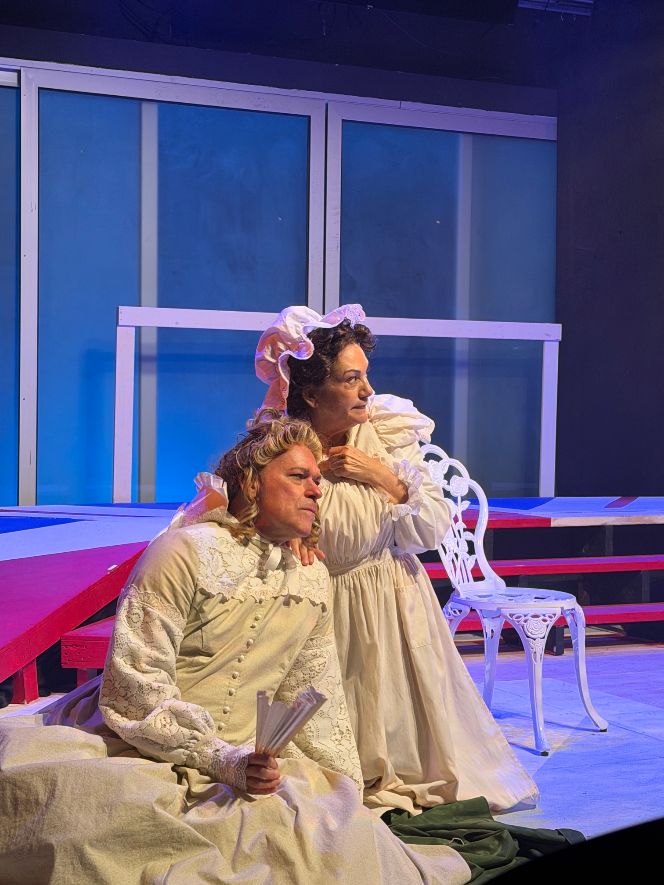
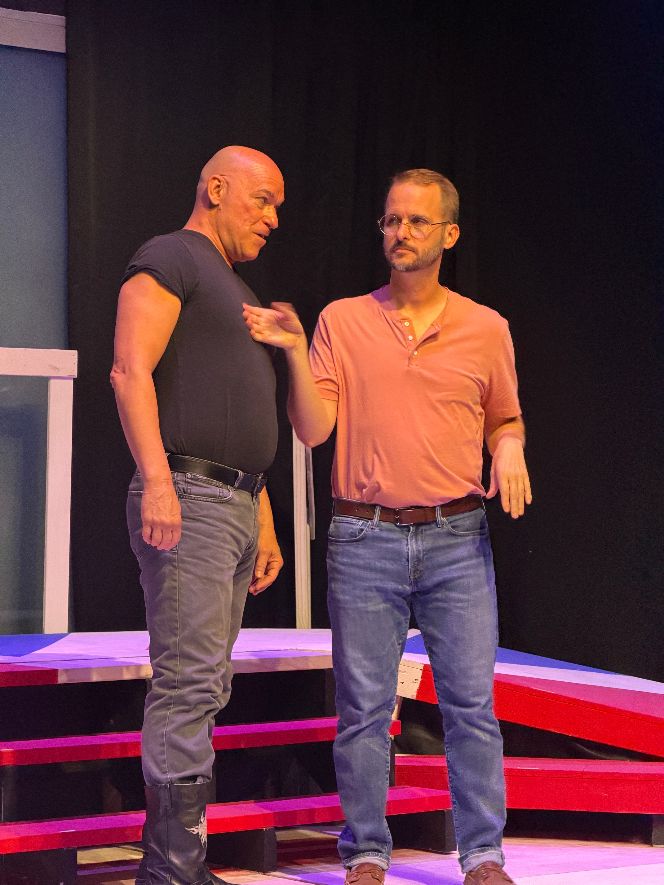
This is the realisation – and challenge – facing characters in this play. We have Betty (played by the male actor Kirk Kelso) who has ‘flirted’ with another man, begging her husband Clive (Benjamin Rodriguez) for forgiveness. (When a lonely woman stoops to folly..) Later in the play, we see Kelso again (no longer in a dress), playing the horny gay man Martin, who ‘flirts’ with Edward (Frank Rivera), a cute gardener who appears to be gay but also apparently sleeps with two women. We also have Ellen, governess to Betty’s young son (played by the lady Maureen Klein Slabaugh), who is a lesbian in love with Betty. And on it goes. What choices will be made, and who will be sacrificed? The answers may shatter Victorian morality.
The literary doyen William Empson, in 1951, wrote
“It may be that the human mind can recognize actually incommensurable values, and the chief human value is to stand up between them.” To ‘stand up between them’ simply means somehow keeping yourself upright while remaining aware of both. This is precisely what the characters in this play do, and it is the challenge also facing the actors, who must keep themselves upright while being lashed by the dragon’s-tail of a play Churchill has created. I must mention here Mark Gerchak, who plays an African explorer in the first act, and a young girl in the second. I can only imagine that most actors given the ‘opportunity’ to play this part would have an OMG moment. Seeing a tall, lanky guy play a young girl is so absurd that it bends right around the dragon to meet its tail, where it finds an oasis of believability, but only in the hands of the right actor. Kudos to Gerchak for this sterling performance. Frank Rivera rounds out this dedicated cast, in the 19th century half, as the saucy African boy with a mean streak who attends to every need of Clive and Betty.
It has been said of T.S. Eliot’s poem The Waste Land that it feels like it inhabits, and depicts, a world that lacks the saving authority of a justification, of a something that underwrites it. The same cannot be said for Cloud9: it is underwritten by the British Empire and Queen Victoria, who name is evoked several times. From the opening of the play, where the British national anthem is played, to the ramp on stage where the Union Jack flag is painted, this play is very much grounded in late-nineteenth-century British colonial Africa. That is the first act: the second takes place in London a century later.
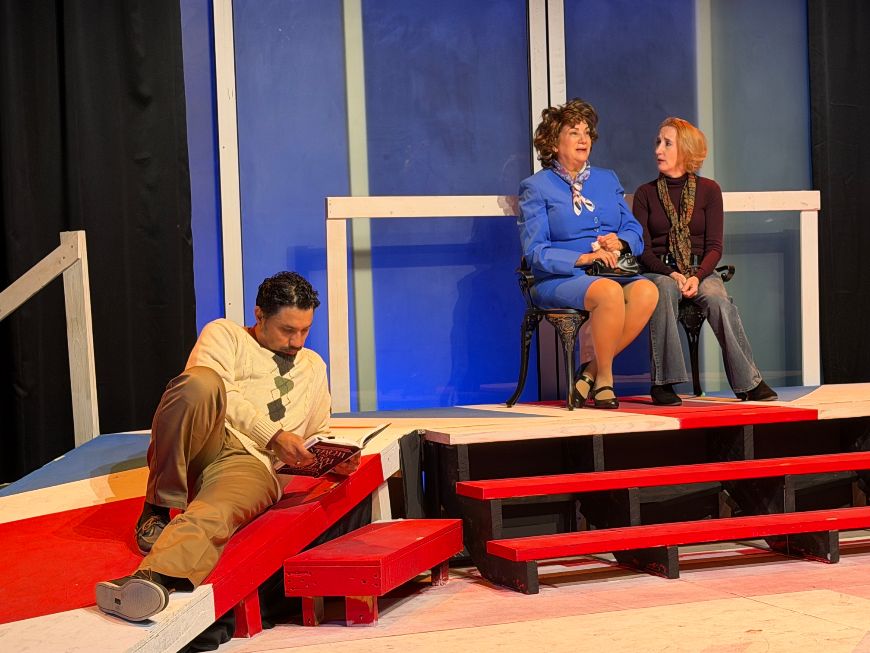
In the second act, Timms plays Victoria, the mother of Edward. She states matter-of-factly, “You can’t separate fucking from economics.” If you can make sense of that, you can make sense of Cloud9. This look at the ever-changing world of sexuality is deliberately provocative to stir controversy.
Go see it, if you dare! It’s a good excuse to support local theatre. Anyone who has the audacity to put this play on deserves your support. By the way, cover design of the programme is brilliant: kudos to Morgan Hebert.
Cloud9 will be performed thru May 24 at The Stage Austin.
Visit the website for tickets: www.TheStageAustin.com
Lead Photo: Kelso (as Betty) and, at right, Maureen Slabaugh, from the 19th century section of the play.
Second photo: Benjamin Rodriguez, with Maureen Slabaugh and Timms; from the 1979 section of the play
Third photo: Kelso (left) and Frank Rivera, also from the 1979 section.