
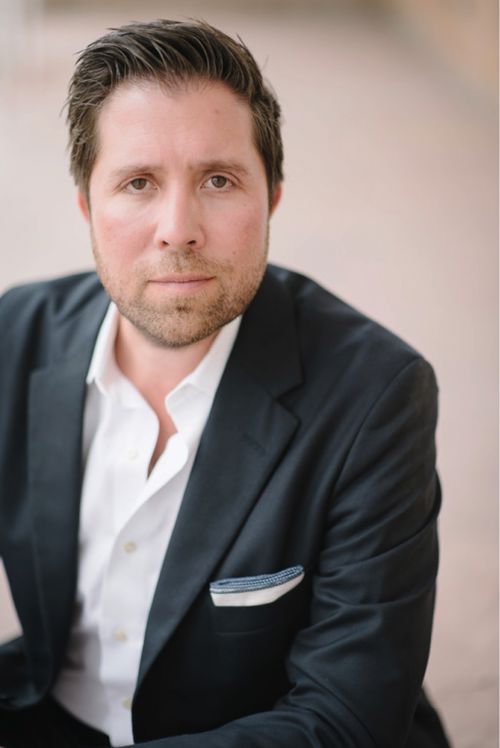
Photo: Timothy Myers, Music Director, Austin Opera Orchestra
The old warhorse opera about a group of Bohemians in Paris in the 1830s has returned to Austin Opera. I reviewed its most recent outing from the stable of classic operas in 2019, so I refer the reader to that review for the details (link below).
In this production of the opera by Puccini, the roles of Mimi and Musetta are being sung for the very first time by Brittany Olivia Logan as Mimi, and Jasmine Habersham as Musetta. The programme notes mention that Logan is also singing the role of Musetta this season at “Pittsburgh Opera in her house and role debuts.” Those who live in Dallas will be delighted to know Habersham will be performing there this year for the Holiday Pops concert of the Dallas Symphony. Both of them delivered exceptional and moving performances in La Bohème.
The British-American tenor Joshua Blue as Rodolfo was superb. He walked the tightrope of this demanding role, which can easily teeter to the bathetic, but he maintained just the proper balance so that by the end the audience genuinely mourned with him as he lost his darling Mimi.
I have mentioned in my opera reviews that the live music is provided by the Austin Opera Orchestra, so I take this opportunity to finally write about that orchestra in more detail. Its Music Director, Timothy Myers (photo), spoke to the audience at the Long Center before the opera began. He talked first about his rehearsal and conducting process.
“In opera, I’m primarily listening to the vibrado of the singers, because that tells me a lot, what it will tell me today is, for example, who slept well last night and who didn’t, right?
“If a singer’s feeling under the weather – their chords are a little swollen – their vibrado shifts a little bit. And so, I’m listening to that because that tells me how to structure things to help them sound their very, very best. That’s something I really love doing, but it’s challenging.”
In this production, there are two Mimis and two Rodolfos, performing on different nights. Myers spoke to the challenge that poses for the orchestra.
“So, for example, last night, the ‘other’ Mimi and Rodolfo performed, where we hadn’t seen them for a few days. I was also really grateful that the orchestra was very, very focused and listened very carefully, because that Mimi is just a little bit of a lighter voice than the one you’ll hear today. And they know that. So they were much more generous and sort of maybe ‘here we don’t play quite so loud to just give her a little breathing room’.
“We’re all listening, trying to make the best musical structure we can for these incredible artists. There’s no microphone. You could pay me a million dollars a year, and I wouldn’t be a singer. I have so much mad respect for them, and I, to be able to be a part of helping them perform their best, is something I’m really passionate about.
Anne Burridge, General Director of Austin Opera, elaborated on the orchestra itself. “I also want to underscore what you said about the Austin Opera Orchestra, because it’s an incredible group of talented musicians. They have existed since 1987 when the company was founded. Most folks don’t realise that there are two professional tenured symphonies in Austin. We have the Austin Symphony, and we have the Austin Opera Orchestra, and there is some crossover, typically any given year, maybe 40% of our players will play in both.
“We do align our schedule with a symphony to make that possible so that we can keep these incredibly gifted musicians here, living in Austin. But an opera orchestra really also just holds so much respect and musicality. And even though most of them cannot see what’s going on, on the stage, this orchestra has become so adept, as you said, at listening and responding and really collaborating with the singers.”
Myers concluded by speaking about Puccini, and his own approach to conducting.
“Other artists were influential on Puccini and his craft. He cared deeply about doing his research about characters, and how he worked with his librettists.
“And you can tell, just from the way he writes, that he’s learned a lot from the masters, and he spent a lot of time studying the scores of composers that came before him, and not just opera composers, but symbolic composers as well.
“And my philosophy is you always steal from the best. I do it all the time. I see a good conductor make a move and I’m like, ‘I’m gonna use that one.’”
A protégé of Lorin Maazel, Myers is a graduate of Southwestern College (KS), Florida State University, and in 2022 completed the Program for Leadership Development (Executive MBA) at Harvard Business School. In addition to Austin Opera, Myers is also the newly appointed Music Director of the Spoleto Festival Orchestra at Spoleto Festival USA.