
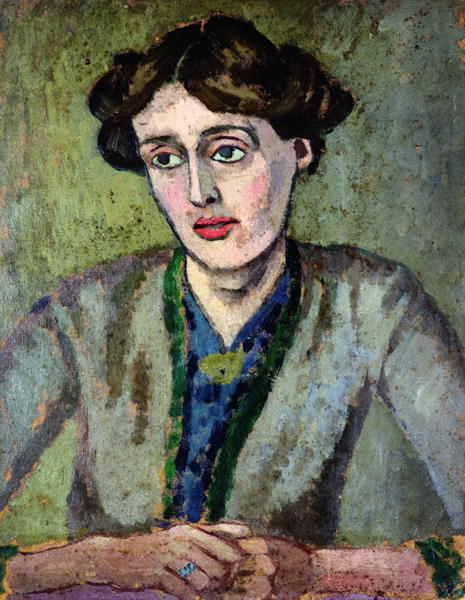
My headline is taken from a novel by Virginia Woolf (pictured here). In Mrs Dalloway (1925), the character named in the title is “someone who can’t understand the pleasures of poetry.” She harbours a “suspicion of anyone who would devote their lives to Milton’s sublime aloofness.” So she derisively tells a young poet that the professor he is talking to “knows everything in the world about Milton!”
My quote comes from this book by Orlando Reade, who has a PhD in English literature. While Woolf did not have that degree, she actually read Milton’s Paradise Lost in 1918, when she was 46 years old. Milton’s personality cast such a long shadow that even into the 1940s he was generally cast out of good society. But that changed when T.S. Eliot gave a lecture on Milton in 1946. Then Eliot declared that “poets are sufficiently liberated from Milton’s reputation, to approach the study of his work without danger.”
Reade here makes his own declaration, which inspired the title of his book: “The revolution was complete. Milton was safe to read!” This book is the story of that revolution. And what a story it is. This book was named a Book of the Year by the Financial Times and The Independent.
The view of Milton has seen a rollercoaster ride ever since his death in 1674. George Eliot wrote what was just recently voted as the best novel of all time: Middlemarch. “The first half of Middlemarch,” writes Reade, “is a horror story about the waste of women’s potential. For Eliot (a woman whose real name was Mary Ann Evans), Milton represented not only the heights of achievement but also the way that men have prevented women from flourishing.”
In Middlemarch, Dorothea becomes disillusioned with her husband and compares him to Milton. “Dorothea had thought,” writes Eliot, “that she could have been patient with John Milton, but she had never imagined him behaving in this way.” That was written in 1871. Let’s skip ahead 43 years. Ezra Pound, in 1914 (the year he first met Eliot), was his usual direct self when he wrote “Milton is the worst sort of poison.” Reade tells us that “Pound’s main objection was that Milton tried turning English into Latin, changing native sentence structure, and importing loan words.” Just a year later, even the young T.S. Eliot “Believed that Paradise Lost was hopelessly cut off from modern life, which was precisely what animated his modernist verse.”
The astute reader will notice the irony here: even though Milton’s main work was beyond outdated, it was still so powerful that it forced Eliot to change the face of poetry in the 20th century, just as Milton had changed its face in the 17th!! Reade does not make this specific point, but it is certainly implied. It’s interesting to note that Woolf met Eliot for the first time in 1916. In this 1914-1916 era, “Woolf was also writing criticism, which was less bombastic than Pound’s and Eliot’s but no less acute. Of the three, she was the most generous to Milton – perhaps because she was not a poet.” Woolf wrote that Paradise Lost was in fact the “essence, of which all other poetry is the dilution.” Generous indeed! Woolf wrote in her diary in 1918 that Milton “was the first of the masculinists.” By that, Reade says, she meant “that his epic was influential among later, muscular English poets. Was Woolf, perhaps, also thinking of her male contemporaries, Pound and Eliot, with their hard, impersonal poetry?”
This book by Reade is so rich that I have written close to 600 words without straying outside of Chapters 4 and 7! But we must go back to Chapter 2, ominously entitled Dorothy Wordsworth Brings Her Brother an Apple. “When Wordsworth looks back at the early days of the French Revolution, his language is haunted by Milton’s language…Milton’s language provides a deep structure for Wordsworth’s poem The Prelude.” It might have been poison for Pound a century later, but for Wordsworth it was an elixir. At once again we see the power of Milton’s works: just as he would compel Eliot to chart a new course for 20th century poetry, he compelled Wordsworth to do same in the 19th century. So Milton caused revolutions in three different centuries!
But whence the title of Reade’s chapter 2? If one were to see it in a film, one would think the director or screen writer had lost their minds. But the truth is that in February 1802, William and his sister Dorothy “had been reading Paradise Lost together…Inspired my Milton’s poem, they play-acted as Adam and Eve.” So it was on the fateful day of 6 May 1802. William was working in the garden (read Garden of Eden) of their cottage in the English village of Grasmere. “At one o’clock, Dorothy came up to give him an apple.” And in that moment of the proverbial apple, all of history began, and all of history changed.
A superb book: even if you have no interest in reading Paradise Lost, you must read this book. Who knows when the next revolution might overtake you?
Image: A portrait of Virginia Woolf in 1917, by Roger Fry.
What in Me is Dark: The Revolutionary Afterlife of Paradise Lost, is by Astra House Press in NY. It lists for $28.