
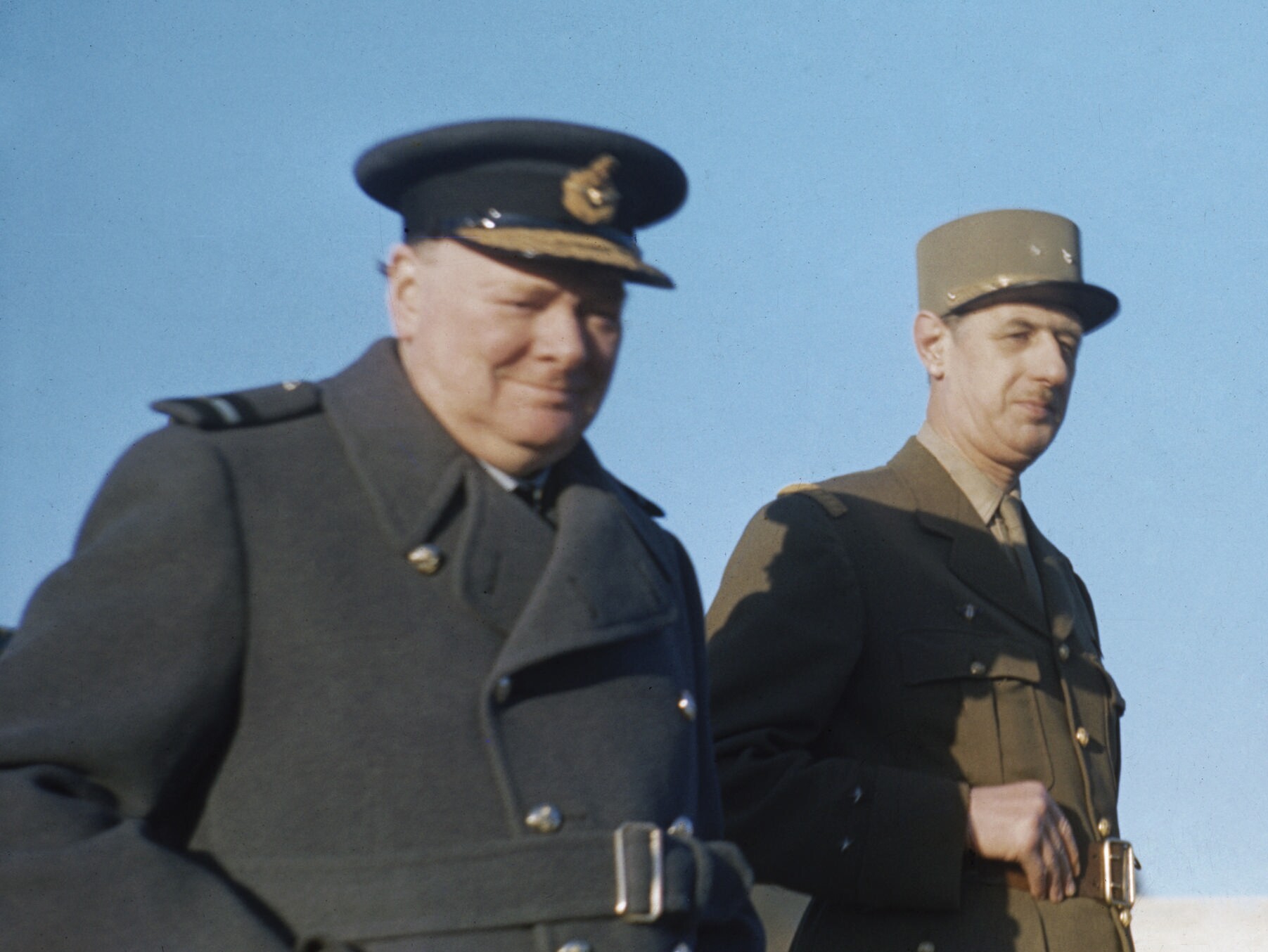
In the changing fortunes of fate, Charles de Gaulle “has become a unifying force in France. Winston Churchill, on the other hand, is now a figure of controversy again.”
How their careers intertwined during and after World War II is the subject of this exemplary book by Richard Vinen, professor of history at King’s College London. He notes with some disdain that over the past decades “The shift of Churchill’s status in the United States is even more dramatic than that in the United Kingdom. Churchill is now an icon of the right in a way that would have seemed odd just a decade ago.”
While Vinen does not remind us that President Obama removed the bronze bust of Churchill by Epstein from the Oval Office, it is back there now. “It is not entirely flippant to suggest that the quickest way to determine the political complexion of an American president now is to find out whether or not the 1947 Sir Jacob Epstein bust is on display in the Oval Office.” As Vinen notes, “Churchill and de Gaulle were both men of the right who formed alliances with the left during the Second World War.”
This book, however, is not focused on what was happening in the United States during the war, but how France and the UK interacted. During the war, de Gaulle was not the leader of France but just one of several prominent Frenchmen who had taken refuge in London after the Nazi entry into Paris. But territory was not de Gaulle’s concern.
“His conception of France was an abstract one. De Gaulle’s concern was to save an ‘idea of France’ rather than to protect a piece of land.” Unfortunately, de Gaulle’s book of 1934 (Towards a Professional Army), was being read not only in Paris but in Berlin. Vinen relates that Albert Speer wrote of what Hitler said: “I have time and again read Colonel de Gaulle’s book on methods of modern warfare employing fully motorized units and I have learned a great deal from it.” It was a key element in the strategy that saw the fall of France in 1940. De Gaulle, however, was not concerned with how to liberate France. The British General Alan Brooke, who met de Gaulle 2 months after France fell, wrote “in all discussions he assumed that the problem of the liberation of France was mine, while he concentrated on how he would govern it, as dictator, as soon as it was liberated.”
One might consider de Gaulle’s dry opinion of Albert Lebrun, who was president of France until its takeover by the Germans. “As a head of state he lacked two things – being a head and having a state.” The contrast between the French and the English is neatly encapsulated by Vinen: “French political scientists often say the British have no conception of the state. It would be fairer to say that the British take elements of the state so much for granted that they are barely conscious of their existence.”
Churchill gave de Gaulle safe haven to plot the future governance of France, transforming himself from a military man to a politician; although he “never seemed at home” in London, he did live there in safety and comfort.
Meanwhile, war raged on in far flung places. Singapore fell to Japan on 15 February 1942. Decades later, I was fortunate enough to meet the prime minister and founder of modern Singapore, Lee Kuan Yew, who uttered what I consider the most important sentence of the century. Vinen relates that “As the Japanese approached, the British blew up part of the causeway that linked Singapore to Malaya. Someone asked the 18-year-old Lee Kuan Yew what the sound was. He replied: ‘The end of the British Empire.’”
The fate of India gets due coverage here, and it is very sobering to see the path Churchill took towards that jewel in the crown of Empire. In the 1930s he was quite opposed to independence, but on 11 Nov 1944 he told de Gaulle that “colonial possessions might sometimes be more of a liability than an asset, as Great Britain’s balance sheet with India now showed.”
While it was a disaster for Churchill, De Gaulle was not concerned with India or Singapore. He was, however, worried the Japanese might take the island of Madagascar. It was a French colony under Vichy rule: that part of France that was collaborating with the Nazis. “De Gaulle was keen to take control of the island,” and it was in fact invaded on 5 May 1942. But de Gaulle’s status at this time may be gauged by the fact that the joint British-American operation to liberate the island took place without anyone telling de Gaulle about it in advance! America had limited interaction with De Gaulle, who did not meet Pres. Roosevelt until July 1944. Vinen relates that Roosevelt “regarded him as a fairly comic figure or as a mystic.” Even in France, the journalist Jean Mousset called Gaullism a “mystique.”
Vinen’s great strength in this book is to trace how this mystique enabled de Gaulle to found the fifth Republic of France and write a new constitution for the country that centralized power in the presidency. As president, his grip on power was nearly absolute from 1959-1969. After his first term as president, from 1944-1946, de Gaulle wrote three volumes of his war memoirs: these were published in 1954, 56 and 59. “They have an Olympian melancholy,” writes Vinen, “that was conspicuously missing from much of what Churchill wrote or did in the decade after 1945.”
I think the best description of the differing personality cults that developed around them by 1958 shows Vinen at his best. In that year Churchill was already three years past his final term as Prime Minister, while de Gaulle was on the verge of his greatest triumph the following year.
“De Gaulle looked to the future rather than the past in 1958, and very few people, not even his supporters, found him reassuring. Churchill was treated with a degree of deference that sometimes made him look absurd; de Gaulle was treated with a degree of trepidation that he sometimes exploited to make everyone else look absurd.”
Named a Best Book of the year by The Times of London, this is a first-rate exploration of the Last Titans.
Photo: Winston Churchill with General de Gaulle during an inspection of French troops at Marrakesh in Morocco, January 1944.
The Last Titans: How Churchill and de Gaulle Saved Their Nations and Transformed the World. Simon & Schuster. It lists for $30.