
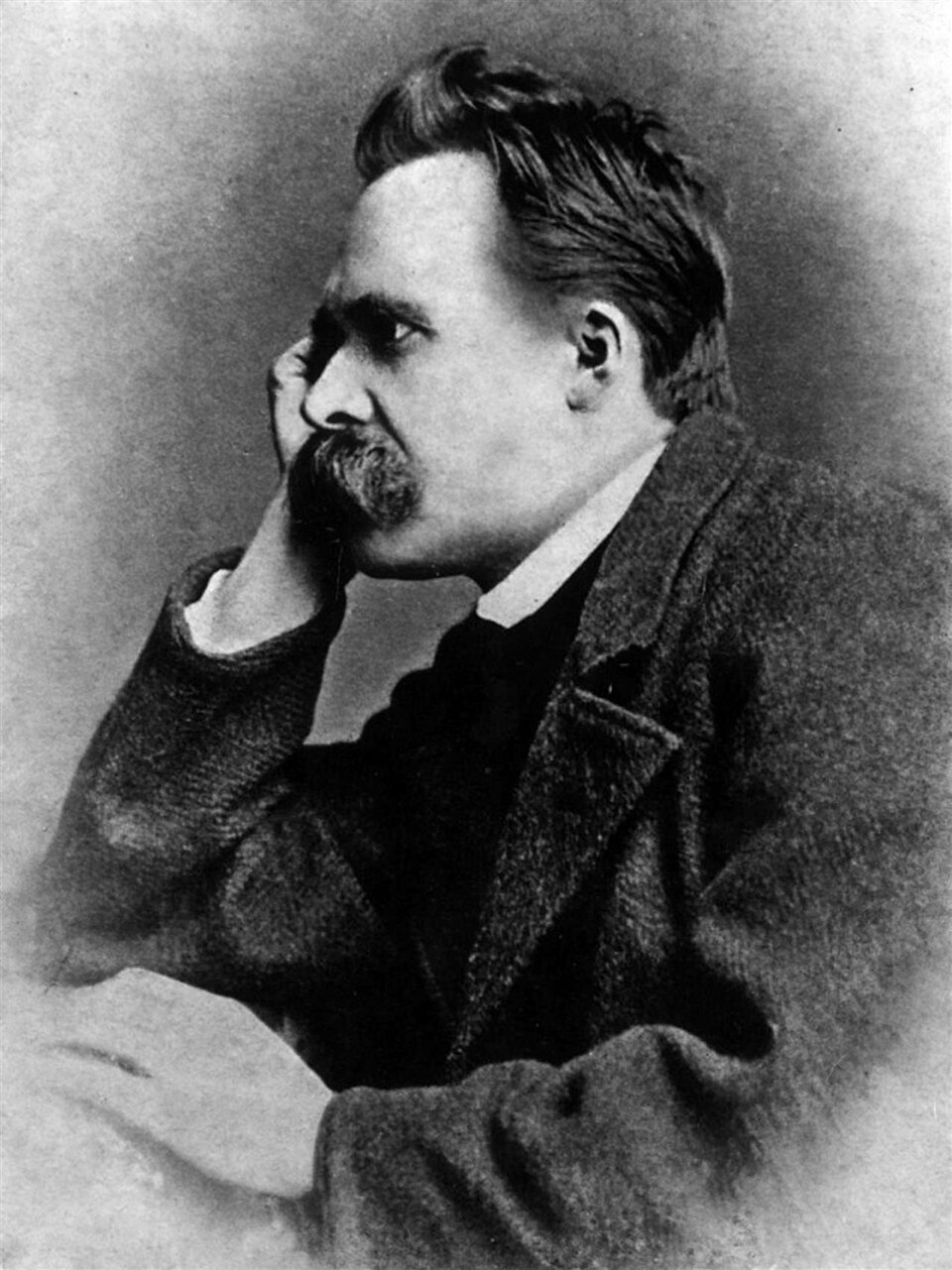
Friedrich Nietzsche was the most eclectic thinker since the Greek philosopher
Plato. Or perhaps I ought to say—in order to avoid absolute judgements—one
of the most eclectic thinkers, since Mr. Nietzsche was a self-proclaimed enemy
of absolute judgements.
There are many interpretations of Nietzsche, but it would be insincere to pretend
that all of them are worthwhile. I’ve always been intrigued by Harold Bloom’s
characterization of him as a “major European poet”, though since there are
many Nietzschean works which do not belong to the genre of poetry, I prefer the
application of the term “rhetorician” instead of “poet”.
Nietzsche seems to rely on all the capacities, quirks and antagonisms of
language to communicate his philosophy: clarity is just as essential as
obfuscation in his works, both methods deliberate and rhetorically calculated.
Polemic and ad hominems are (more than) occasionally used as argument
strategies or presented as apparent facts. Irony and bald insults are equally
relied on. Some of his most substantial work is paradoxically driven by
aphoristic insights. In Thus Spake Zarathustra, Nietzsche proffers his vision
through a scriptural paradigm, calling upon, if not explicitly demanding, his
message be accepted as a prophetic, indeed revelatory, one.
Above all, Nietzsche is an “untimely” thinker—one too large for his own era,
genius, an intellectual who anticipated the cruel excesses of the 20th century
and the social pathologies of our own time.
Such were my opinions when I picked up Nietzsche in the Nineteenth Century,
by scholar Robert C. Holub.
The Nietzsche of Mr. Holub is very different than the commonplace myth:
“Despite his insistence that he was untimely in his contributions, we often find,
even in early writings, that he articulated positions shared by many
contemporaries.
NINE DISCOURSES
His book, Mr. Holub explains, is meant to situate Nietzsche within 9 discourses
of the late 19th century and to “understand how and what Nietzsche learned
from these discourses, and how his thought then participated in the larger
concerns of the era.” These discourses are each posed as trying to answer a
question, namely, “the education question, the German question, the social
question, the women’s question, the colonial question, the Jewish question, the
evolution question, the cosmological question, the eugenics question.”
This project of “contextualization”, Mr. Holub claims, is especially important for a
thinker like Nietzsche, who has become somewhat of a philosophical
ubermensch, mythic creator of his own contexts: after all, he points out,
Nietzsche himself characterized philosophy as “the personal confession of its
author, a kind of unintended and unwitting memoir.” Why shouldn’t this
observation be imposed upon the one who made it?
Because I do not intend to write a book-length review of a book-length study,
the reader must forgive me and accept as representative the few remarks made
on just several of the book’s numerous facets, especially the play between
Nietzsche’s timeliness and untimeliness.
Each chapter shows, for example, how Nietzsche, far from being exclusively
“untimely”—itself a rhetorically motivated self-stylization—was perhaps more
concerned than certain other thinkers in the philosophical tradition to be
exceptionally timely, someone who had a plethora of opinions on contemporary
events and developments and who, accordingly, wanted to exert his own
influence on the attendant conversations.
It may be said, apart from his concern to have a share of the public discourse,
Nietzsche was understandably shaped by the goings-on and the personalities
around him.
Consider the German question, where Mr. Holub usefully summarizes
Nietzsche’s positions this way: “Nietzsche’s enthusiasm for Arndt and the
nationalist tradition occurs in his youthful period, and his views on the German
question would evolve over the next decade and a half from a Wagner inspired
German patriotism through a cosmopolitan stance toward German affairs before
ending in an overt rejection of almost everything associated with Germany in the
last years of his sane life.”
The very same teenager who was “the leading force in establishing a cultural
club called Germania” is the same, much older itinerant academic who wrote
about the Germans: “Every great cultural crime of the centuries is what they
have on their conscience.” Nietzsche, once a devoted follower of the German
composer Wagner, at last accused the Germans of having “deprived Europe of
the seriousness, of the meaning of the last great age, the age of the
Renaissance”.
Mr. Holub aids us in tracing how exactly these belief shifts took place, drawing
out the common themes in Nietzsche’s personal and philosophical life—the
more permanent concerns, as it were, which underpinned Nietzsche’s radical
swings in belief.
Consider one of the central occurrences in Nietzsche’s adult life: his relationship
and eventual fallout from Richard Wagner.
In a peculiarly Nietzschean episode, the philosopher at first develops an almost
cultish devotion to the composer, dedicating his first book, The Birth of Tragedy,
to tracing the re-emergence of the Dionysian spirit of Greek Art—the spirit of
creativity and cultural renewal—through a series of outstanding Germans, from
Schiller through Beethoven to Wagner himself. Wagner, by virtue of his
magnificent musical tragedies, was bringing about “the renewal of cultural
greatness in music”.
Until, of course, he wasn’t.
THE ANTI-WAGNERIAN TURN
By 1878, Nietzsche had completed a notorious break with the composer,
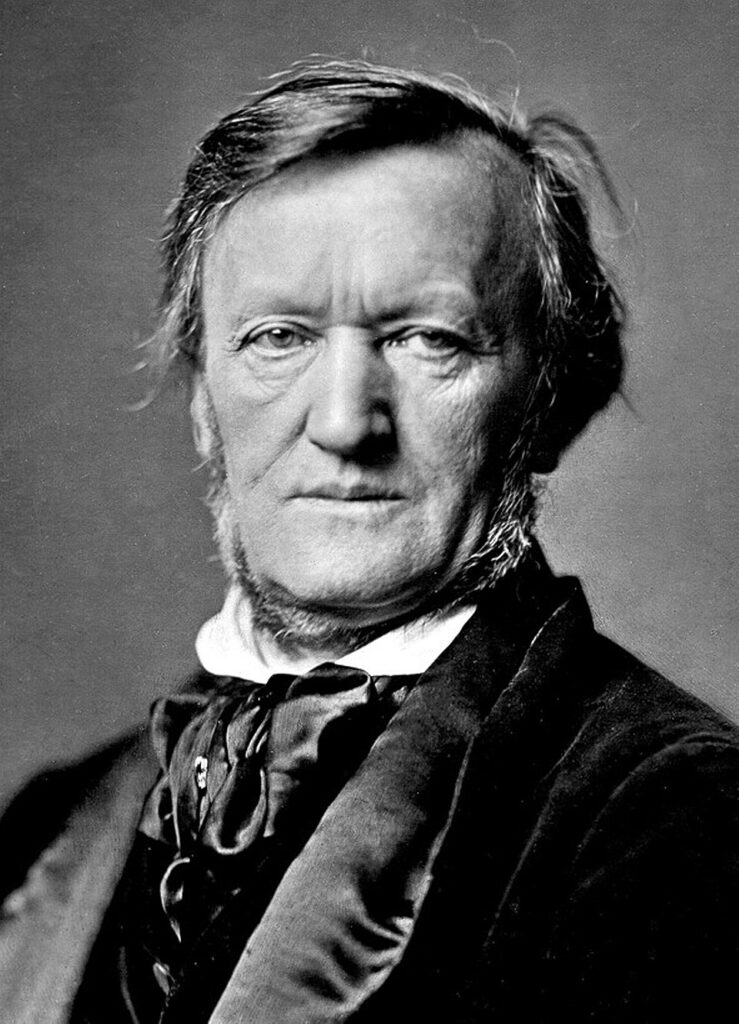
describing in 1888 the opening of Wagner’s Bayreuth opera festival and how
Wagner (pictured here) had prostituted his project out to a “pathetic crowd of patrons . . . the
whole idle riff-raff of Europe.” Wagner, according to this later account from
Nietzsche, had made his cultural project a “sporting event.”
Then again, Nietzsche gave different reasons at different times for his break with
Wagner, including the composer’s supposed turn to Christianity or a
“mysterious” deadly insult mentioned by Nietzsche in an 1883 correspondence
letter.
This is somewhat of a Nietzschean theme: the re-writing of history to flatter
one’s perspective.
Notwithstanding, what mattered, before, during, and after Nietzsche’s
Wagnerian period, was his concern for “cultural achievement” and a cultural
renewal in his own day, or, to use a term from the book, Bildung [meaning:
education for moral, cultural, and personal achievement]
Indeed, his rejection of the the Wagnerian project is at least partly due to his
belief that Wagner has betrayed genuine Bildung.
It is this obsession too which informs his anti-democratic attitudes regarding
education: Nietzsche did not see the opening up of education as beneficial.
Rather, such widening of educational opportunity diluted the quality, rigor, and
aristocratic excellence of institutions which should be teaching Bildung to the
relative few who are truly capable of that sort of achievement: “Bildung for the
masses cannot be our goal, but rather Bildung for the select few, for people
equipped to produce great and durable works”.
Thus, Nietzsche sees an unwelcome domino effect in the “Enlightenment
demand for ‘universal education’, which call for “an extension of Bildung into
ever widening circle of society”, which leads to an educational system which
accommodates itself to the masses, which in turn leads to a democratization of
standards where demands do not exceed mediocrity, since mediocrity is all the
masses are capable of.
Likewise, it was a concern for cultural renewal which informs Nietzsche’s anti-
Wagnerian turn in relation to the Jewish question. It wasn’t that Nietzsche
became philo-semitic, Mr. Holub writes; “In many cases, Nietzsche retains the
cliches about Jews he had employed in the late 1860s”, but “he now situates”
those cliches in “a vastly altered framework.”
Jewish financial canniness, long a stereotype of antisemitic ideologies, actually
contributes to Nietzsche’s “truly provocative and ‘untimely’ suggestion that
Jewish success in business partakes in the will to power, and that Jews are
therefore preferred genetic material for a new European ruling class.”
By no means does that mean Nietzsche abandoned his very “timely” anti-
semitism altogether; in the final years of his life, we find him suggesting that the
Jewish religion is the foundation of slave morality, the backbone of Christianity
and the enemy of truly aristocratic culture.
Nietzsche’s allegiance to an aristocratic cultural project even colors his
perspective on the women’s question, for he declares early on in “Human, All Too
Human” that the Greek role for women was a biologically and socially appropriate
one—one in which they produced “handsome, powerful bodies in which the
character of the father lived on as uninterruptedly as possible.”
Then again, as with everything in Nietzsche, how much can be separated from
his personal grievances against women in his own life?
“When I look for my profoundest opposite, the incalculable pettiness of the
instincts, I always find my mother and my sister”.
This is another one of the many themes in Nietzsche’s life: personal grievance.
Indeed, his virulent rejection of the German people may have more to do,
suggests Mr. Holub, with how few devotees he had amongst his own
countrymen than because of any special philistinism characteristic of them.
HOW NIETZSCHE FORMED HIS VIEWS
The intricacies of how Nietzsche formed his views in relation to the
arrangements and debates of his time are endless. Mr. Holub seems to account
for nearly all of them. He quotes extensively not only from Nietzsche’s published
works, but from his unpublished letters, notebooks, and commentaries.
Who knew, for instance, that Nietzsche was terribly concerned to justify his
theory of eternal recurrence in light of the cosmological science of his own day?
Underscored throughout this rather Un-Nietzschean—that is to say, “timely”—
study of Nietzsche is the fact of Nietzsche’s continuing relevance to our own
day, where so many of the same issues are confronted, attacked, aggrandized,
and tossed back-and-forth.
Who can fail to appreciate Nietzsche’s attack on “historical education” as
“inborn gray-headedness” in an era where “historical studies” so often seem like
an education into the ancient grudges and prejudices of the human race—
prejudices as apparently crippling and irreversible as old age itself.
Who can ignore Nietzsche’s penetrating criticism about women who have
achieved “a high school education, trousers and the political rights of voting
cattle” in an age where people are more liberated and more miserable than ever
before?
A TIMELY THINKER
Mr. Holub instructs us in the historical dimensions of Nietzsche, persuasively
showing that he, like every other philosopher, is a timely thinker. But he is
perhaps more timely now than ever, when the culture is dominated by idiotic
pieties and a childish terror of mispronouncing words and meanings.
If Mr. Holub aspires to “understand some of the social and scientific
confrontations that informed” Nietzsche’s thought, I, having read his book,
aspire to understand Nietzsche in terms of the social and scientific
confrontations which inform our thoughts.
Thus, Nietzsche will have become both a timely and an untimely thinker, one
born after his lifetime and even to this day not failing to exert his influence.
Nietzsche in the Nineteenth Century is by Univ. of Pennsylvania Press. It lists for $104.95
Conlan Salgado earned his degree in philosophy from Roosevelt University, Chicago.