
THE HUMAN ATLAS DISPATCHES
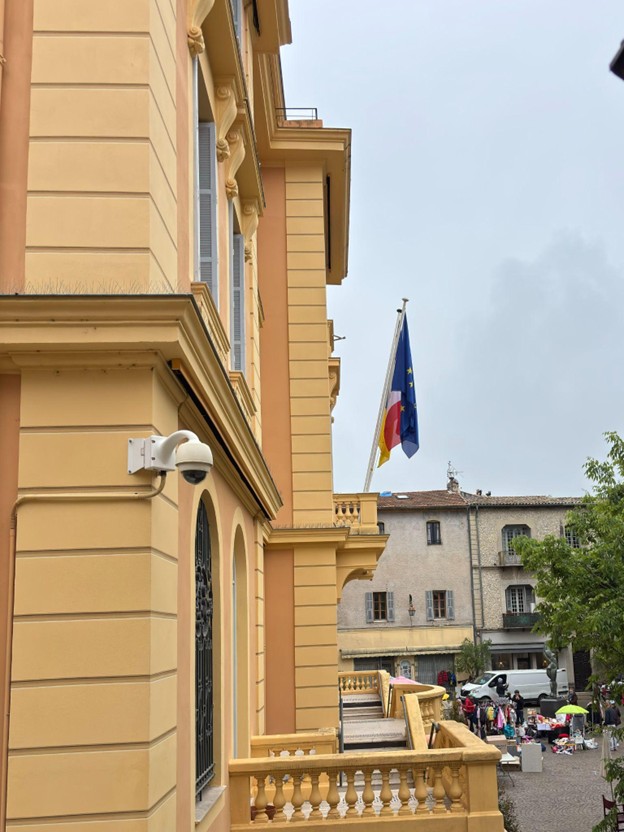
I am sitting in Place Clémenceau in Vence, France. To my right, the Mairie of Vence (Mayoral office) — that canary yellow building, the colour of something both official and optimistic — faces the small church where Chagall built his mosaic. I’m at a cafe table with an espresso and my notebook, and concurrently I am also here in 1996, at this same table, with a different notebook and another self who did not yet know what she was building.
This is not nostalgia, which is soft at the edges. Something more precise is happening in my brain: I am triangulating.
Memory, as a discipline, is not the same as memory as a feeling because those are somewhat unreliable. The discipline — the practice of returning to a place with deliberate attention and asking what has changed and what has not — is one of the most rigorous tools available to any writer, and to any person trying to understand who they are.
When I arrived in Vence last week, my memory was both true and slightly blurred. I recognized the square the moment I stepped onto the cobblestones and walked through the arc-shaped port. The pace settled into my bones on day three, when I strolled through the town. The quality of light in the afternoon, when it hit the pale pink church wall, was something I had carried but could not quite verbalize. What I didn’t know yet was whether I had changed enough that the place would feel different — or if the lens I brought here in 1996 was the same as the one I now carried.
On the first and second days, I was still adjusting from the reeling experience of every administrative task gone sideways. On the third day, something settled. The Grand Jardin square was more or less the same save for a few “improvements” (more concrete around the perimeter and more plants and bushes). The rhythm hadn’t changed: slow, purposeful in a Mediterranean unhurried way, a pace humanity resists as it trades what appears to be efficient on principle. People weren’t looking down at their phones while walking. They strolled alone or with a companion, engaged in conversation. The faces had changed — of course they had — but not the effect the place has on a person who pays attention to it.
The place remembered me more accurately than I had remembered it.
Cognitive psychology has been quietly confirming this for decades. Memory is not a recording; it is a reconstruction, built each time from materials, some emotional, sensory, social, and others simply invented by a mind trying to maintain narrative coherence. In a landmark 1974 study, Elizabeth Loftus showed that memory is profoundly susceptible to post-event information: what we are told after an experience shapes what we believe we experienced. Her work, extended by decades of follow-on research, established something writers and travellers have known intuitively: the story we tell about a place is not the place. It is about the person telling it.
But here is where it becomes more complex and interesting. What Vence has given me this first week is rarer than revelation; it provided verification. The wonderment I felt here in 1996 is the sentiment I feel now, the lens similar, perception and feeling in alignment.
In my work as a ghostwriter and narrative architect, this distinction matters enormously. When a founder or executive sits across from me and tells their story, they are not delivering a transcript. They are expressing a version of their story that has survived the years, shaped by subsequent events, by who they became, and by what they needed the story to mean. My job is not to accept that version uncritically, nor to dismantle it; it is to find where memory and reality are the same, where they have quietly diverged, and to help the writer understand the difference before putting either into print.
The gap between memory and reality is not a flaw; it’s a data point. It tells you something about who you were then and something about who you became in the interval. A memoir or biography that cannot locate that gap is not a memoir. It’s a press release.
Psychologist Douwe Draaisma, in his research on autobiographical memory, found that our recollections of emotionally significant places are more stable than our recollections of events, that the atmosphere of a place, its sensory signature, persists longer and with greater fidelity than the specific details of what happened there. Vence bears this out. I do not remember every conversation from 1996. I remember exactly how it felt to be in this square.
The people of Vence have changed. Shops have shifted. The town has adjusted to eighteen more years of technology, tourism, a changing Riviera economy, and the particular pressure that beauty places on a place that knows it is beautiful. But the character of the square, its pace, proportion, the way it holds the afternoon light, has not changed at all. I can locate myself inside it with an accuracy that surprises me.
I know who I was back then. I know who I am here now. The delta between those two people is what I’m discovering.
Vence is not a dramatic place. It’s a muted medieval market town in the hills above the Côte d’Azur, old enough to predate most of the ambitions of the people who work here or pass through it. What it offers is the continuity of a place that has outlasted many versions of the people who loved it. I am grateful to it for that. I am grateful to it for that. For still being what it was. No other place creates that bubble of sensuality, warmth, and comfort in my very being, and coming back showed me it never stopped.
You know who you are when you know where you are.