
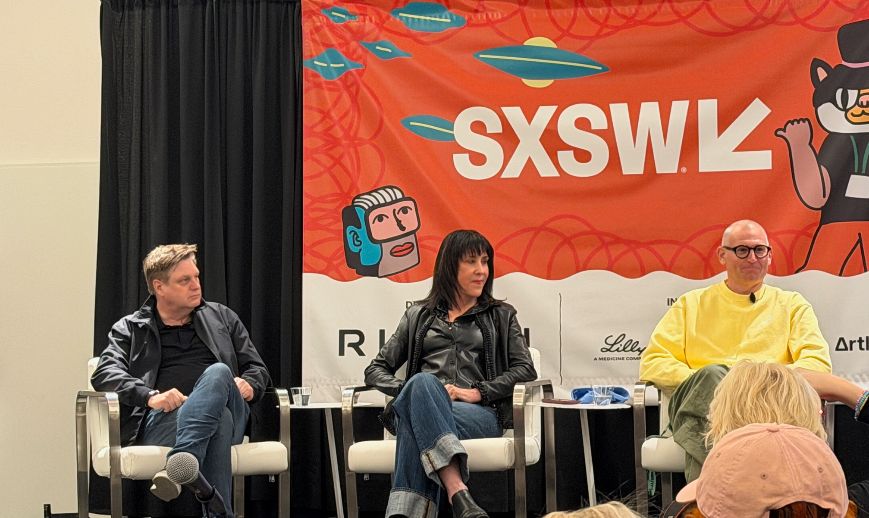
NICK FOSTER, futures designer and head of Google X from 2016-2023, took to the stage at SXSW in Austin to issue a dire warning about the future of design:
“I think the world’s become a more skeptical place, a more uncertain place. Moving forward we need to start talking about the future with plurality and thinking about the future as a terrain rather than a destination. That’s the fundamental change that I see.
“I spent 15 years in Silicon Valley, so I’m very biased through my view of what design is. I trained as an industrial designer, but I’ve spent my time around technology and the design of future technology. And I think that the last 10 years, design’s been sort of, how do I put this delicately? Like sucking up to those in power and changing what it does in order to please those in power.
And I think that now, particularly with the rise of AI, we’ve seen a radical reorganization of the shape of the companies I work within, where design had sort of managed to suck its way up to the top, and now it’s all computer scientists and sort of MBA product people, and design has been turned into this sort of servile delivery focused arm of these organizations.
“I really worry that unless design finds its own confidence and its own ability to imagine and its own ability to push back, it will just continue to be a cost center. And so I’m frightened about the future of design, particularly when talking about the future of technology.”
“What I would love to see would be a move away from predictions. I don’t want to go to conferences where people are standing on stage with a big numeral behind them saying 26% by 2035. It just feels like a fantasy from the past.
“We need to start embracing the fact that the future is… to use a military term, “vuca”, volatile, uncertain, complex and ambiguous.
“And as such we need to start thinking about the future in this sort of dualistic or pluralistic way and start to run through those scenarios.
If this happens, then what do we do?
What might we respond with?
What might that be good for?
What might that be bad for?
What might make us uncomfortable?
“So I always think holding lots of things in possible space is the best way to approach thinking about the future. Design is good at that because it can translate from ideas and trends into real lived experiences. Prototypical obviously through filmmaking, through storytelling, through prototyping, through testing. But I think doing lots of things together in concert is the only way we can sort of productively talk about and move forward with the future.”
Photo by C. Cunningham: Nick Foster, at far right, was on a panel with Uwe Cremering, CEO of IF Design; and Doreen Lorenzo, assistant dean of the School at Design at UT Austin