
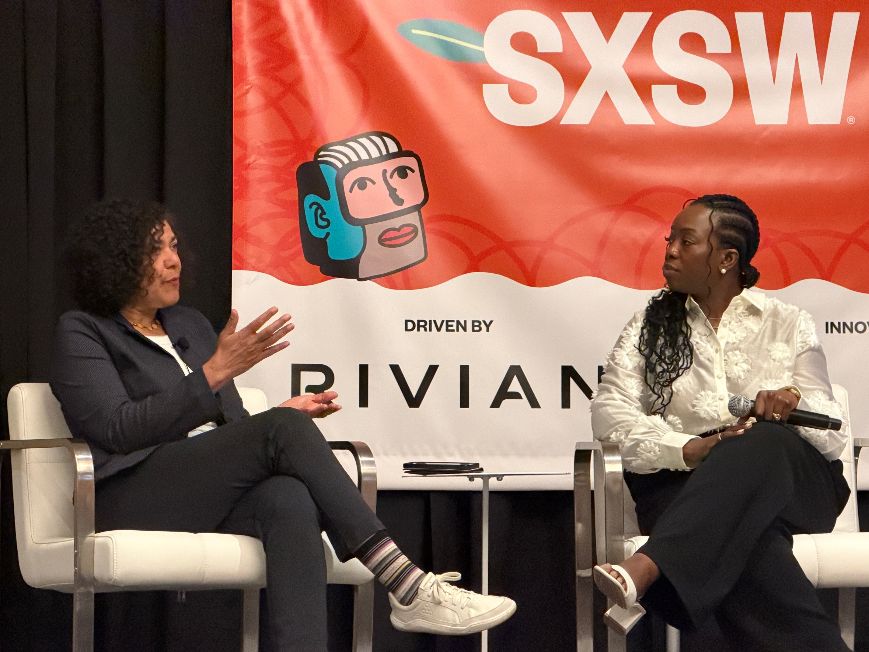
In a wide-ranging SXSW discussion about People Skills in a Changing World, two prominent leaders offered a lot of sage advice. Here, I give two of the core arguments from each of them.
“What is it that leaders think they’re good at but actually aren’t?”
“How much time do we have?,” chuckled Vanessa Tanicien, Peloton’s global director of learning & development (right in the photo).
“When we think about leaders in the workplace, they’re very stretched thin. And when it comes to working with their direct reports or working with their peers or obviously working with their leaders, they tend to go into execution mode versus taking the time to think strategically about how to lead teams.
“In the world right now, there’s a lot of volatility and change: there is a requirement to sit with ambiguity and figure out how we’re going to make choices that are going to be really high impact.
“Managers and leaders are not taking the time to think strategically about that. That is one of the skills that folks need to be able to take time to do, is to set aside that time, to think about goals, to think about roles, to think about the metrics that matter, and they’re often not doing that.
“Additionally, because we are working at such a high speed, those conversations that are developmental often get pushed to the side. Conversations that sort of cut off bad behavior of the past or help people elevate their thinking aren’t happening because again, people are stepping into execution mode to just get things done.
“So, if I had to boil it down, time to strategically think, time to provide feedback and direction, as well as providing explicit clarity around goals are some of the things that leaders aren’t doing right now.”
“And so, I think the missing curriculum is about leadership that creates more space for humans to thrive as with their own kind of sense of agency and co-creation. Ironically, people actually grow and work harder when they feel like they can choose to do an action in space of invitation, not just clear orders.”
“Nigel Vass, who is the CEO of a strategy company that I really admire, has been helping companies around the world with digital transformation for decades.
“One of the things that I heard him say that really clicks for me is figuring out how to get a test use case in your company that will allow you to experiment, innovate, try things, fail, learn, but that particular experiment is translatable to larger company issues across the organization.
“So, you can create your own little innovation lab, take and extract the learnings from that and begin to apply it to different parts of the business.
“It doesn’t matter if the outcome is from an IT problem if the IT problem has the same basic elements as something that you’re seeing in marketing and something that you’re seeing in manufacturing and something that you’re seeing in sales.
“It really is about identifying where does it make the most sense for us to experiment where we’re going to learn the most, where does it make sense to take the most risk because we believe this will pay off to the broader organization.
“And that was a really sort of light switch moment for me as a practitioner. Learning and development is thinking about how can I help leaders spot the opportunities that have outsized learning potential for the organization.”
Brooks expounded on courage.
Heidi Brooks is senior lecturer in organizational behaviour at Yale School of Management.
“We’re in a politeness crisis,” Brooks explained, “and maybe related to that is the courage to be able to break some of the norms of the crisis that we’re in.
“I think of courage as a rage of the heart. What do you care about enough that you’re willing to act?
“And so, in that way, I think we might be having a little bit of a crisis, in that people often don’t feel invited at all levels to let themselves be known enough at work for what they actually care about.
“Part of discussability and the other part of the listening is that people actually have to speak in ways that are revealing enough about their thoughts and their feelings and their perspectives that there’s actually something to listen to and for me to discuss and to be courageous about.
“A lot of workplaces don’t have norms of letting people be known. And so part of my work is about humanizing the workplace enough that people can bring more of themselves so we can access them. And that’s, I consider that work of being more courageous, organizational community.
“Like, what do we care about the work? What do we care enough about our people being able to be themselves so that we have access to more of who they are. “We want to access their whole brain and heart and spirit to create a powerful human community where we can actually learn without so much restriction and kind of role pressure to show up in a certain way, because we’re losing a lot of value on the table as people try to fit into a kind of acceptable and authorized law for what needs to be in your workplace.
“And so, when we can open that up, and it feels like a norm, it’s not really a norm of courage, it’s just how we do things around there. And to get there might be a work of courage, but I consider that a certain kind of crisis because we need more humans in a changing world.
“It’s the only thing that’s going to get us to be able to not just follow a kind of… shareholder privacy or kind of like financial ends become the means and mechanism for every action.
“We need human dreams, human wants, human aspirations to be able to be that are generated from the heart, from a place of what we want the world to feel like it, to be like and for us to be together in a world that’s compelling, not just transactional.”
Photo by C Cunningham