
Anyone who knows of Rome will be familiar with Lucilius, Horace, Persius and Juvenal. These great poets wrote satires that have influenced writers for 2,000 years. In this book, John Goodwin looks at the often-outrageous visions that these poets conjured up.
Each of these poets had a style, or laboured under a regime that dictated what style they were able to write in without being banished or executed. Here is a one-liner summary to get started:
Juvenal claims to be speaking of contemporary Rome, but one element of his critique is that he dare not risk naming living reprobates for fear of reprisals.
Persius, writing under the emperor Nero, restricts his satire to general themes of human behavior.
In Horace, satire becomes a form of ethical discussion of how we all ought to live rather than simply mocking the foolish.
Lucilius sometimes attacked men who were big names in his own day, but he wrote in the Roman Republic. The others wrote after its death.
Any of my readers who sees a parallel here with modern times would not be far amiss. Satirists and comedians today who have current events as their stock-in-trade are vanishing from the television. It happens when Republics die.
Godwin tells us Lucilius (born 180 BCE) was the “father of verse satire.” He was “credited, by Horace, as the inventor of the genre because of his trenchant social criticism, and many people today find his invective style of satire – which seeks to hurt the feelings and the reputation of named individuals – to be the closest to our own forms of printed satire…He lost a lawsuit suing a comic actor who had libelled him on stage and so seems to have been more thin-skinned than his reputation and poetry might suggest.”
The move from invective was exemplified by Juvenal (born in 55CE). He “begins his first satire with a lament about the dire state of contemporary poetry with its derivative and tired tropes, but he makes full use of poetic techniques to form material for his own work. The transition to generalized satire is a wise one,” writes Godwin, “as invective dates very quickly, while more universal satirical texts speak to us all.”
Godwin cautions at the outset that “Nobody can appreciate Roman satire without a working knowledge of Greek culture.” While the Greeks did make use of satirical tropes, the “Romans took it much further.” In essence, the Greek wrote plays “more like what is now called situation comedy, rather than blunt satire.”
Horace (65-8 BCE) wrote a “satirical snapshot of Roman culture” by describing a dinner party. As the party progresses and patrons swill wine and stuff cheesecakes into their mouth, the tapestry that depicts an epic story fall down on the food and drink. Godwin suggests this was Horace’s way of depicting the “lowering of literary style and thus symbolize the whole enterprise of Latin hexameter satire.” While Godwin offers us excerpts from Horace, he sadly concludes that “no translation can ever do justice to the verbal fireworks of this fine Latin poet.”
As an example, he offers the ending of Sermones 2.2, where a guy named Ofellus tells about the new ownership of his plot of land. “The moral point is hammered home,” writes Godwin. “You may lose your home if you live a depraved life, but this is also undermined by the brute fact that being dead will rob you of it anyway.”
Horace concludes with this line: “Live therefore as brave men and set your stout heats to confront adversity.” Godwin’s opinion of this final line is that it “is as elegant as it is powerful, but it is still hard to judge the tone of this ending. The heroic style of that final line can be read either straight or as a parody of the situation which is far from heroic for either the victors of the victim.”
This is certainly of the most insightful elements of the book under review. I heartily recommend it for anyone who studies ancient poetry, and also those who read about satire in the 18th and 19th centuries, as this book exposes the bedrock upon which everything else is based.
There is a typo on page 47: “write” should be “wrote”
Roman Verse Satires: Spleen and Ideal is by Liverpool University Press. It is available on Amazon for $103 (hardcover) or $42 (paperback).
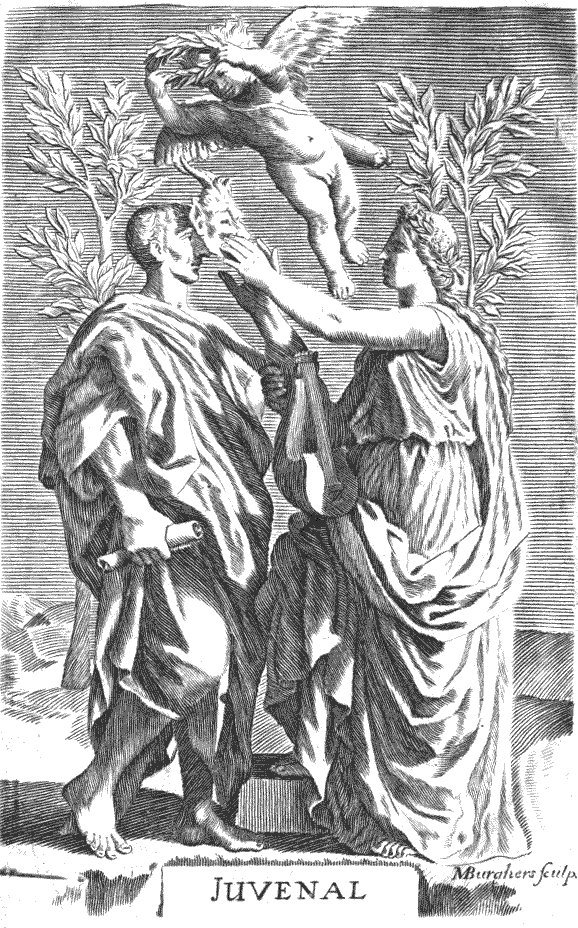
Image: Frontispiece from John Dryden’s 1711 book The Satires of Juvenal and Persius. It shows a mask being removed from Juvenal’s face as he is crowned as the greatest poet.