
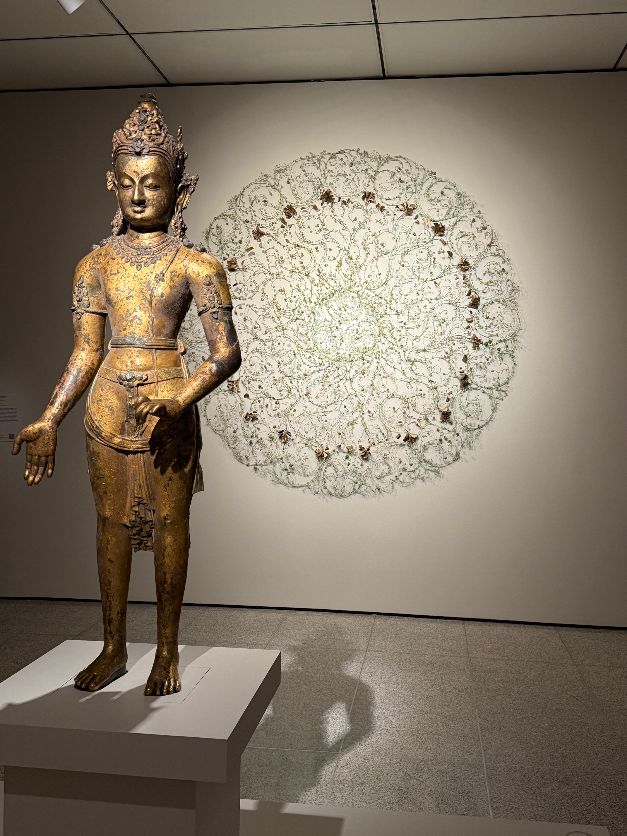
Hao Sheng, the consulting curator of Asian art, gave the curatorial lecture for the fascinating Buddha | Nature: Five Dialogues on Our Shared World exhibition at the Museum of Fine Arts, Houston (MFAH). I was lucky enough to attend this event, whose main points I report on here. I also interviewed one of the two Austin-based artists who created works to bring a contemporary viewpoint to five sculptures of Buddha from centuries ago.
CURATOR’s LECTURE:
In every living being without exception there exists an inherent capacity for wisdom and compassion not something you earn, not something reserved for the only the enlightened something that’s already there among the many wonderful metaphors Buddhist nature, the metaphors of Buddha nature, my favorite is the lotus flower. Emergent from the muddy pond, open and poised, above water and pristine. Buddhism is the practice of washing away that mud.
This is the exhibition’s animating premise that this capacity, capacity to see clearly, to act with compassion, to wake up, is exactly what this current moment demands from ordinary people, from all of us.
This exhibition didn’t come from a library: it came from the garden, from the potter’s wheel, from watching what’s happening to the world around us and knowing my daughter will inherit it. From the daily physical experience of tending and making in your hands and not in my head.
These questions about interconnection, about impermanence, about how we are woven into the living world, they are not abstract.
That’s why Buddhist art speaks to me, and I think they speak to you. Not because Buddhism answered my questions, but because it has been sitting with the same questions for 2,500 years. So, here’s the question that drives everything in this exhibition. What does wisdom look like in the face of change?
Wisdom is not information. We have more access to information than any moment in history, but we are still stuck. Wisdom is something older and harder, the capacity to see clearly and to do– to act well in the face of what we know.
The Buddhist sculptures in this exhibition were made to teach– to aid in enlightenment, to transmit something across the gap between one person, one mind to another. That has been their job for centuries and this exhibition asked them to do that job again. But now in conversation with contemporary artists who are wrestling with the same question from our side of time.
That activation, the moment when an 800-year-old sculpture and a living artist speak to something you already know, you already carry inside you, is what this exhibition is for.
As I envisioned the show, a moving meditation, and it starts by asking, “How are we today?” And ends with, “What do we do now?”
Each gallery focuses on one Buddhist insight. We begin with samsara, then impermanence, then karma, then compassion, and finally awakening. The galleries are in sequence stages of insight.
Gallery 1, Samsara
Samsara is a spinning circle, the cycle of birth, death, rebirth, all forms of life turning on this wheel together, bonding a web of interdependence. Nobody is exempt.
The Buddha taught that this circle is carried characterized by “duka,” usually translated as “suffering,” but the actual literal meaning is actually more precise. It literally means “a wheel whose axle doesn’t quite fit the hole.” A perpetual wobble. And the teacher calls it “the suffering of struggling with life as it is.”
Buddhism teaches that samsara, the circle of suffering, is kept spinning by what we call the sweet poisons: ignorance, greed, and denial. And in the face of environmental degradation, this suffering is felt collectively. Many Buddhist teachers today speak of that as an ecological samsara. A planetary cycle driven by the same three forces of ignorance, greed, and denial. Ignorance, the delusion that we are separate from the natural world. Greed, a culture of relentless consumption, the conviction that the earth’s resources exist for our extraction. Denial the refusal to look at what we are doing and what it’s costing.
Let me introduce you to the first work of the show. This gilt copper wisdom Buddha was made in Tibet in the 12th century. Notice the elaborate crown, the jewelry, the sacred thread across the torso.
In Tibetan Buddhism, Wisdom Buddha, doesn’t represent the historical Buddha Shakyamuni, but actually represent aspects of the enlightened mind itself.
But I also want to show you something else when we turn to the back of the sculpture. And when you go into the gallery you have to go to the other side. When you walk around the sculpture the exposed back has been torn open: jagged edges, iron armature exposed, a wound being a 900-year-old object.
In mid-20th century, iconoclastic campaigns destroyed hundreds of temples in Tibet. And the Buddha, this particular Buddha, was violently removed from its original setting, ripped from its context and its original halo lost.
Now meet Beverly Payne. She was commissioned to reimagine the missing halo (Lead photo). Her response, titled “Samsara,” is a radiating circle of bronze flora that both completes the ancient sculpture and stands entirely on its own. The plants she chose are what botanists often call disturbance-loving species. In this case, thistles and bayhops, they thrive in places wracked by human activity. Like the lotus rises above the muddy pond, her plants thrive from this struggle and emerge. And I think that’s one of the most beautiful ideas in this exhibition.
Gallery 2, Impermanence
All things arise and pass away. Nothing stays the same. Change is not the exception, it’s the fundamental nature of reality. The glacier, the coastline, the species, the civilization: everything in flux. The teaching of impermanence offers two things.
First, equanimity, the steadiness to face change directly, without collapsing into despair or retreating into denial, to be present with what is actually happening. And second, agency, because if the future is not yet determined what we do now matters enormously.
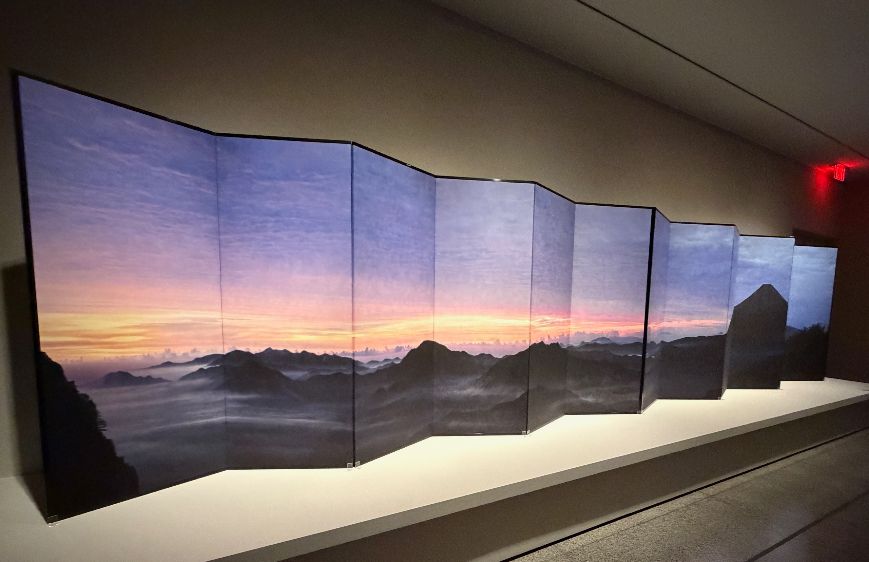
The Zen teacher, Thich Hanh, put it simply, “Thanks to impermanence, everything is possible.”
Japanese photographer and conceptual artist Hiroshi Sugimoto, who has spent decades exploring time, perception, and the nature of images themselves.
And he created this panoramic photograph of Mount Fuji and down, warm reds and purples behind the mountain’s silhouette: 25 feet wide, printed on paper, mounted on traditional Japanese folding screens.
It continues a century-old tradition of depicting the sacred mountain. Here, Sugimoto is not just looking backward in tradition. He is wondering, he actually muses out loud, that Mt. Fuji is an active volcano. It can erupt anytime and bury the nearby Tokyo like Pompeii. He finally said, “Let’s admire its appearance well now.”
Sugimoto’s call to presence, “Admire its appearance well now,” is a Buddhist instruction dressed as an aesthetic one.
Gallery 3, Karma
Karma is action. It is the law of cause and effect unfolding across time. Not cosmic payback, but the simple, profound recognition that past deeds and patterns of thought shape the present.
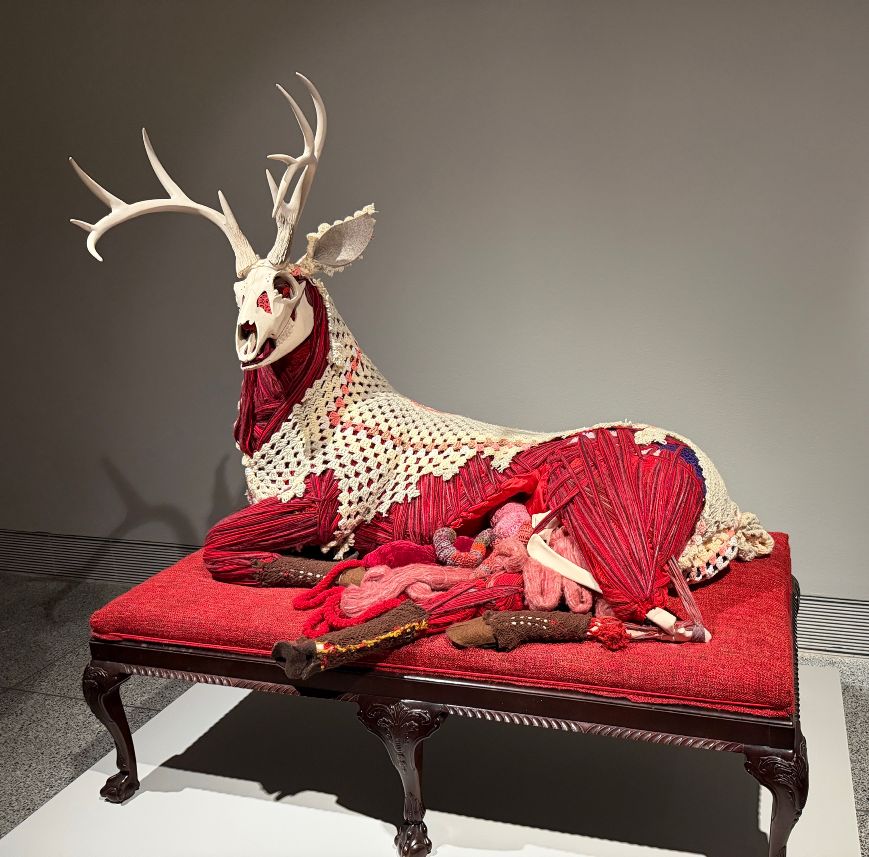
If we want to understand where we are now, we have to examine the choices, individual and collective, that brought us here.
A terracotta panel from 6th century India depicts one of the most dramatic moments in the life of the Buddha. On the night of his enlightenment, he sits cross-legged in the lotus pose. And the demon Mara on his proper right arrives with his army to shake the Buddha’s resolve. As his answer to Mara’s challenge, the Buddha raises his right hand and put his finger forward to touch the earth. This is the earth-touching gesture: he’s calling the earth goddess to bear witness.
You see a bare torso emerging from the ground. The head is missing under the Buddha’s hand. Originally the goddess is probably reaching up to bear the weight of the Buddha’s finger. Witness to what? To his accumulated karma, not just this lifetime but across eons of lifetimes in which the Buddha practiced compassion, generosity and ethical living. The accumulated good karma generated his actual enlightenment. Compassion without wisdom becomes sentimental, ineffective. We need both wings to fly.
[Image: a 2020 work entitled (No)stalgia by Cannupa Luger. “The climate crisis is the Earth’s way of reminding us that we cannot sustain ourselves outside of a right relationship with the whole,” Luger writes. In (No)stalgia, the museum tells us, this relationship becomes visible: a practice of reciprocity and regeneration, where the transformation of discarded materials gives them renewed purpose and generated positive karma toward a sustainable future.]
Gallery 4, Compassion
The arc of the exhibition has been moving into this gallery from understanding to action. This is where understanding becomes care.
This limestone triad from 6th century China dated precisely to the year 526. The Buddha in the center is holding his hand in a formalized way. The hand gestures are called mudras: right hand raised, palms facing, it says fear not. And the left hand raised, palm facing again, it indicates wish granting, it’s granting proof. Don’t worry, be happy. This is the smileiest Buddha from the sixth century. This smile is both the knowingness from wisdom and the warmth from compassion.
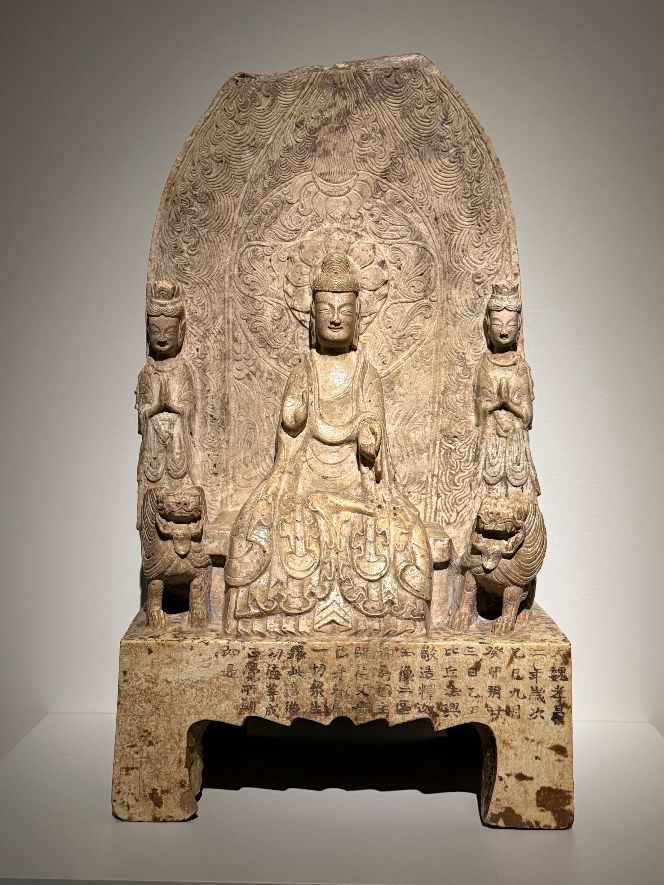
The stone carries one of the most beautiful inscriptions from the period.
A Buddhist monk named Faxing commissioned it and on the inscription he said, “Monk Faxing made with reverence of this sculpture of Shakyamuni. And respectfully, I pray that the emperor, teacher, fellow disciples, parents, relations, and then all sentient beings may all reach enlightenment.”
All sentient beings, not just the people he knew, not just his family: his nation, his species, all sentient beings. That is the Buddhist vow of compassion in its fullest expression, a circle that keeps expanding until it includes all lives.
In this gallery we have two paintings by the Chinese artist Liu Xiaodong. He spends his career travelling to places of difficulty and painting the people he finds there. Border zones, conflict areas, communities in upheaval, overlooked small individuals, yet painted at the scale traditionally reserved for kings and generals.
This painting is of the Martinez family, (at a border town across from Eagle Pass, Texas), of three generations together. The reason he chose this family he says, is because something in them reminded him of his own: a traditional Chinese family, three generations, trying to make a life together.
The second painting takes a different kind of courage. During the pandemic, back in rural Northeast China, where he grew up, Liu brought his urban friends: rock musicians, people dressed in ways that were, to put it mildly, unfamiliar in the countryside, and painted them alongside with local farmers who came to watch. The reference is Monet’s “Lunching on the Grass,” a painting that scandalized Paris in 1863, with its nude woman among clothed men.
Liu’s version scandalized a different sensibility. He invited these true farmers to stand with shovels, in his words, “as if to bury this new way of life.” But once they were there, they became curious. They became spectators. And in the distance, a mother cannot hold back her child, rushing towards the newcomers. Curiosity is instinct to open. That’s where compassion begins.
Gallery 5, Awakening
I want to be careful about what I mean by awakening, because it would be easy and wrong to use it as a kind of inspirational resolution.
Awakening in the Buddha sense is not a belief that things will turn out well. It is something more demanding: it takes work, the willingness to see clearly, to act with intelligence. and to do so not alone but together.
A Zen teacher predicted and probably also hoped the next Buddha may take the form of a community, a community practicing understanding and loving-kindness. That is the proposition of this final rule.
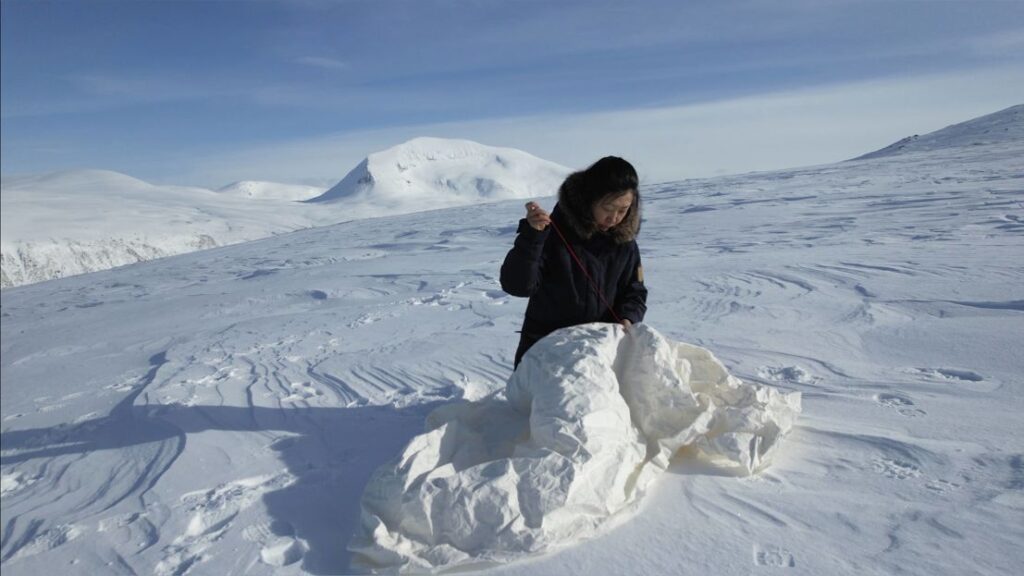
Austin-based artist, Beili Liu, traveled to the Arctic Circle in Norway to five different locations from snowy valleys to semi tundras to the rocky shores and sat in the landscape and sewed. The video showed her a solitary figure in a dark parka.
Against relentless retreating glacier, snow falling, sewing red threads through mulberry paper in her lap. The Arctic is warming four times faster than the global average. She’s not there with a solution: she’s there with a needle and thread. And here’s what she says about that act.
“I’m sharing a message that we care. And in the snow, I’m here stitching. And the stitch is recording this intention. When the snow started falling, I felt, perhaps it is hearing me.”
The paper that Liu sewed in the Arctic came back with her. It gathered stitches, wrinkles, stains of snow and earth. She calls it a vessel of time. [it is on display here]
She says about sewing, “It is an act of healing. It’s an act of giving. The patient daily discipline of stitching is not a metaphor for climate action. It is climate action itself. It is the form that care takes when it refuses to be overwhelmed.”
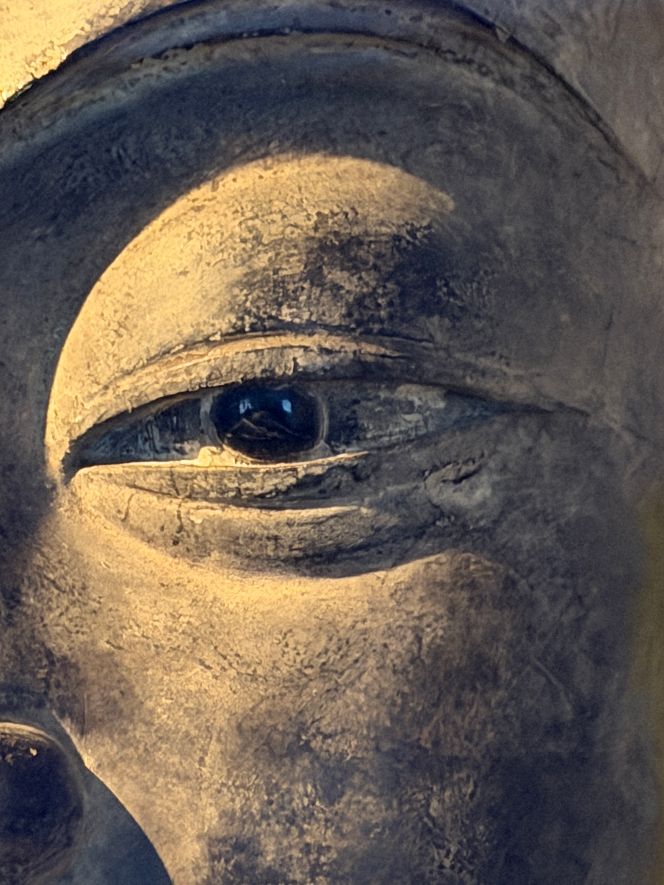
And the final object in this exhibition is a head of Buddha from the 8th century China, Tang dynasty, made from a special technique called Hollow-core dry lacquer. It was once part of a monumental sculpture, but light enough to be carried. [Quoting from the information plaque in the gallery, “The eyes, two original glass spheres, catch light from every angle. Wherever you stand, you feel his gaze, even today.” I have chosen to picture here a closeup of one of those searching eyes.]
To summarise:
In permanence, we understood that no condition is permanent and that this is both a warning and a ground for hope. Karma, we examine the choices, collective and historical, that shaped our present and we recognize that new choices are possible. Compassion, we expanded our circle of care from ourselves to strangers to species to future generations. We expand and now awaken.
The Buddhist gaze in that final room sees you not as a passive visitor but as someone who possesses Buddha nature, the capacity for wisdom, courage and change and this sees you as part of something larger.
You are not alone. A collective awakening is underway. [end of curatorial lecture]
Beverly Payne
In my interview with Beverly Paine, she offered a very personal interpretation of the Buddha exhibit:
I think it’s a profound journey through some basic human understanding of the natural world or perception. The curator did talk about it as a kind of progression. I felt like it was a kind of progression mostly because of the contemporary artworks.
I felt with my own piece that I was creating it also. I felt like it was an opportunity to explore the extremes of absence and presence, as negative and positive of death and decay. as well as live material because of the way I use live materials to incinerate it, to make memorials of things that are ephemeral.
And then when I moved through the galleries and I saw the Mount Fuji, it was really lovely. I felt like especially that glowing sky represented the hope of sunrise but also the fear and the death of lava flowing: the potential of disaster.
So, I felt like going from an idea of this kind of basic (my weeds, the base material, things that are maligned) into something that was revered but showed the promise under threat. It felt like kind of the next level.
And then moving into Eric Swinson’s gallery (Karma), the duality. They were in conversation with each other as from again both ends of the section of death and rebirth, which are not concepts of our Buddhists, but I still felt like I was experiencing a journey through the eyes of the contemporary artists.
The paintings in Gallery 4 then brought me back down to a sense of the beauty and the relevance of profound human compassion. Like that very earthy basic idea that was present in both paintings. that the feelings were elevated in a situation of poverty and Oh, okay. A premise of absence and neediness and scarcity.
And then moving lastly into Beili Liu’s gallery. That idea of work and labor as having an incredible value. I thought this is how it’s saying in the lecture that it isn’t an answer, but it’s a pathway toward an answer. That idea of labor and love and creating something rather than destroying something, even if it’s just a really basic and not so profound action.
The Catalogue:
The printed catalogue, authored by the curator (128 pages), is excellent at surveying the entire Xuzhou Collection, which comprises 28 examples of Buddhist art on long-term loan to the Museum of Fine Ars, Houston. It does not, however, engage with the special exhibit, which is the subject of this review. None of the contemporary works of art, juxtaposed with five of the 28 Buddhas, is mentioned or illustrated.
The exhibit is on display thru May 10, 2026. Go see it!
https://www.mfah.org/art/exhibitions/buddhanature
Photo credits: Image of Liu in the Arctic, courtesy of MFA, Houston. All other photos by C. Cunningham