
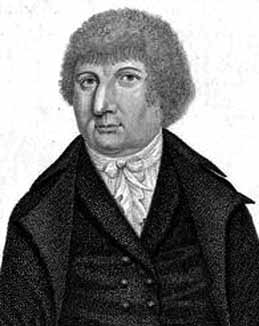
Image: John Collins (1625-1683)
While some Continental advances in mathematics are covered, this book is largely about the practice of mathematics in Great Britain. By the late 18th and early 19th centuries, the amazing mathematical aptitude of the populace was commented on by John Playfair at the University of Edinburgh. He refers here (in 1808) to several popular journals and almanacs that gripped the nation:
“In these, many curious problems having a considerable degree of difficulty, and far beyond the mere elements of science, are often to be met with; and the great number of ingenious men who take a share in proposing and answering these questions, whom one has never heard of anywhere else, is not a little surprising. Nothing of the same kind is to be found in any other country.”
One of the most prominent magazines that published math problems was The Ladies Journal; literally thousands of people contributed problems and solutions! The profusion of regional or local societies and journals in England is explored in several chapters, in an effort to explain why so many philomaths (often farmers, miners or handloom weavers) existed.
As explained by Sloan Despeaux (Western Carolina Univ.) and Brigitte Stenhouse (The Open University, UK), the hunt for these philomaths became an obsession for two mid-nineteenth century practitioners. There are three volumes of letters written between Stephens Davies and Thomas Wilkinson, held at a library in Manchester. Both were “prolific contributors” to numerous periodicals and newspapers. They made a particular point of identifying other contributors to several dozen mathematical publications, who often used assumed names in print, going so far as to unmask and interview them. Their historical investigations are invaluable for scholars today, but even they could not keep track of it all. Davies, writing in 1850, said of 18th century periodicals “devoted wholly or partially to mathematics that we could never even approximate towards completeness.”
Some journals lasted only a few issues. Despeaux and Stenhouse do not say whether such completeness has ever been achieved by a modern institution such as the British Library. I would like to know! The chapter by Benjamin Wardhaugh (former fellow of All Souls, Oxford) laments the dispersal of the library formed by Charles Hutton, who died in 1823. The greatest library of math publications in England was sold at his death; the thousands of items took nearly a week to auction off! “The Literary and Philosophical Society in Newcastle stated that had it only known of the unfolding situation, it would have purchased the library complete.”
This disaster relates in part to the fact that mathematics was viewed as “anti-social.” Even worse, the Royal Society “was no friend to mathematics, for a range of convoluted reasons.” In a lengthy chapter on mathematics at literary and philosophical societies, Christopher Hollings (an editor of this book) further tells us that the Royal Astronomical Society became the home for mathematical activities. Then, in 1865, the London Mathematical Society was formed. “It soon became a forum for only for mathematicians in the capital, but also those from nearby university cities.” Looking further north in England, Hollings writes that “A more detailed study is needed to determine whether the Liverpool Society, like its Manchester counterpart, hosted mathematical contributors” beyond the one person he identifies.
This book comprises 16 essays on a wide range of mathematical issues, each written by experts across Europe and Canada. The emphasis is on the practical, and nothing was more practical than navigation at sea. The first navigational journal in tabular form was by John Davis in the 1590s. He was known as both the “most learned seaman” and a “good mathematician.”
One of the editors, Philip Beeley, looks at practitioners of mathematics in seventeenth century England. Book contributor Margaret Schotte (see below) uses the term ‘mathematical sciences,’ and it recurs again here in connexion with a book published by the Savilian professor of geometry, John Wallis. On 12 August 1665 he met with an accountant, John Collins, who posed a mathematical problem to him (it is given in the chapter). A few days later Wallis sent Collins a five-page solution to the problem. Much of Beeley’s chapter centers around Collins (lead photo), who published his first two books on mathematics in 1653, and was elected to the Royal Society in 1667. The web of confederates Collins became acquainted with is a fascinating tale. He even met Isaac Newton, and “went on to introduce Newton’s name to the wider Republic of Letters.”
“Collins,” writes Beeley, “considered the last of his three books to come out in 1659 to be an introductory work suitable for seafarers…Collins saw his book as potentially furthering the aims of the East India Company through improved training of seafarers.”
In her chapter on navigation, Margaret Schotte (York University, Toronto), tells us “The two types of knowledge that remained vital for ship navigators up through the close of the eighteenth century and beyond, were geography and the calculation of positions.” For John Davis, writing a navigation manual obliged him “to accommodate the realities of shipboard practice.” He thus faced a dual task, “addressing the culture of the sea, and addressing his mathematical colleagues in a way that recognized and applied their categories of knowledge and skill.” Thus, his manual paid due attention to both the mathematical arts and mechanical practice. The mathematical sciences were not part of his remit.
While Schotte neatly defines this tripartite aspect of mathematics, other authors did not explore it explicitly. Thus, there is no Index entry for ‘mathematical arts’; nor is there one for either ‘mathematical sciences’ or (as Schotte also terms it) ‘speculative mathematics.’
Joao Domingues, in his chapter on Portuguese military engineers, talks of a 1744 book that “divided mathematics, as was then usual, into ‘pure mathematics’ and ‘mixed mathematics.’”
The ‘pure’ referred to both arithmetic and geometry, while ‘mixed’ included physics, geography, mechanics, optics and artillery. Both ‘mixed’ and ‘pure’ make it to the Index.
The Index is excellent, but it does not extend to the footnotes. For example, Henry Gellibrand, an astronomy professor at Gresham College in London who died in 1637, is on page 277, but not indexed. I find it curious he is not treated in any detail: he worked within the time frame of the book, developed a method for measuring longitude based on eclipses, and supported practical mathematics – the very subject of this edited book. In a column I wrote for Mercury magazine in 2006, I stated “In 1633 he advocated the progress of practical mathematics as a means to reform science. In a published address to the University of Cambridge, Gellibrand argued for the overthrow of Aristotle so ‘that the same improvement may by this means accrue unto our Physics, that hath advanced our Geography, our Mathematics, and our Mechanics.’”
German aspects of mathematics are included in a study of Johannes Faulhaber, who wrote extensively on the Great comet of 1618. Since this volume concentrates on British topics, such books as Practical Astronomy, written in Italian by Filonzi (1775), is not mentioned. But Italy is covered in one chapter by Stefano Gulizia (Univ. of Milan). His focus is on the Veneto, comprising such cities as Padua and Venice. This captures such famous astronomers as Clavius and Galileo. Reproduced here is a diagram by Galileo, made in response to his reading of Kepler’s book Mysterium. “Galileo drew the diagram to capture the relations between ‘mechanical’ and astronomical thinking.” Gulizia’s exploration of the role of Gian Vincenzo Pinelli (1535-1601) as a catalyst of sorts for the mathematical practitioners of the Veneto is quite important. Pinelli believed that a good mathematician had to also be grounded in many other disciplines. The information that flowed through his hands, writes Gulizia,
“reminds us of the familiar image of a late Renaissance polymath and also displays multiple points of reference, as if one were browsing in a genuine storefront.”
No quote betters sums up what this marvellous book represents.
ABOUT THE EDITORS:
Philip Beeley, Research Fellow and Tutor, Faculty of History and Linacre College, University of Oxford, Christopher Hollings, Departmental Lecturer in Mathematics and its History; Clifford Norton Senior Research Fellow in the History of Mathematics, The Queen’s College, University of Oxford
Philip Beeley studied philosophy, mathematics, and history of exact sciences and technology at the University College of North Wales, and at the Technische Universität in Berlin, gaining his PhD in 1993. He held posts at the University of Hamburg and University of Münster before coming to Oxford in 2007. He is the former President of the British Society for the History of Mathematics and is a member of the International Academy of the History of Science.
Christopher Hollings studied mathematics at the University of York, gaining his PhD in 2007. He has held post-doctoral positions in mathematics at the universities of Lisbon and Manchester, before moving to Oxford in 2010 as a researcher in the history of mathematics.
Beyond the Learned Academy: The Practice of Mathematics 1600-1850, is by Oxford Univ. Press. It lists for $45.99.