
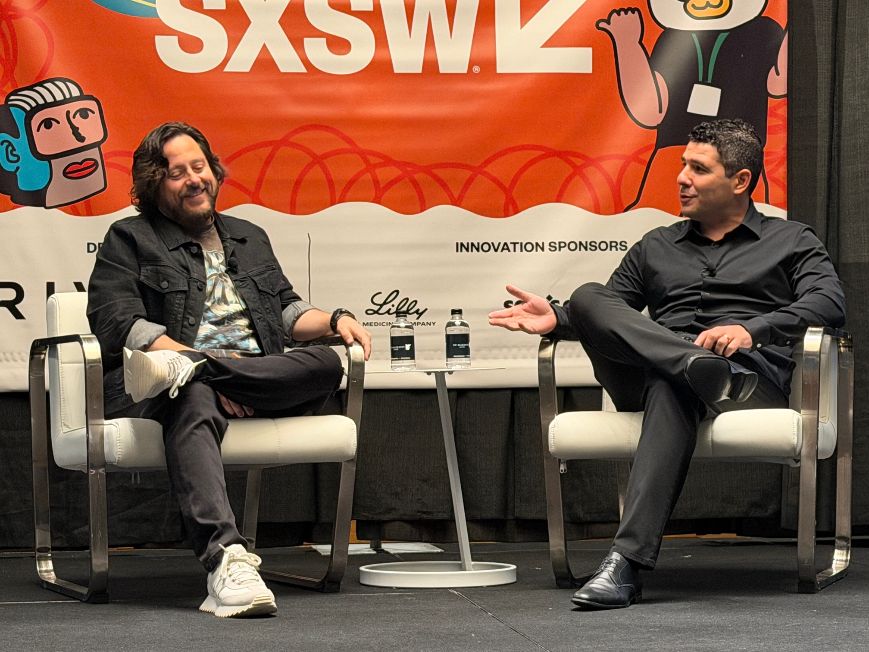
“I think synthetic biology will be more transformative than any other technology set of capabilities that we have on this planet.”
That bold declaration was made at SXSW by Ben Lamm, CEO and founder of Colossal Biosciences (CB), based in Dallas. What is CB? None other than the world’s first de-extinction company. Founded in 2021, it made explosive headlines last year when it revealed the existence of two dire wolves, a species that went extinct some 10,000 years ago.
Technically, the company made 20 edits to a genome of already existing grey wolves. While not a true resurrection (or de-extinction of dire wolves), it is merely a foretaste of what will happen in coming decades. How about a T-Rex in your local zoo?
Putting aside such wild speculations, Lamm was focused in his SXSW talk on practical matters.
“We’re losing species at a crazy clip: up to 50% of biodiversity in the next 25 years. So how can you solve that? We’re slowing the rate of extinction through policy and conservation, but just being slower and slower and slower and slower, right?
“We need new tools and technologies and so he had this crazy vision that said maybe we can bring back to species and then leverage that to subsidize technologies that could then be applied to conservation.
“You know, incredible feats of strength in science a lot of times just gets buried, a lot of research no one hears about.
“If you think about even genetic engineering, CRISPR and all of these tools and technologies, everyone thinks about them mostly as it relates to human health care, yet the application of these technologies is way broader and more powerful just human health care. And so we saw that this incredible work that’s being done in academia and in some industries, it just lost to the general public.
“In the first year before we started this business, actually went to different labs and funded about 100 postdocs. We funded 17 different top universities in the world.
“And so we wanted to change that.” Lam said he told the academics doing amazing research “We want to inspire the next generation to want to be you, and then the next thing that someone can take part in.”
Lam wants young people to understand these insane breakthroughs when they wake up say, “Oh my gosh, I want to do that. I don’t want to make a reality show when I grow up. I want to do that!”
Harkening back to the Apollo-era when people walked on the Moon, Lam said “I think that moonshot thinking is here, and we try to do the best we can to pair it with pop culture and tell those stories in interesting ways. It’s still like 95% science at Colossal and 5% fun, but at least we try to make that 5% pretty loud!”
Of course all this requires huge equity. Lam surprisingly said that “our investors come from their kids. 30% of our investors found out about us not from someone like you, but from their kids. 30% of our investors account for $615 million. Tom Brady reached out to us because of his kids.”
Further to the ‘pop culture’ aspect, Lam went on to relate his relationship with Peter Jackson, the New Zealand producer of the Lord of the Rings trilogy.
People know that Peter Jackson’s is a big investor in the company, but Peter came to us to take part because of his vision; as a young child was like promised jet packs and like moon missions and all this stuff; where is all that, right?
“And he said ‘this was the first thing that I really felt was like deliberate attempt on that stuff I read about in the comics when I was a kid.’ But separately, it’s not just like him writing a check or Tom writing a check. They lean in in a new way. We, Colossal, would not be able to work on the Moa, one of our flagship species, without Peter Jackson.” The moa, a huge bird, went extinct in New Zealand, and Jackson has been instrumental in getting Colossal access to the museums and the Maori in the country.
There has been a substantial push-back from some quarters about what CB is doing. Lam responded.
“So for me, I think that it’s unethical not to leverage the peak of human ingenuity and innovation to solve problems, including the problems that were created by previous iterations of technologies that we made. These are technologies that are readily available in some places on the scale that we have them. But you’re going to have nefarious actors that use these tools too.
“But I think that if you do it the right way, if you have animal welfare and governments and all these things, if you have a vision of what you’re doing, you can lead by example.”
“We’ve backed up all critically native species and all the genomes: to publish that to the world is our goal.
“I hope all of the species that we’ve announced in the next 10 years have not just been brought back, but have been brought back and successfully rewilded with indigenous people groups. and other partners back into their natural habitat.
“And then I’m going to raise a billion dollars for conservation: that’s a big goal.”
Photo by C. Cunningham. Lamm (l) was in conversation with Julian Holguin, CEO of Rolling Stone