
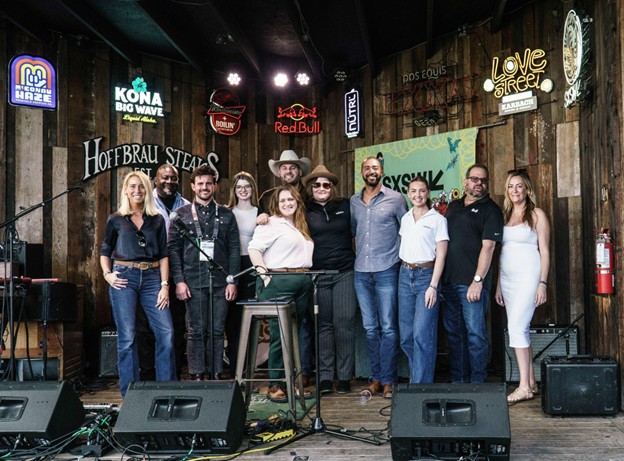
Davis Harris, founder and owner of Liaison AI, has spent the last several years quietly building one of Austin’s most practical bridges into the enterprise AI ecosystem. Liaison AI doesn’t sell software or chatbots directly; instead, it acts as a trusted connector, helping companies navigate the crowded, often confusing world of AI tools, platforms, and vendors. From Fortune 500 companies to startups, Harris and his team provide real-world insights on what works, what fails, and which AI technologies are worth adopting—saving organizations time, money, and the headaches of trial-and-error experimentation.
Harris’s journey into AI started with the same independent, entrepreneurial drive that shaped his life from an early age. Growing up in Northeast Louisiana, he watched his grandfather, a self-made nursing home owner, turn ambition into tangible success. “Even in fifth grade, I knew I wanted to start my own business,” Harris said. “I’d interview local entrepreneurs for school projects, invest in the stock market in high school, anything to learn firsthand how to grow something from scratch.”
After attending LSU and studying accounting, Harris took those lessons and applied them to technology. “I’ve always been independent, always planning for a business of my own. That persistence—that curiosity—is what led me to build Liaison AI,” he said.
Liaison AI operates in a space that might seem crowded on paper: Austin hosts countless AI consultancies, development shops, and enterprise tech accelerators. But Harris’s approach is unique. While many firms sell tools or implement AI themselves, Liaison AI offers an unbiased, peer-driven evaluation. The company matches organizations with the right AI solutions, based on operator feedback and real-world performance rather than marketing promises. “Our goal is to cut through the hype. Companies come to us because they’ve already spent time and money on projects that failed,” Harris explained. “We give them confidence that their next step is actually going to deliver value.”
The company’s philosophy was showcased most prominently at the recent SXSW AI Rodeo, an event Harris created to bring together AI newcomers and seasoned executives. Across five live presentations, speakers demonstrated how AI tools could succeed—or fail—under real-world conditions. Harris moderated the sessions, blending commentary on enterprise adoption strategies with practical insights from his own consulting experience.
For attendees, the lessons were immediate and tangible. One consumer discovered Sanas’ accent-neutralization technology, solving a frequent communication challenge with offshore support agents. A VP of IT from a billion-dollar enterprise realized Boost.ai offered a solution that better aligned with his chatbot’s deployment strategy. Another attendee, who had spent $50,000 on a failed AI proof-of-concept, gained actionable advice to avoid repeating the same mistakes.
“It’s one thing to hear about AI in a sales deck. It’s another to see it work—or fail—in front of you and learn why,” Harris said. “That’s the insight Liaison AI brings to every client, whether it’s a startup or a multinational.”
Harris’s own business is entirely bootstrapped, built on diligence, networking, and a deep understanding of both technology and organizational behavior. “We take a vendor-agnostic approach,” he said. “We look at what’s actually working in the field and share that with companies before they commit.” Liaison AI provides evaluations at no cost to the customer, serving as a trusted second opinion that complements internal IT and AI teams.
The event’s speakers reinforced this mission. Kurt Schulte of 8×8 highlighted the importance of integrating AI across the entire customer journey. Jamie DeWitt of Vonage demonstrated how tight integration within Salesforce can create seamless workflows. Emily Steen of Thrive showed that AI adoption is a crawl, walk, run process, emphasizing that AI should empower human analysts rather than replace them. Hannah Pryfogle of Boost.ai drew attention to the staggering failure rate of AI projects, underscoring the need for context, alignment, and human intelligence. Jamaal Savwoir of Nextiva showcased a live demo of an AI receptionist in action. Tiffany O’Malley of Sanas demonstrated real-time accent neutralization and translation with live agents across continents.
For Harris, these demonstrations were more than showpieces—they were proof of concept for the Liaison AI philosophy: informed adoption drives success. “In Austin, we have incredible AI talent and infrastructure,” he said. “But what Liaison AI offers that’s truly unique is a peer-driven, vendor-agnostic guide through the chaos. That’s something no tool or platform alone can provide.”
As AI continues to transform enterprise operations, Harris is confident his model will scale. “It’s about providing clarity,” he said. “We help companies understand what works, what doesn’t, and why. That’s our value, and that’s what sets Liaison AI apart.”
Photo Credit: Sandra Dahdah