
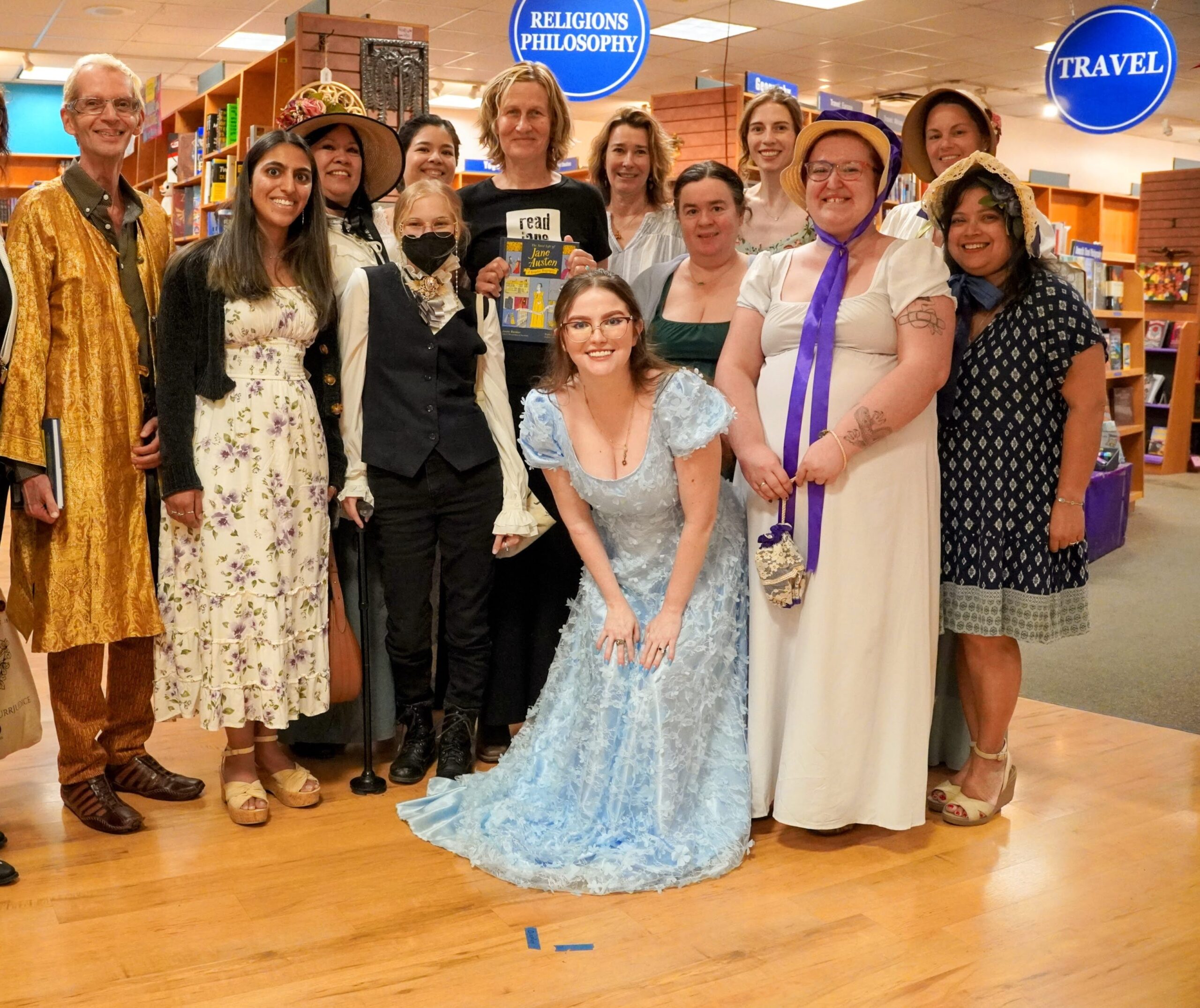
December 16 marked the 250th birthday of Jane Austen. This is the third article published in Sun News Austen to commemorate the event (see below)
Professor Janet Todd (Univ. of Aberdeen) has been entranced by Jane Austen for a long time. It even prompted her to write a novel in 2021, Jane Austen and Shelley in the Garden. This year, she has released a book of deep meditation about Austen.
Since Jane liked hyperbolic language (we learn this on page 65), I submit that Jane herself was “the choicest gift of heaven.” The phrase comes from Jane’s own writing, in Persuasion, the last book she completed before her death in 1817. “Through her letters,” says Todd, “Austen shows how much she admired those who make the best of things under severe pain.” In Persuasion she created the character of Mrs. Smith. Impoverished, confined and in pain, she shows to her old schoolfriend Anne Elliot
“…that elasticity of mind, that disposition to be comforted, that power of turning readily from evil to good, and of finding employment which carried her out of herself, which was from Nature alone. It was the choicest gift of Heaven.”
Austen may have been thinking of herself here, as her final months were difficult: it was the act of writing Persuasion that carried her out of herself. The gift she received was being able to write some of the finest novels of all time, and they are her gift to us.
In the novel Emma, Todd finds an oasis of calm. She writes that “Emma’s moments of profound experience come in stillness away from home.” Standing still at the door of Ford’s shop in Highbury, Austen writes “A mind lively and at ease, can do with seeing nothing, and can see nothing that does not answer.” Again, I believe this is Jane talking directly to us about her own way of seeing.
Of this passage where Emma sees the hustle and bustle of daily life, and yet sees nothing, Todd writes “This vision from Ford’s remains a beautiful passage, which I find extraordinarily calming. It’s part of Jane Austen’s genius that, with her subtle techniques of free indirect speech, her shifting closeness to and ironic distance from the heroine, she allows the reader to appreciate both the seductiveness of Emma’s vision and its limitation.”
For the 200th anniversary of her death, in 2017, the British government issued a 10 pound banknote with Austen’s visage. On it was printed a line from her most beloved novel, Pride and Prejudice: “I declare after all there is no enjoyment like reading.” But Todd prefers a different line had been used. Looking once again to the book Emma, she selects this as a better aphorism: “Seldom, very seldom, does complete truth belong to any human disclosure.”
Jane Austen was very much an ENGLISH author, not just an author in the English language; to wit, the following quote. A friend of hers, Alethea Bigg, was planning on a trip to the Continent. Jane wrote to her rather briskly:
“I hope your letters from abroad are satisfactory. They would not be satisfactory to me, I confess, unless they breathed a strong spirit of regret for not being in England.”
It is this spirit, in my opinion, that has imbued itself into the fabric of every novel she wrote. That is why Austen is often now mentioned in the same breath as Shakespeare as an exponent of Englishness, and of the very language that has, quite rightly, become the lingua franca of the planet.
As a pivotal insight into Jane’s mind, Todd gives us this gem: “I’ve mentioned Jane Austen’s naughty habit of letting her fictional characters live beyond the books. When once visiting London she sought likenesses of her creations.” Austen went to an exhibit of paintings by Sir Joshua Reynolds, and another exhibit at the Society of Painters, searching for likenesses of Darcy and Elizabeth.
“There was nothing like Mr. Darcy at either,” wrote Jane. “I can only imagine that Mr. Darcy prizes a picture of her too much to like it should be exposed to the public eye – I can imagine he would have that sort of feeling – that mixture of Love, Pride & Delicacy.”
She was truly the choicest gift of heaven, and Todd (who has been ‘living’ with Jane Austen for decades) has done a superb job here of bringing her to life, just in time for the big 250!
There is a typo on page 178: “certainly” should be “certainty”
Living with Jane Austen is by Cambridge University Press. It lists for $25.95
Lead photo: Dr Cunningham, at far left, at a Jane Austen celebration in Austin in 2025. At centre (back) is Dr. Barchas of the University of Texas, one of world experts on Jane Austen. Photo credit: BookPeople and/or Zareef Chowdhury