
“I am unable to satisfy my thirst for books.”
That pithy line was written in 1337 by Petrarch, and that was even before the printing press was invented! Imagine what he would think now, with millions of books printed.
As author Andrew Hui (Yale-NUS College, Singapore) says, Petrarch was “open about his obsession.” His ‘thirst for books’ quote is merely the opening line in a whole paragraph Hui gives us in Chapter 1. Setting the stage for this study of Renaissance libraries, Petrarch goes on to say “Books please us inwardly, they speak to us, advise us and are joined with us in a kind of living and penetrating intimacy.” I think that might be where the popular phrase ‘book-lover’ derives, although Hui wisely does not delve into the erotic nuances of Petrarch’s quote.
Hui uses the three fictional characters Dr. Fautus, Don Quixote, and Prospero to explore the consequences when an interest in books goes too far. “Don Quixote is the exact contemporary of two other towering figures of the Renaissance driven mad by their bibliomania. These three are all melancholic loners: all three become bewitched by their books. One goes mad; one is exiled; the last (Faustus) is damned.”
You might my headline comes from the story of Fautus, but it’s actually from the story of Don Quixote. In the story, a servant girl says she saw devils in hell playing tennis with books instead of balls. When one devil tells another that the book is Avellaneda, the other responds: “Take it away from here; and throw it into the pit of hell so that my eyes never see it again.” Hui draws the obvious conclusion: “So even hell has a library.” But Hui assumes too much here, not telling the reader that Avellaneda is the name of an author who wrote an unauthorized 1614 version of the book by Cervantes; he incorporated this unacceptable book into his own second volume of Don Quixote, published in 1615. Thus, he is throwing not only the book, but Avellaneda, into Hades.
“Books offer Prospero power, Don Quixote adventures, Faustus perdition. The three characters,” concludes Hui, “mark the generations of the last Renaissance humanists and the first modern white men. The apotheosis of their knowledge, their striving, their passion to conquer and know it all undergird modern epistemology’s quest of ceaseless dominance.”
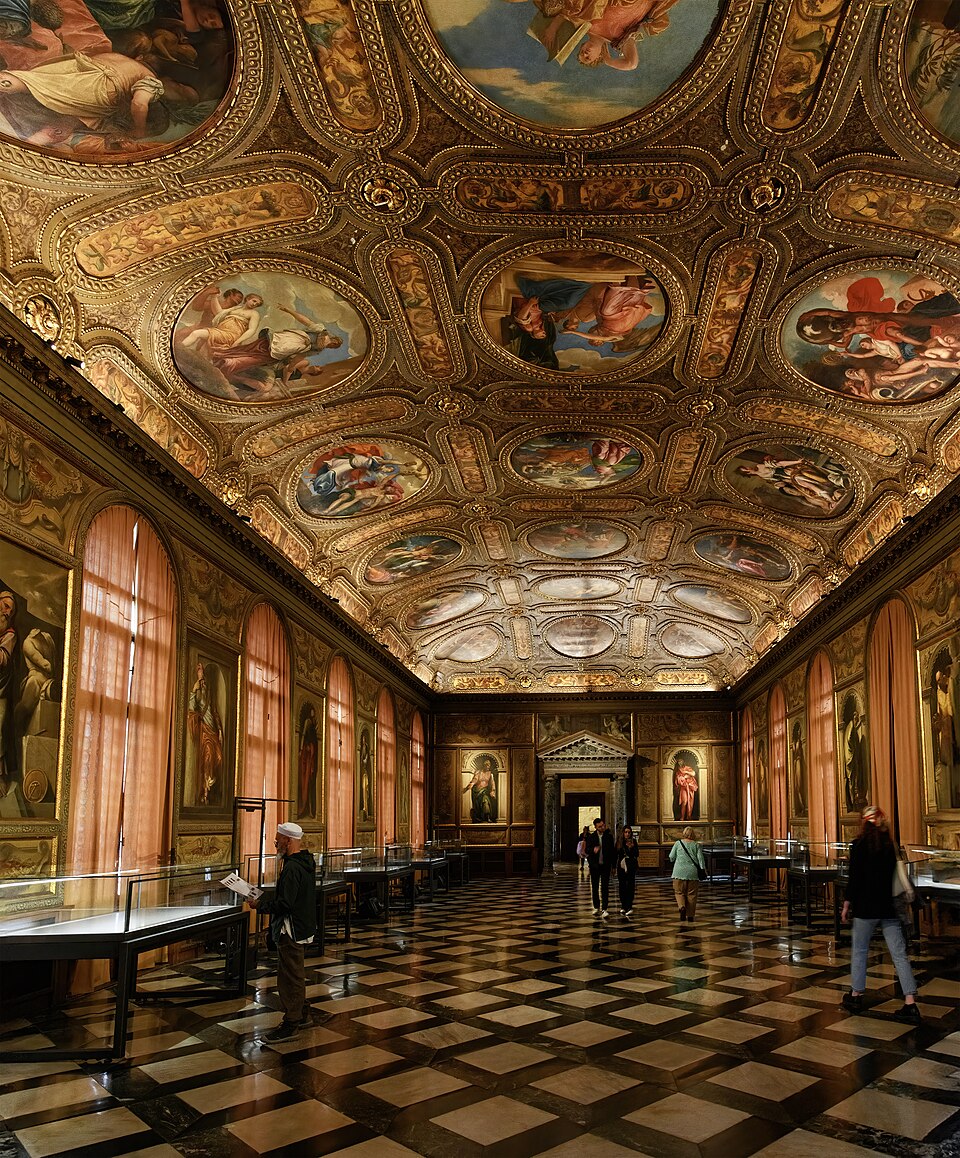
The focus of the book is on these fictional characters and their libraries. He has little to say about real Renaissance libraries, such as the one in Venice pictured with this review. With regard to Rome, he does note that “The grandeur of these libraries became so well known that they were featured, ranked, and praised in the city guides of the period.” In the Vatican the librarians were cardinals; one them even became Pope as Julius II.
Hui identifies the author Rabelais “as a hinge, because he serves as a transition from real libraries to imaginary ones, and he demonstrates the transition from the Middle Ages to the Renaissance.” Rabelias created the character Pantagruel, “but he is quite different from the bookish company of Don Quixote, Prospero and Faustus. Pantagruel enters into an institutional library, only briefly at that, and emerges unscathed. My sense is that Don Quixote, Prospero and Faustus fared worse: they were invented to show how their noble minds were overthrown in their individual libraries.”
Hui also looks at art from the 15th and 16th centuries (there are 20 plates, mostly in colour). An especially intriguing one is by Ghirlandaio. His Annunciation, from 1482, depicts an angel on the left and Mary on the right. A Bookshelf functions “as the physical barrier” between them, “but this barrier is also a medium, a hyphen between two worlds.” And in the famous St. Jerome in the Desert by Bellini (1505), we see the saint lost in thought as he reads a book.
But this book is primarily about the Renaissance imaginary library. “It lies,” concludes Hui, “at the intersection between material inscription and metaphysical infrastructure, all summoned through the effervescent fantasy of total knowledge.”
As an exploration of imaginary libraries, Hui has written a very real and most important book of his own.
There is a typo on page 196: “the figure of obsessive reader” should be “the figure of an obsessive reader.”
Image: The Marciana Library in Venice, constructed between 1537 and 1588. A key example of Venetian Renaissance architecture.
The Study: The Inner Life of Renaissance Libraries is by Princeton University Press. It lists for $29.95