
You may think you know the ruins of ancient Rome, but this book will make you think about them in new ways.
Roland Mayer is Emeritus Professor of Classics at King’s College London. He begins the book with the counterintuitive assertion that “The Romans out no aesthetic value on ruins.” While for several centuries this aesthetic appeal has been the overriding attitude of visitors to Rome, it was not always so! “The Romans did not make any appeal to the imagination or aesthetic sense,” writes Mayer. “They might point to a moral about the transience of things, but in general they cast no spell.”
Mayer misses an opportunity of incorporating the views of Humbert of Romans (born around the year 1200). In his commentary on the Rule of St. Augustine, Humbert wrote that images of visual art inspire devotion: an aesthetic and cognitive experience. “Thus, the aesthetic inspires both intellectual and emotional responses. Although referring to the impact of visual art experience, these positions can apply to any aesthetic experience,” writes Brenda Schildgen (2025:45) The inspiring aspect of the aesthetic that is the backbone of Mayer’s book, an aspect recognized as such in the 13th century by Humbert, is thus grounded in the writing of St. Augustine, who is not mentioned in this book. Mayer writes that the first to record an aesthetic experience of the ruins of Rome was Hildebert of Lavardin (archbishop of Tours), who visited Rome several times in the early 12th century. While true, it can safely be surmised that any visitor steeped in the works of St. Augustine (from the long ago 4th and 5th centuries) would have engaged with an aesthetic response. We simply have no record of it.
That said, this is a superior book in every way. It covers the entire sweep of history. In the 19th century, for example, we read the words of Percy Bysshe Shelley that he wrote his iconic poem Prometheus Unbound (1820) “upon the mountainous ruins of the Baths of Caracalla.” Mayer says “It is noteworthy that Shelley felt the intoxication of a Roman setting, just as Gibbon had done when he arrived in Rome, surely an unexpected bond between the two.” Here are a few lines from Shelley’s poem Adonais:
“Go thou to Rome – at once the Paradise,
The grave, the city, and the wilderness;
And where its wrecks like shatter’d mountains rise,
And flowering weeds, and fragrant copses dress
The bones of Desolation’s nakedness.”
In the latter 19th century, Henry James “Rome and especially the Coliseum provided the setting in a number of his stories and novels.”
Literature has been a powerful motivator in the search for, and (in more recent centuries) the appreciation of ruins. Mayer tells us that “The ancient tourists’ chief reason for visiting Troy was that the city featured in literature: its remains were not dumb; they had a story to tell through Homer’s poetry.” This attitude towards ruins has its modern counterpart. “Once ruins can be set within a narrative and are seen to make their own contribution to a human story, they either continue to live or, in the case of the ruins of Rome, they acquire a dazzling new life.” Modern tourism has been a major driving force in the preservation and partial restoration of the ruins.
But for many centuries scholars lamented the state of Rome, more than they sung its praises. In the year 793, Alcuin described it thus:
“Rome, world capital, world glory, golden Rome
Now all that is left to you is a cruel ruin.”
A turning point came in the mid-14th century: “Petrarch is crucial to the development of ruin-mindedness thanks to his re-evaluation of the ruins of Rome as treasuries of historical memory, not rubble. Petrarch was the first to find cultural value in material remains, even ruinous ones. He initiated the topographical impulse to describe and resurrect a historical Rome.”
But it was not just the visible ruins that animated him. “What remains fundamental to Petrarch’s reaction to the ruins,” Mayer discerns, “was its source: upon his reading, so that his literary imagination re-peopled the desolate sites, sufficiently to endow the broken stones with a human dimension they still retain.”
Petrarch and Alcuin would surely be sad to see the Rome of today. Mayer devotes an entire chapter to “The Battle for Ruins,” where he explores the desecration of the ruins through the centuries. In the 14th century, the “Ruins were clearly still deemed a blot upon the city’s beauty.” Many ruins seen by Petrarch and Alcuin don’t exist anymore because the citizens of Rome used the ruins as sites to be robbed, and even melted down (marble was burned for lime!). The real wonder of the ruins of the Rome is that any still exist.
This was not lost on Alberti, who wrote in a letter of 1422 to Giovanni de Medici that Rome’s beauty was its ruins. “Such a response to decay,” opines Mayer, “must be recognized as a striking development in aesthetic sensibility.” But it still took another three centuries before Denis Diderot, in 1767, wrote “a multifaceted meditation on what he called ‘the poetic of ruins.’ Diderot’s critique is a fundamental document for ‘ruinologists,’ since it substantially widened the appreciation of ruins to include sentiment and dreamy reflection.” It was just before this that Piranesi “transformed the way ruins would be viewed.” Between 1747 and 1761 he published 10 volumes of engravings on the ruins of Rome. In the next century, the American painter Thomas Cole created a series of 5 paintings entitled ‘The Course of Empire.’ In the final one, the imperial city has been reduced to ruins. Some saw it as a moral lesson to the new country of the United States; so, we come full circle to what I wrote at the beginning of this review about the transience of things, something the Romans themselves were aware of.
A fascinating book of great depth, it should be read by anyone with a serious interest in Rome, especially those who plan their first trip to the Eternal City.
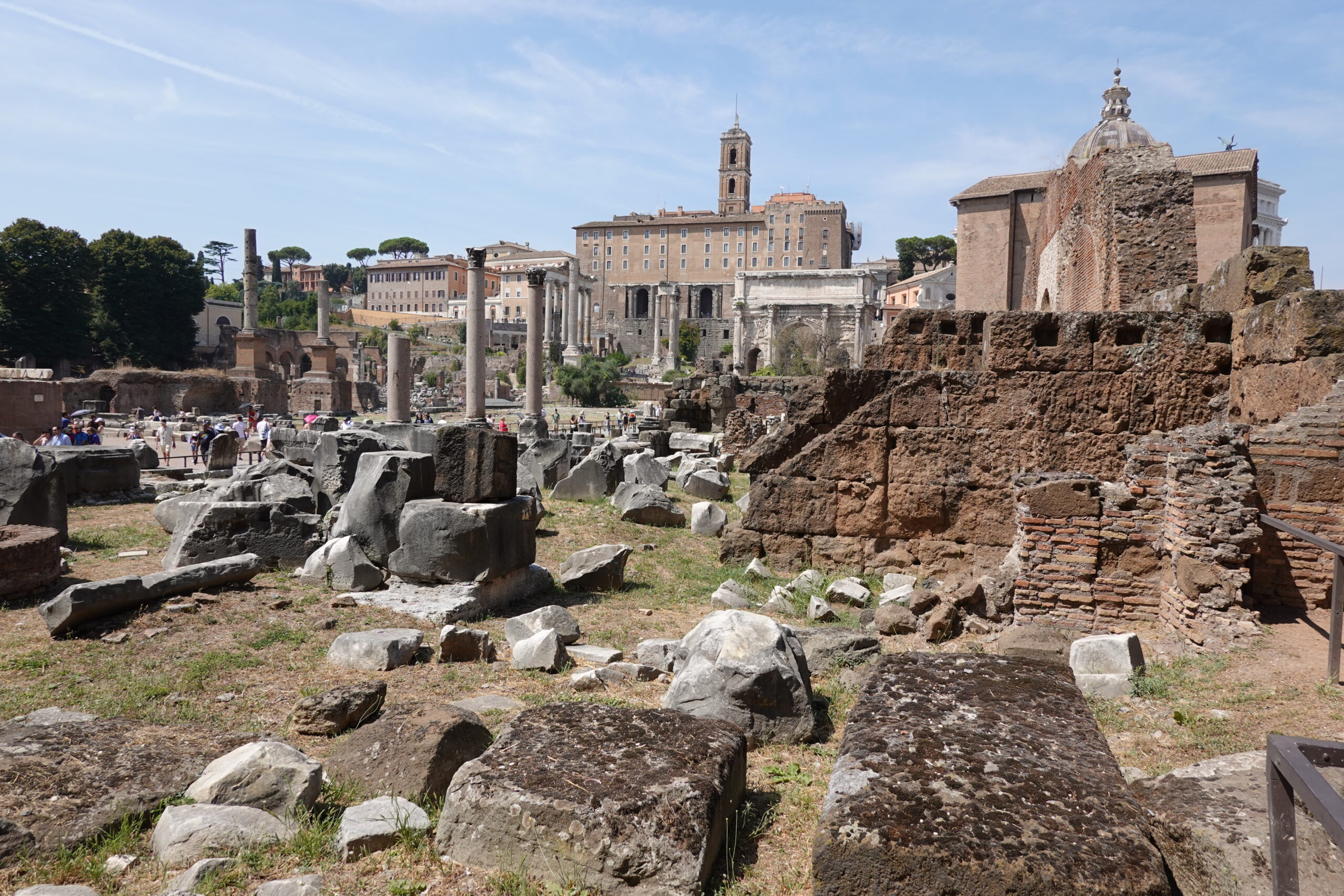
Photo: The ruins of the Roman Forum which, as Mayer states “Have benefitted from some restoration.” Photo by C. Cunningham, 2023.
Reference:
Schildgen, B. (2025) Boccaccio Defends Literature. University of Toronto Press.
The Ruins of Rome: A Cultural History, is by Cambridge University Press. It lists for $39.99