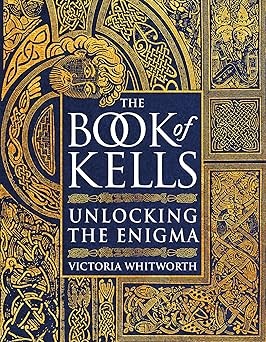
The greatest treasure of Ireland, The Book of Kells, is considered the most magnificent medieval manuscript that survives and one of the oldest. The Latin manuscript contains the four gospels of the New Testament, Matthew, Mark, Luke and John; the book was most probably created in a medieval monastery by monks in the late eighth or early ninth century But scholars have never been able to establish exactly where it was written. The Book of Kells is one of the many lavishly decorated manuscripts which are the richest surviving artworks of the Celtic period, but Kells exceeds all others with its extraordinary creativity, brilliant coloring, endless variety of intertwined patterns and surprising human and animal figures.
This latest scholarly study of the Book of Kells by art historian Dr. Victoria Whitworth presents a new account of the book’s components; its text, its artwork, its accuracy, its scribe and artists and most importantly its place of origin. Art historians have argued about these features for many years; this new monograph presents the most recent research on the monumental book. New archaeological discoveries in northern England have provided evidence that the monastic location for the writing of the Book of Kells may have been somewhere entirely unexpected. This new study reveals additional factors for establishing a more accurate understanding of the history and influences behind this special manuscript. The author has pieced together her own research and that of archaeologists to present new theories concerning all aspects of the ancient manuscript. She calls the Book of Kells, “the crowning masterpiece of Insular art” (p.93)
The Book of Kells contains 340 folios, 640 pages, recto and verso; all of these are decorated in some way. Unfortunately, the initial pages are missing and the few folios at the end that usually tell the name of the scribe, artist, patron and location (called the colophon) also went missing long ago. Not perfect, the manuscript is both damaged and unfinished in parts; the vellum edges were trimmed at some point and a few folios have disappeared. The fully illuminated gospel book is now bound into four separate manuscripts and is held at the Trinity College Library in Dublin, attracting 570,000 visitors every year.
The book is named for the monastery at Kells in County Meath, founded in 807 CE, probably just after the book was created. It did not arrive at the Abbey of Kells until the second-half of the ninth century; the monastery housed the precious manuscript for numerous centuries. When considering its hazardous 1200-year history, it is miraculous that this famous manuscript has managed to survive. The very bulky book must have traversed far, over land and sea to arrive at Kells after escaping from raids at its former location. Early monasteries were prime targets for the Vikings and Danes since they had supplies of food and precious artifacts, including candle holders, chalices, and liturgical instruments, and no means of defense. The manuscript survived through the many Viking raids on Kells Abbey and was stolen in 1006. Thankfully, the valuable book was discovered a few months later, hidden in a bog but its golden, jeweled cover had been stripped. The Book of Kells remained at the abbey until 1653; eventually it was sent to Dublin and then to Trinity College in 1661.
Although Ireland would like to claim that the important manuscript was created there, most scholars believe that the manuscript was made at the prominent monastery at Iona, a holy island off western Scotland. Author Whitworth suggests a production site that is completely new and unexpected. Recent research has shown that the land of the Picts had a prosperous monastic site that could have created manuscripts that would rival those from Iona. The Picti, meaning painted people, were named by the Romans when entering northern England and Scotland. Whitworth proposes that the place of origin for the manuscript was not Iona, nor an Irish monastery but a Pictish monastery at the town of Portmahomack in eastern England. That ancient monastic community thrived from the eighth to the ninth centuries. Like Kells Abbey, not a trace of that monastery survives.
Why does this recent study discount the traditional site of Iona for the origin of Kells? The author feels that “the wit, verve and apparent spontaneity” of the Book of Kells is not present in the many books produced at the monastery of Iona. She adds, “There is no hint in surviving art and writing from Iona that these scholars and craftsmen were interested in the Labyrinthine wordplay, puzzles and enigmas that fascinated the Scribe-Artist of Kells”. (Whitworth p.17) The author presents numerous scholarly arguments to support her theories concerning Pictish art styles, such as, surviving examples and religious trends of that period.
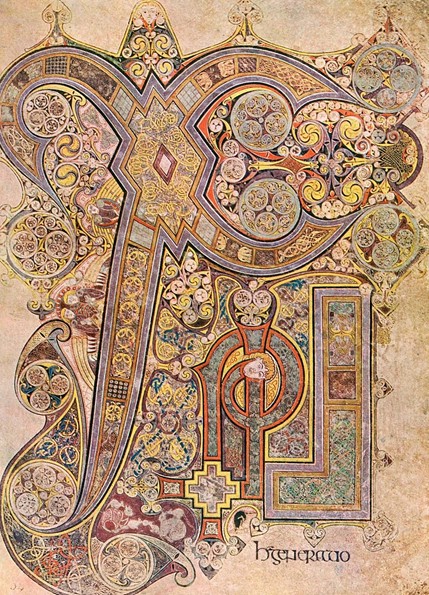
The most famous of the painted pages in the Book of Kells is the fabulous Chi Rho design found in Matthew’s gospel, the first of the manuscripts in the book. The Greek letters Chi and rho are celebrated, even overwhelmed, in Matthew’s gospel because this announces the birth of Jesus. The Kells artists packed the entire page with endless swirling patterns and a variety of forms in complementary colors. The author describes the magnificent artwork as: “a rich ecosystem, full of surprises. Hidden among the letters and patterns are a moth, two human heads, three angels, four mice, two cats, and an otter with a fish in its jaws”. (pg 232)
The enlarged monogram was embellished with a whirling ornamental field applying both typical Pictish knotwork and Hiberno-Saxon interweave, and the artists’ creative genius. As an art history professor, students are always amazed when they are shown this amazing work of art. I was amazed one day when teaching Insular art; a dedicated graduate student removed his T shirt in class and showed that he had an exact duplicate of the Cho rho page tattooed on his back. Ouch.
Art historian Whitworth has written a new and authoritative account of one of the most famous and admired manuscripts ever created. The book is beautifully illustrated and supplies an analysis of the smallest details on the folios and her careful study of surviving Pictish carvings and text engravings in stone, wood and metal has enabled her to bring a new understanding to both the colorful artworks and the carefully aligned text of Kells. Analysis of the manuscript allowed her to state definitively that there were only two monks who created the huge gospel book, one she calls the Master-Artist, who created only the artwork and the other she named the Scribe-Artist, who did some of the artwork but copied all of the text. Both monks were masters of their trade. It is hard to imagine the devotion, dedication, concentration, time and talent necessary to produce the imaginative artwork and the perfect lines of text that fill the extraordinary Book of Kells.
Dr. Marion Dolan University of Pittsburgh
lead image: Chi Rho page, folio 34r, depicts the first two letters of the word Christ in Greek.
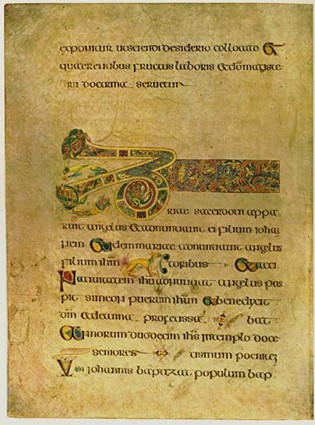
2nd image: Text page from Luke’s gospel, f 19v