
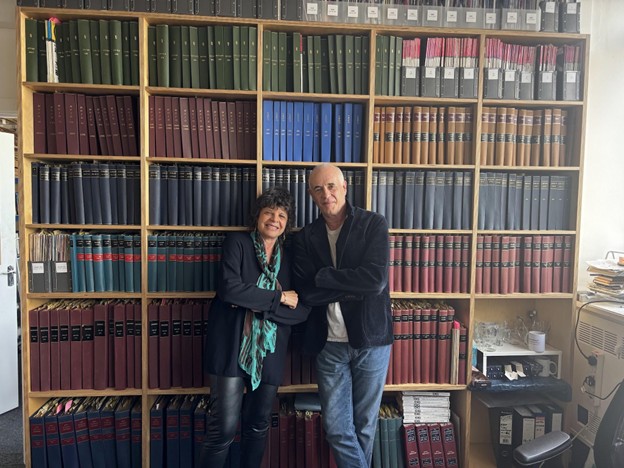
lead photo: Author Elise Krentzel and Founder of Rocks Back Pages Barney Hoskyns at their HQ
There was an instant camaraderie — that rare, unspoken recognition between two people who’ve lived on the same frequency of backstage chaos, late-night interviews, and too many deadline coffees.
I admired the view from Britannia House, where Rocks Back Pages quietly operates above the hum of West London. “Yeah,” said founder Barney Hoskyns, with a dry half-smile. “It’s a view — but of rooftops.”
That was my introduction to the man who has built the world’s most comprehensive digital library of music journalism — an archive that stretches across seven decades of sound, style, and storytelling. No exaggeration: Rocks Back Pages is where the DNA of popular music writing lives on.
“We started talking about the idea in 1999,” Barney said. “The Stone Age, really.” Back then, the Internet was little more than dial-up and HTML dreams. Print was dying. Music journalism — once the wild frontier of pop culture — was losing its footing. “It was going to be a music site,” he explained. “Consumer-facing. We didn’t really know how it would work — but we thought maybe hardcore fans, journalists, researchers, record companies — anyone who’d find this collection useful.”
By 2001, the dream had become a website. It launched with about thirty writers and a few thousand digitized articles. “We started with people I knew,” Barney said. “Writers from NME, Melody Maker, and Rolling Stone. Some big names, yes. Now we have around nine hundred.”
From that handful of contributors, Rocks Back Pages has grown into a digital cathedral of over 57,000 articles — stretching back to the late 1940s. “We even have stuff from the early pop press — Disc, New Musical Express, and Melody Maker,” Barney said. “And then, of course, as we get into the rock era, there’s more and more. The launch of Crawdaddy, Creem, Circus… all of it.”
The archive reads like a sonic map of modern life. Every major musical movement of the last sixty-plus years lives within its database. From the gospel roots that seeded soul and R&B to the country that bled into rock ‘n’ roll — the story unfolds decade by decade, beat by beat.
There’s the jazz of the 1950s, when musicians spoke in code and critics wrote in smoke. The British Invasion and the American counter-revolution. The psychedelic sprawl of the late ’60s; the singer-songwriter introspection of the early ’70s. The sneer and grit of punk. The pulse of disco and electronica. The politically charged verses of reggae and hip-hop.
And not just those towering genres — but their offshoots and underground movements, too: post-punk, funk, new wave, ambient, industrial, grunge, glam, prog, folk, alt-country, trip-hop.
“Rocks Back Pages covers everything from gospel to hip-hop, punk to reggae, blues to electronica,” Barney said. “If it mattered to people — if it shaped a generation — we’ve got it.”
It’s an unfiltered record of cultural history. Reading through the archive is like scrolling through time itself: the rise of Elvis, the fall of Altamont, the birth of MTV, the emergence of Prince, the birth of rave culture, the digital democratization of the 2000s.
The Writers: Witnesses to the Music
“Rocks Back Pages isn’t just about magazines,” Barney said. “It’s about the people who made sense of it all — the writers.”
And what a cast of characters.
There’s Simon Frith, the academic whose sociological dissections of pop gave rock criticism intellectual muscle. His essays linked the ecstatic noise of teenage fandom to the deeper mechanics of social identity.
Vivien Goldman, the “Punk Professor,” who reported from the front lines of London’s reggae and punk scenes with ferocious empathy and a feminist lens. Her dispatches were not about idols but communities — people building new languages of resistance.
Al Aronowitz, the bridge between the Beat Generation and the rock revolution, who introduced Bob Dylan to The Beatles and chronicled the cultural combustion that followed.
And of course, Lester Bangs — the enfant terrible of Creem magazine — whose raw, manic, hyper-verbal prose turned criticism into its own form of art. Bangs didn’t just describe music; he performed it on the page.
“They were all there,” Barney said. “Each with their own lens. Simon was analytical. Vivien was inside the scene. Aronowitz was part of the mythology. And Lester — well, Lester was Lester. He made writing dangerous again.”
RBP has immortalized them all. Their voices, once fleeting on pulp and ink, are now searchable, citable, and preserved for future generations.
“We didn’t start this to glorify the past,” Barney said. “It’s about making it accessible. These writers captured the world as it was changing.”
The backbone of Rocks Back Pages is simple: scan, digitize, and index. But behind that simplicity lies twenty years of obsessive dedication.
Fifty new pieces go live each week, alongside a new audio interview. “We’re always adding,” Barney said. “It never stops.”
“So how do you survive?” I asked. “Are you sponsored?”
“We’re not sponsored,” he replied. “We’re a subscription site. Most of our revenue comes from group subscriptions — mainly academic and public libraries.”
That means Harvard, Oxford, UCLA, the British Library — institutions where scholars and students mine the archive for research. “Paul’s our sales guru,” Barney said. “He’s been with us about fifteen years. He got us a lot of subscribers, especially in North America, but also here and in Australasia.”
This academic model gives RBP a quiet stability. No ads, no corporate funding. Just libraries, universities, and cultural institutions sustaining a labor of love. “We didn’t set out to do it that way,” he admitted, “but it’s where we found support. People who value context — not just content.”
The Audio Revolution
Around a decade ago, Rocks Back Pages expanded into sound. “We realized a lot of writers had kept their original interview tapes,” Barney said. “That’s when we started digitizing audio.”
Those reel-to-reel and cassette interviews are now in growing demand. “We get requests from documentary makers all the time,” Barney said. “We’ve licensed segments for films on George Michael, Madonna, Joni Mitchell — you name it.”
Why? “Because audio is real,” he said. “You hear the hesitation, the humor, the sighs. You can tell who’s performing and who’s revealing. It’s intimacy you can’t fake.”
Audio has also become an unexpected revenue stream. “People want short clips — 20 or 30 seconds. It’s cheaper than licensing video. But those little moments — they bring history alive.”
Barney’s team adds one new audio per week, carefully cleaned and tagged. “It’s slow work, but it’s worth it,” he said. “Some of these tapes are the only surviving record of those conversations.”
The RBP Podcast: The Archive Speaks
The Rocks Back Pages Podcast might be the most delightful offshoot of all. Hosted by Barney, longtime editor Mark Pringle, and producer Jasper Murison-Bowie, it’s part oral history, part fan club, part salon.
“We started the podcast because we were having these great conversations about the archive,” Barney said. “We thought — why not record them?”
Each week, the trio discusses writers, artists, or moments from the archive, often joined by guests. Vivien Goldman has been on to talk about reggae and the spirit of punk. Paul Morley dissected the contradictions of 1980s excess. Other episodes have explored David Bowie’s shifting personae, Prince’s genius, and the lost art of liner-note poetry.
“The podcast lets us reanimate the archive,” Barney said. “We bring those voices back into the present tense.”
It’s loose, literate, and filled with affectionate teasing. These are people who lived it — critics, journalists, musicians — still chewing over the question of what music means.
And that’s the secret: Rocks Back Pages isn’t just preservation. It’s a conversation.
Of course, the question arises — what happens if disaster strikes? “If there’s a fire, there’s a fire,” Barney said bluntly. “We’re insured. But everything’s being digitized. It would take twenty people working around the clock to do it all, but we’re doing as much as we can.”
The team maintains backups across multiple drives and locations. “We always make sure there’s redundancy,” he said. “It’s not glamorous, but that’s what keeps it safe.”
The physical archive — thousands of magazines, tapes, and photos — remains stored and protected. The digital archive lives in multiple mirrored servers. Of the two, the past is both tangible and future-proof.
When asked if they’re the biggest archive in existence, Barney didn’t hesitate. “We are,” he said. “There’s nothing that jockeys with us.”
He’s right. RBP isn’t just large — it’s singular. It holds the collective memory of music journalism itself: the language, tone, slang, and soul of how generations have written about sound.
Every genre, every scene, every seismic shift is captured in some critic’s words. And every writer, from Simon Frith to Vivien Goldman, from Al Aronowitz to Lester Bangs, adds a voice to the chorus.
As Barney put it, “Writers are historians, whether or not they admit it.”
Before leaving, I asked if they had any swag. Barney’s sales manager rummaged in a drawer and placed a small black guitar pick in my hand. I must’ve grimaced. They all burst out laughing.
“This is the worst swag ever,” I said. “No bumper stickers? No laptop stickers? Come on, guys — get with it.”
They were still laughing as I left. Outside, the rooftops stretched gray and infinite — exactly as Barney said. A view, yes, but also a metaphor. Beneath those roofs lies the beating digital heart of musical memory, preserved not by corporations, but by a handful of believers.
The Beat Never Ends
Rocks Back Pages isn’t nostalgia — it’s evidence. It’s the living archive of how we listened, thought, argued, and evolved. It’s where gospel meets grunge, where punk and hip-hop share the same electric pulse, where a 1965 Melody Maker column sits alongside a 2000s blog think-piece and a 2020s retrospective podcast.
Barney and his team have turned what most saw as ephemera into enduring literature. As trends fade and platforms die, Rocks Back Pages remains, quietly uploading, preserving, and reminding us that the soundtrack of history isn’t just what we hear — it’s what we wrote about it.
Music fades. The words remain.
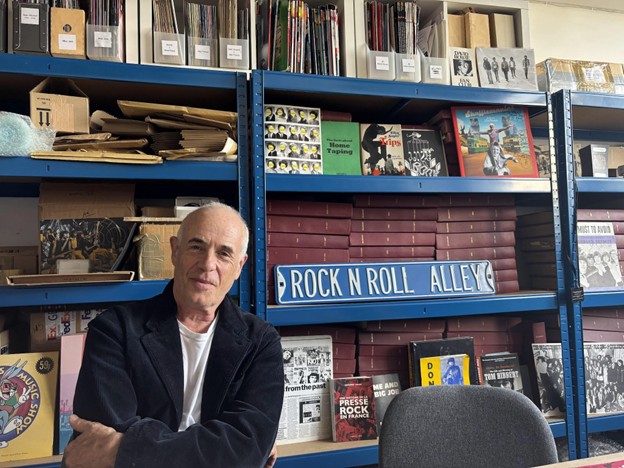
second photo: Barney Hoskyns; Photo Credit: Elise Krentzel