
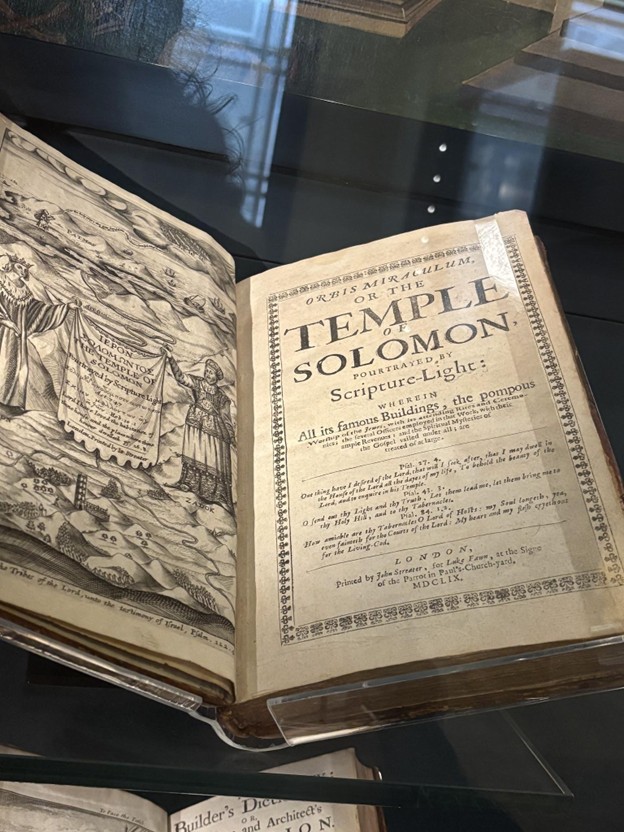
I’ve always been drawn to the hidden language behind the visible — the carved sign above a doorway, the ceremony that marks a passage from one state of being to another, the geometry that claims to hold the key to order in a chaotic world. My lifelong fascination with symbology and rites of passage has led me to monasteries, temples, ashrams, and psychedelic art studios. So when one of my clients quietly mentioned he was a Freemason, the idea clicked like a code unlocking itself. I had to see the source. On my recent trip to London, that curiosity guided me through the bronze doors of the Museum of Freemasonry, a place that has stood for centuries at the intersection of secrecy, craftsmanship, and myth.
Before I ever set foot inside, I wanted to understand what exactly this brotherhood was — and what it wasn’t. The Masons have been alternately revered, condemned, romanticized, and feared for over three hundred years. Depending on whom you ask, they are either a charitable fraternity of upright men or a global cabal of shadowy elites. The truth, predictably, lies in a labyrinth somewhere between those extremes.
Freemasonry as we know it emerged in early 18th-century Britain, when the working guilds of operative stonemasons — the men who literally built cathedrals — evolved into “speculative” lodges devoted to moral and philosophical building instead of stone. By 1717, London had its first Grand Lodge, and within a century, Masonic halls had appeared in nearly every major city in the Western world. The appeal was obvious: a moral code based on craftsmanship, a fellowship across class lines, and an escape from both religious dogma and political tyranny.
Many of history’s luminaries were drawn to the fraternity’s blend of ritual, secrecy, and intellectual freedom. George Washington laid the cornerstone of the U.S. Capitol wearing his Masonic apron. Benjamin Franklin helped found the first American lodge. Winston Churchill, Sir Alexander Fleming, Mark Twain, Voltaire, Mozart, Oscar Wilde, and even Prince Philip counted themselves among the Craft. The list reads like a strange guest list for a celestial dinner party — politicians, poets, scientists, kings, and revolutionaries breaking bread beneath the same symbolic eye.
To its members, Freemasonry offered purpose and brotherhood. To outsiders, it offered suspicion. And to historians, it presented a paradox: an order devoted to “light” that thrived in secrecy.
The pros are as old as the order itself. Masons have raised billions for charity, built schools and hospitals, promoted literacy, and fostered self-discipline, civility, and fraternity. Their motto — “to make good men better” — is embroidered into aprons, carved into stone, and whispered in lodges from London to Lagos.
But the cons are real, too. The exclusivity. The archaic gender barrier — women still barred from most lodges, though female and mixed lodges now exist independently. The hierarchy, the passwords, the handshakes. And, of course, the secrecy that feeds endless conspiracy theories: that Masons control governments, banks, Hollywood, the Vatican, or the entire world. The irony is that Freemasonry’s secrecy isn’t about power — it’s about symbolism. The rituals are private, not sinister; the oaths are allegorical, not imperial. But in a world allergic to ambiguity, secrecy smells like smoke, and where there’s smoke, the internet sees fire.
Still, not every regime was fooled by myth. The Nazis banned Freemasonry in 1934, equating it with Jewish influence and internationalism. Hitler’s propaganda depicted Masons as part of a “world conspiracy.” Franco did the same in Spain. Communist governments from Russia to Cuba outlawed the order, branding it bourgeois and subversive. Paradoxically, those persecutions only burnished the Masons’ image as defenders of liberty. Any group hunted by both fascists and communists must be doing something right.
Every time the Masons are mentioned, someone mutters the word cult. It’s easy shorthand for anything secretive or hierarchical, but Freemasonry doesn’t fit the mold. There’s no messianic leader, no prophet, no demand to abandon family or faith. No tithes beyond modest dues. Members are free to believe in whatever they wish — as long as they believe in something higher than themselves. The “Great Architect of the Universe” is the unifying principle or GAOA as some use as a signature, a divine placeholder vast enough to include God, Allah, Brahman, or Geometry itself. That flexibility is the point.
Yet the resemblance to cultic structures is undeniable. The degrees of initiation, the coded rituals, the dramatic allegories of death and rebirth — these are powerful psychological experiences, and like all initiations, they can inspire awe or suspicion. Masons argue their rites serve to awaken moral awareness, not control minds. Critics counter that the secrecy breeds elitism and favoritism. Both are true, in their way. Freemasonry is what happens when moral philosophy borrows the language of mystery.
Even cinema hasn’t resisted the allure. Stanley Kubrick’s last film, Eyes Wide Shut, plunged audiences into a masked underworld of ritual sex and elite secrecy, filled with checkerboard floors, columns, and arcane ceremony — imagery straight from the Masonic aesthetic. Some claim Kubrick was exposing hidden societies; others think he was merely staging a dream about moral corruption and class. Whatever his intent, the film tapped the same psychic vein: humanity’s obsession with what happens behind closed doors. A visual metaphor for duality, moral ambiguity, and the peril of curiosity, the checkerboard pattern beneath Tom Cruise’s feet could easily have been taken from a Masonic lodge.
As I walked through London’s Freemasons’ Hall, that imagery came rushing back. The marble lobby gleamed like Kubrick’s set, the air scented faintly with polish and mystery. But here, the masks were replaced with open display cases — an invitation to see, rather than be seduced by the unseen.
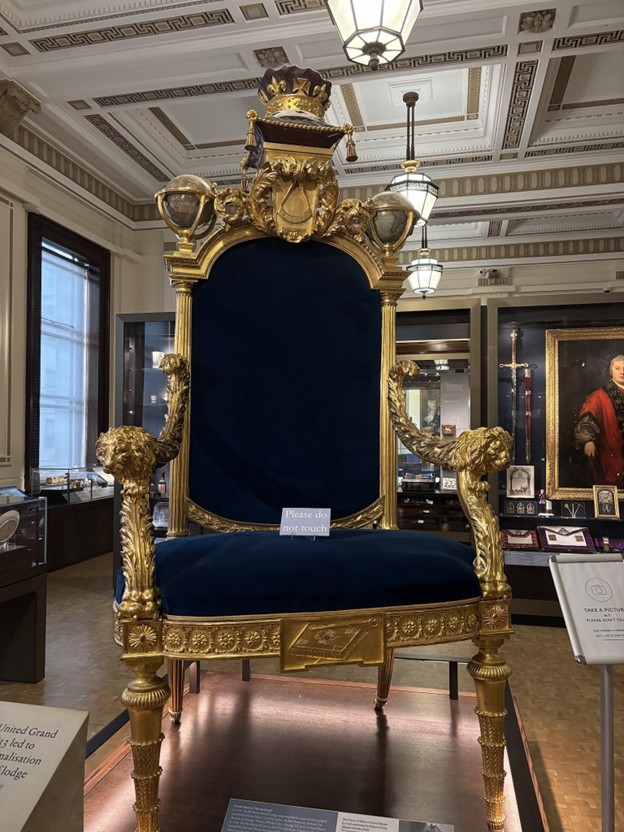
Freemasons’ Hall, at 60 Great Queen Street, was completed in 1933, a memorial to Masons who died in the Great War. Its façade is a symphony of Art Deco geometry — every angle purposeful, every surface measured. Inside, the Museum of Freemasonry spreads across the upper floors, open to the public Tuesday through Saturday. I arrived mid-morning, notebook in hand, feeling less like a tourist and more like an anthropologist entering a myth made real.
The Tools of Their Trade
Behind glass, the tools of the trade gleamed with quiet eloquence. The Square and Compasses, the order’s most iconic emblem, sat displayed in silver and brass. The square stands for integrity, the compasses for restraint, the two together forming the moral geometry of life. Between them, often, the letter “G” — Geometry or God, take your pick.
Nearby, the Eye of Providence gazed from a triangular frame — a symbol older than the Masons themselves, borrowed from Christian art but repurposed to mean moral vigilance. “The All-Seeing Eye,” read the caption, “reminds every Mason that his thoughts and deeds are observed by the Great Architect of the Universe.” In other words: act as though conscience is always watching.
One display held a pair of rough and perfect ashlars — a block of unhewn stone beside one polished smooth. The metaphor was simple and devastatingly elegant: man as raw material, life as the quarry, character as the sculptor’s chisel. At the far end of the gallery, a floor mosaic in black and white squares stretched out like a moral chessboard. Light and dark. Good and evil. Day and night. Duality as destiny.
And then there was the Seal of Solomon — the six-pointed star most of us recognize as the Star of David. But within Freemasonry, it carries another name, another story. Here it’s the Seal of Solomon, the emblem of wisdom and mastery. According to legend, Solomon’s signet ring bore this pattern, allowing him to command spirits and speak the language of beasts. In Masonic terms, the interlocking triangles symbolize the union of opposites — fire and water, spirit and matter, heaven and earth. It’s geometry as theology, and theology as architecture.
The Relation to Solomon’s Temple
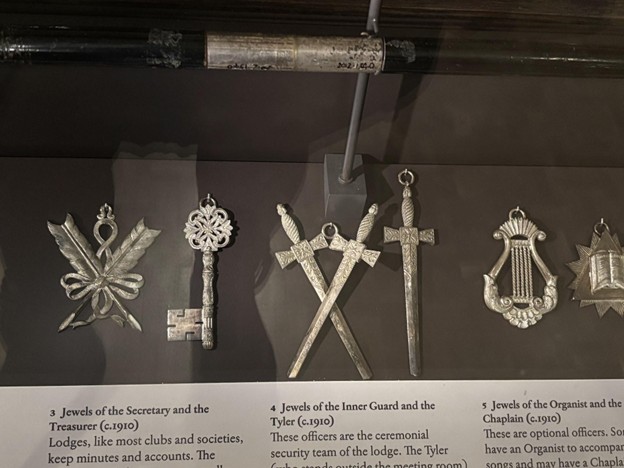
Because Masons claim, allegorically, descent from the builders of Solomon’s Temple, any symbol tied to that legend becomes relevant. The Seal of Solomon represents not religious obedience but completion — the divine seal on human craftsmanship. It fits perfectly into the order’s tapestry of symbols that transform building tools into instruments of the soul.
When Masons talk about Solomon’s Temple, they’re not invoking Torah law or Halacha; they’re invoking architecture as moral metaphor. In the Old Testament, the Temple was the meeting place of divine presence and human craft. For speculative Freemasons, emerging in the seventeenth and eighteenth centuries, it became the perfect symbolic blueprint: every Mason is building his own inner temple of virtue, modeled on the perfection of Solomon’s. Following Solomon means following the architectural and wisdom tradition, not Mosaic Law.
Freemasonry re-casts the biblical narrative as a universal parable, stripped of sectarian commandments. The “Great Architect of the Universe” might be Yahweh, God, Allah, or pure cosmic principle — undefined by design. That’s why Jews, Christians, Muslims, and deists can all meet in one lodge without ideological bloodshed.
The choice of Solomon is deliberate. In early modern Europe, Solomon embodied the ideal of sacred wisdom joined with craftsmanship. He employed Hiram Abiff, the legendary master builder, to construct the Temple — a story that became Freemasonry’s founding myth. When medieval stonemason guilds evolved into speculative lodges, they retained that myth, transforming it into moral allegory. The Seal of Solomon thus symbolized mastery and divine sanction for creation — not obedience to Jewish ritual law. The “descent from Temple builders” is symbolic lineage, much like knights tracing their ethics to the Round Table — not genealogy but philosophy.
Freemasonry’s constitution, first printed in 1723, declared that a Mason must be “of that religion in which all men agree,” meaning belief in a Supreme Being without adherence to any sect. They borrowed freely: Hebrew scripture for symbolism (Solomon, Hiram, the Temple), Christian allegory for virtue and resurrection, Pythagorean geometry for cosmic order, and Enlightenment ethics for humanism. The result is an exquisite syncretism — a stew of languages all pointing toward a single truth: build your character as you would build a cathedral, with precision and care.
While the narrative frame is Hebrew, the content is ecumenical. The pillars Jachin and Boaz might come from Solomon’s Temple, but their meaning — strength and establishment — belongs to everyone. The checkerboard floor recalls moral duality as readily as Eastern yin and yang. The trowel spreading mortar becomes an emblem of brotherly love rather than bricklaying. The apron, once a practical garment, becomes the badge of innocence and moral labor. Everything physical becomes metaphysical.
As I left the museum, I paused before a plaque listing the names of Freemasons who died in the world wars. It was a sober reminder that behind all the ritual, the compass, and the myth, these were ordinary men trying — however imperfectly — to live by a code. In that sense, Freemasonry isn’t so different from the ancient orders, monasteries, or guilds that shaped civilization: a structured way of remembering what virtue feels like in a disordered world.
Outside, the city of London pulsed with taxis and tourists. I glanced back once at the Hall’s Art Deco façade, its lines converging upward like an invisible compass. The myths, the symbols, the suspicions — all of it melted into a single thought: perhaps humanity needs a little secrecy to preserve mystery, and a little ritual to preserve meaning.
Freemasonry has been called many things — a club for elites, a cult for the credulous, a moral school for men. But walking through its museum, I saw something simpler: a centuries-old experiment in how to keep light alive in a world that forgets to look up.
Visit the museum at: 60 Great Queen Street, London WC2B 5AZ, United Kingdom museumfreemasonry.org.uk
Telephone: (+44) 020 7395 9257
Admission Fee: Free entry to the museum. ugle.org.uk+1
Opening Hours: Tuesday to Saturday, 10:00am – 5:00pm
Photo Credit: Elise Krentzel