

Texas doesn’t always let its artists leave cleanly. Even when they go, the imprint stays.
That imprint—equal parts ambition, polish, competition, and tradition—travels with Emma Wallace, an actress from Austin, and Sara Wojta, a producer from Houston, both now living and working in the UK. Their friendship, formed not at home but abroad, underpins a new production of The Last Five Years, the intimate two-person musical by Jason Robert Brown, running January 22–25 at Porter’s Theatre.
For Sun News Austin, this is not a review. It’s a reported portrait of what happens when Texas-trained artists step outside the Texas theatre container—and discover a fundamental difference in relationship to interpretation, intimacy, and creative authority.
Both moved to the UK at 18 and have now lived there for roughly five years. Wojta studied at the Royal Welsh College of Music & Drama and is based in Cardiff, Wales. Wallace trained in Liverpool and is now based in London.
They met at an after-party for The Tempest in London. That distinction matters. Their friendship is not a continuation of a Texas past; it is a relationship forged through displacement, early independence, and the shared experience of building a creative life far from home.
“Having that shared experience of moving so young really helped us connect,” Wojta said. “When you don’t have that physical support system, you grow up fast. You’re paving your own way.”
Wallace echoed that sentiment. Leaving home at 18, she said, “forces you to become an adult very quickly.” What might have felt optional in Texas—self-reliance, clarity, boundaries—becomes essential abroad.
Both women speak with affection about Texas’s abundance of theatre opportunities. Wojta described growing up surrounded by musical theatre outlets and performance competitions, environments rich in talent and momentum. “You were constantly being inspired by people your age,” she said. “But it was also very competitive.”
That competition sharpened ambition early, but it also created a subtle pressure to conform. As Wojta described it, young performers are often navigating three competing forces at once: their own interpretation, a director’s expectations, and what they believe the audience wants to see.
“In Texas, especially in high school theatre, it can get really intense and personal,” she said. “And it doesn’t need to be.” Wallace described a similar dynamic from the performer’s side. Texas audiences, she said, often want a recognizable version of what they already know. “People like tradition in Texas,” she observed. “They want to know exactly what they’re getting.”
That preference can slide into replication rather than interpretation. Wojta put it bluntly: “How can we take the show that’s already been on Broadway and recreate the exact same production?”
For both women, that mindset—however well-intentioned—can crowd out experimentation. A script becomes something to reproduce, not interrogate. Emotional truth risks being overridden by presentation.
The shift they describe in the UK is not about superiority; it’s about emphasis. In UK training and practice, both women encountered a greater focus on internal truth and audience trust. “It’s less about showing the audience what an emotion looks like,” Wallace said, “and more about how it actually feels.”
That distinction becomes critical in The Last Five Years, a musical that offers nowhere to hide. With no intermission, minimal staging, and only two performers, the work depends on emotional precision rather than spectacle.
“There’s a lot more stillness allowed here,” Wallace said. “Sometimes just speaking the words is enough—if you mean what you’re saying.”
She gave a concrete example: a wedding scene staged without a wedding dress. “They don’t need to see it,” she said. “If they see me feel it, that’s enough.”
For American artists trained in large spaces and commercial aesthetics, that restraint can feel radical. For UK audiences, it’s familiar. As Wojta noted, many British productions rely on minimal sets or nothing, trusting the audience to imagine rather than holding their hand. Economics also plays a role. Lower production costs and ticket prices allow producers to take risks. In high-cost U.S. markets, audiences often demand the safest, most recognizable version of a show. “It becomes about bang for your buck,” Wojta said. “Here, you can afford to reimagine.”
Wallace’s connection to The Last Five Years is deeply personal. She plays Cathy, a struggling actress whose career stalls as her partner’s accelerates. The tension at the heart of the musical is not simply romantic—it’s existential.
“She’s juggling between putting her career first or putting her relationship first,” Wallace said. “And as a woman in this industry, there are hoops you have to jump through that men don’t.”
Her comments landed with particular force because they are not new. As someone who fought the same battle four decades ago in the music industry, I found it painful to hear the same structural bind articulated by a woman in her early twenties.
What Wallace described is the emotional cost of being asked—implicitly or explicitly—to choose. “If I’m in a relationship in a country I’m not from,” she said, “do I uproot my whole life? Do I ask someone else to?”
Wojta pointed out the asymmetry embedded in the musical itself. Jamie, the male counterpart, is not forced into the same dilemma. “He actively makes a point to have both,” she said. The structure of the show—withholding parts of his story until later—mirrors how audiences, and societies, often default to believing men first.
At one point in the conversation, Wallace referred to Cathy as “messy.” I pushed back—not to sanitize the character, but to clarify the stakes.
“Messy” is defensive language. “Human” is accurate.
Wallace immediately agreed. “Men don’t say it’s messy,” she said. “Human is the right word.” That exchange crystallizes the ethos behind both the production and the partnership: a refusal to apologize for complexity, emotion, or female sovereignty.
Wojta reinforced that perspective from the producer’s side. Her team, she noted, is predominantly female by design. Producing, for her, is not just logistics—it’s a way to choose which stories move forward and how women are allowed to occupy space within them.
Wojta’s and Wallace’s paths reflect a broader difference between Texas and UK training cultures. In the UK, artists are actively taught how to produce, direct, act, and develop their own work. “It was implemented in our curriculum,” Wojta explained. Producing is not framed as failure or fallback, but as agency.
In Texas, she felt more boxed in. Stepping outside a predefined lane—actor, singer, dancer—can be misread as defeat. “Producing because you’re not acting,” she said, summarizing the assumption. “But human beings have lots of different interests.”
That flexibility is something she wants to normalize. “If there’s no space for you,” she said, “you have to create it. If doors keep slamming in your face—build a door.”
It’s an ethos that feels both radically pragmatic and deeply Texan. The difference is where it’s being exercised.
What makes this story more than a résumé comparison is the friendship itself.
Wallace and Wojta are not merely collaborators; they are mirrors for one another’s experience—two female Texans navigating a different cultural grammar together. Their bond is not nostalgic but forward-facing, built on shared risk and mutual respect.
Geographically, their lives form a clear line: Austin and Houston → London and Cardiff. Two hours apart in Texas; two hours apart again in the UK. That symmetry underscores how much has changed—and how much hasn’t.
Texas gave them drive, polish, and resilience. The UK gave them permission to slow down, strip away excess, and trust emotional truth. Austin prides itself on being an exception within Texas—a city of experimentation and creative risk. In some ways, it is. But the broader theatre ecosystem still exerts pressure toward tradition, replication, and scale.
What Wallace and Wojta’s story illustrates is evolution. When artists leave, they don’t discard their origins. They test them. And sometimes, what comes back isn’t a review, or a transfer, or a headline production. It’s a lesson about what theatre can be when it stops asking performers to prove and starts allowing them to become.
That lesson—learned across an ocean, sustained by friendship—is what ultimately connects Austin and Houston to London and Cardiff. Not geography alone, but agency.
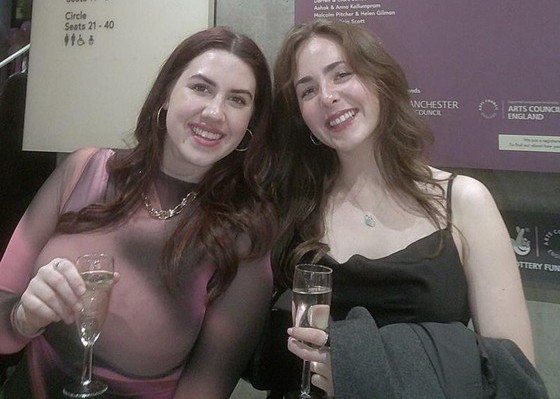
second photo: L: Sara Wotja R: Emma Wallace