
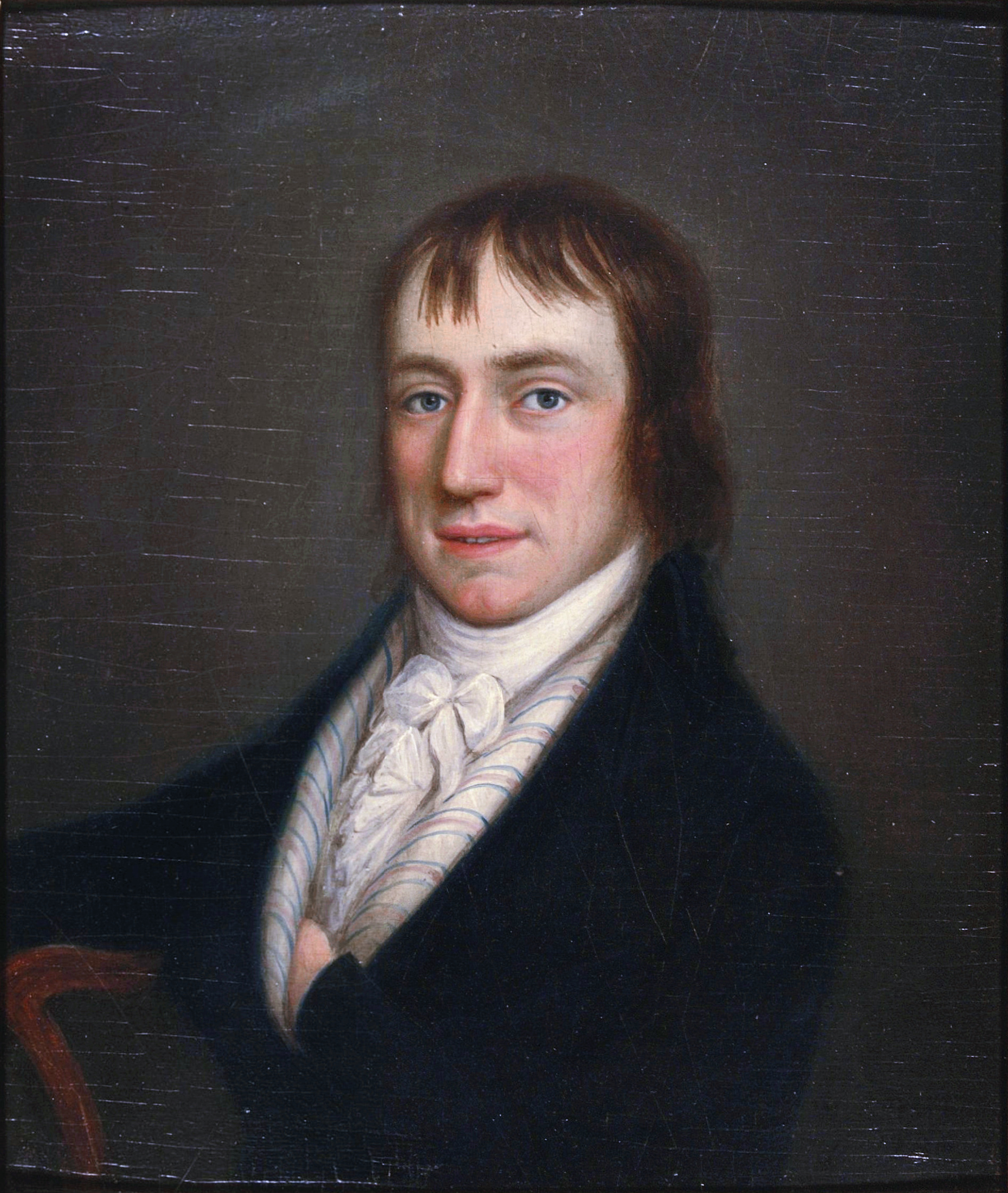
Wordsworth is pictured here around the year 1800.
Under review here is the first in a series of 10 books, examining (mostly English) literature decade by decade from 1800-1900. This volume covers 1800-1810. Most other volumes have been published, but the 1820s and 1840s are still under development. The series began in 2019.
This book consists of 14 chapters, which cover of broad range of thoughts and concepts across a decade which has been widely regarded as a “transitory wasteland” between the first generation of Romantic poets (Wordsworth, Coleridge and Blake) of the 1790s, and the second generation (Byron, Shelley, Keats) of the 1810s [more on this below]. There are 4 divisions in the book, but in this review, I have created my own subheadings (two of them extracted from the book) to explore select themes across the chapters.
I take my headline from a letter written by England’s Poet Laureate, Robert Southey. In a letter to a certain lady in 1824, he wrote thus about the French Revolution: “Old things seemed passing away, and nothing was dreamed of but the regeneration of the human race.” As one can see from this quote, the book’s authors do not strictly limit themselves to the ostensible timeframe of 1800-1810. This quote from the 1820s describes a revolution that happened from 1789-1799, but the concept of regeneration is very apropos to the first decade of the 19th century. Regeneration is what this book is all about.
The Dropping of an Acorn
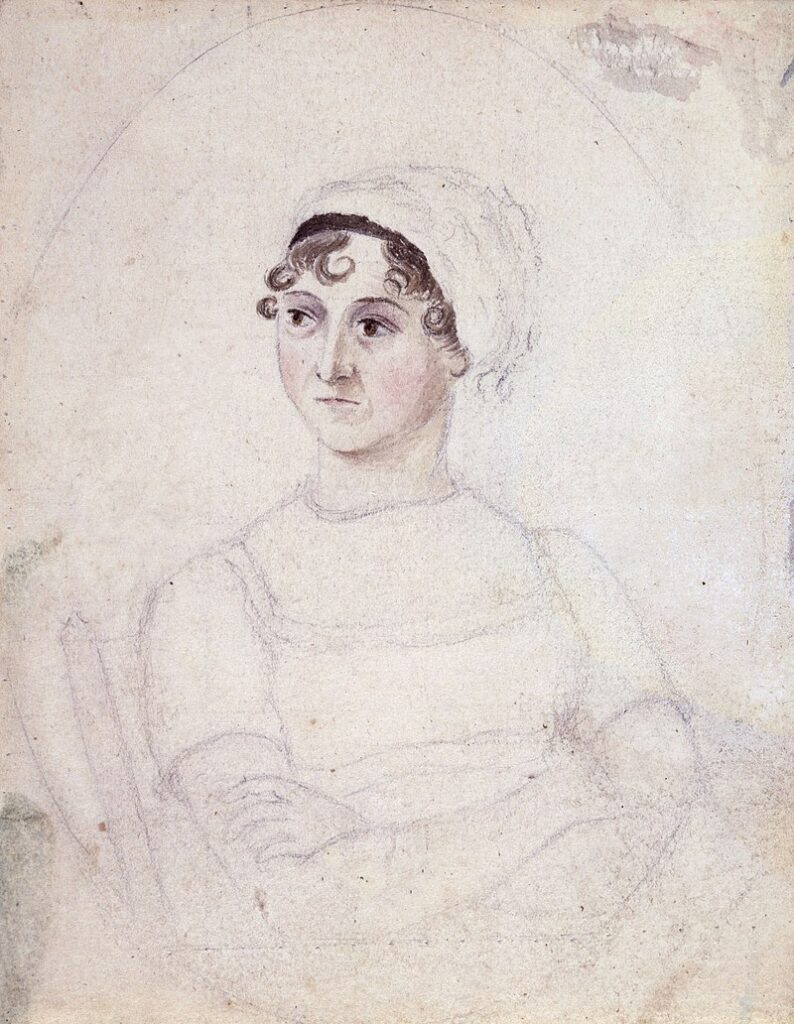
Like a squirrel dropping an acorn in a hole, Jane Austen (shown here as she appeared in 1810) squirreled away three manuscripts in her writing desk in this decade. Yes, even she could not get three novels published as her career began! We learn this in Chapter 10, by Deidre Shauna Lynch (Prof. of English Literature, Harvard). Lynch describes Austen’s inability to get published as a “disquieting fact,” which will surely be regarded as an understatement by Janeites. These acolytes of Austen are aware of the fate of these manuscripts, but Lynch leaves the rest of us wondering what these novels were. In any case, Lynch does draw an important conclusion: “These texts highlight the role contingency plays in literary history.” The novels she is compelled to consider as defining this decade – since Austen was not a force yet – reinforces the view they “undermine the periodization ‘from Richardson to Austen’ that frames so many histories of fiction.”
This unfortunate state of affairs shaped the view of this period in the entire twentieth century in terms of marital relations. Overturning it leads Lynch to a critical insight that is the central tenet of this book under review: Scholarship in this century has “retreated from that Enlightenment optimism, as from the proposition that history has a direction. The emphasis that this volume places on the short run as well as the long term in literary history requires us to tolerate an aesthetic mess. We might value the narrative experiments that centre this essay in that spirit: precisely because to engage them inserts a hiatus (or reprieve?) in literary historian’s usual narratives about courtship and English novels.”
She is adamant that “scholars should dispense with developmental narratives and accommodate instead time’s discontinuities and its unexpected disturbances, whirls and eddies.” Put concisely, Lynch ordains that “in this decade accounts of intimate life resisted marriage.” Fans of Bridgerton (which functioned as a non-stop marriage market, set largely in the decade following the period under study here) may to shocked to learn this!
Even though I have begun my subheading with Lynch’s Chapter 10, it actually derives from Elizabeth Weybright’s Chapter 8, on the topic of acoustic poetics.
In a study of William Wordsworth’s iconic poem The Prelude, Weybright (Barnard College) states that one finds sound “everywhere, often in emphatically mundane moments, like the occasional dropping of an acorn ‘with startling sound’ interrupting the speaker’s state of blank calmness of mind.” She goes on to write “Wordsworth’s inclusion of the disruptive acorn shower in the poem exemplifies how the most consequential sounds are often those most faithful to the auditor’s experience.” She divines that it is emblematic of Wordsworth’s belief that what is knowable is largely introspective. “The interruptive sounds of the dropping acorns” shows that “the perfect accord between an interior frame of mind and external circumstances is precarious.” Weybright brings in Samuel Taylor Coleridge here to nail the point home. “Like Coleridge’s ticking watch, the acorn suggests that even tiny sounds can either amplify an interior frame of mind or startle it, troubling and directing the course of thought.” Just as Lynch warned about “unexpected disturbances, whirls and eddies,” Wordsworth’s acorn and Coleridge’s watch can sonically expose ‘time’s discontinuities.’ And it is there that this book makes major advances in our understanding of literature from 1800-1810.
The Language Really Used by Men
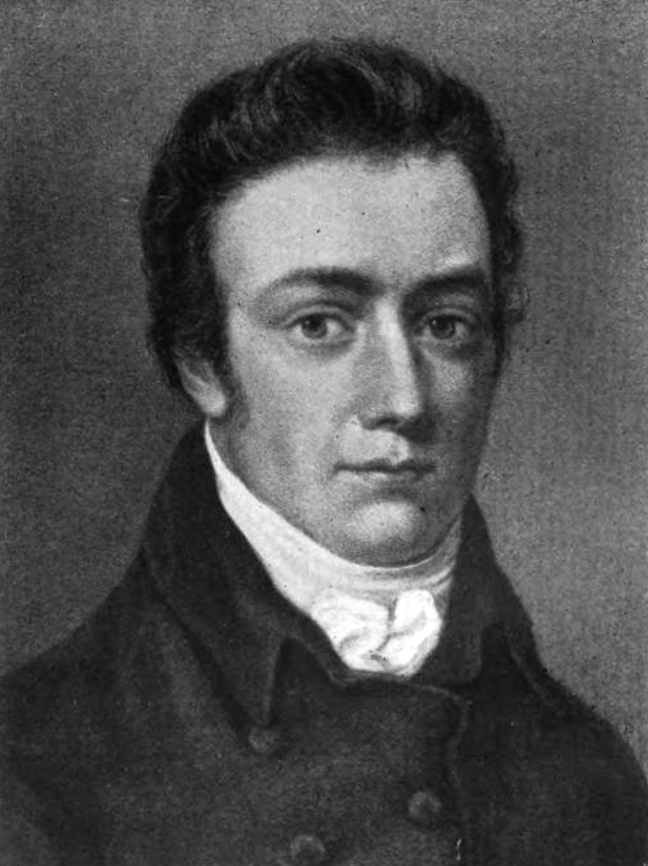
Wordsworth and Coleridge (pictured here) are the subject of a deeply fascinating chapter by Omar F. Miranda (Associate Professor English, Univ. of San Francisco). He studies the Lyrical Ballads “that were composed at the opposite ends of the first decade of the nineteenth century.” At the beginning (actually 1798) we find Coleridge’s The Rime of the Ancient Mariner, while at the other end is The White Doe of Rylstone by Wordsworth. Both men “considered it to be the final lyrical ballad (begun and completed in 1807 but not published until 1815.)” The Lyrical Ballads were “poetic experiments that he began collaboratively with his friend and fellow poet Coleridge.” Miranda writes that “as experiments in both form and genre these ballads resist confinement to any singular literary lineage by reimagining romance, elegy, legend, lyric, balladry, and hymnody. Their striking convergence suggests a broader literary project of generic innovation and hybridity.”
Trying to summarise Miranda’s deep study in a book review is a fool’s errand, but there is a hidden nugget in footnote 24 that will give the reader here a valuable insight. Wordsworth wrote that, for him, the collection’s poetic experiments exhibited the “language really used by men.” Miranda tells us that The Rime, being the first published, exemplifies this aim of creating “simple and unelaborated expression,” to quote from Wordsworth’s Preface to Lyrical Ballads.
Not everyone was pleased with Wordsworth’s reliance on the language really used by men (meaning the common man). Author Matthew Sangster (Professor of Romantic Studies, Univ. of Glasgow) talks of the fierce critic Francis Jeffrey, who wrote in the equally fearsome Edinburgh Review (founded in 1802). “While Wordsworth argued for the uncommon wisdom of common experience, Jeffrey was deeply uncomfortable with the politics of this position. Consequently, his own vision of poetry pushed back against both Wordsworth’s subjects and his claims for their superiority.” The Edinburgh Review gave bad notices of the poetry of both Wordsworth and Byron!
That Deep Romantic Chasm
Published in 1807 was Wordsworth’s poem Resolution and Independence, a work infused with geological knowledge. “Poetry and geology underscore mutually influential changes in the understanding of time in our decade,” writes Jonathan Sachs (Professor of English, Concordia Univ.).
You will recall the “transitory wasteland” quote I offered at the opening. This comes from Sachs, who was writing about the (former) scholarly view of the 1800s. Due to scholarship in this century, “Romanticism and the Romantic period have begun to look considerably more diverse. Far from being a wasteland, it is a potentially rich decade.”
Sachs sets out on a grand and perilous adventure in this chapter. “I wish to understand Romanticism as a response to a set of temporal problems that arise when the sense of accelerated daily life collide with new senses of slow and deep time produced by developments in geology and the earth sciences.”
Unlikely as it sounds, Sachs has in the process ‘unearthed’ (pardon the pun) much of merit. It was in this decade (1807) that the Geological Society of London was founded. What, you might ask, does that have to do with Romanticism? Consider the first lines of Resolution and Independence:
As a huge stone is sometimes seen to lie
Couch’d on the bald top of an eminence;
Wonder to all who so the same espy
By what means it could thither come, and whence;
So that it seems a thing endued with sense.
Wow! Sit back and ponder that for a moment: a huge stone in a peculiar place, imbued with sense. “This ‘huge stone’ alludes,” writes Sachs, “to the geological formation known as an ‘erratic block,’ and this underscores how geological concepts contribute to the poem’s figural field.” Here we see the slow, invisible change of geology at work (Sachs does not explain that erratic blocks were deposited on the landscape (often on peaks) when the glaciers of the great Ice Age receded, before recorded human time).
“This sense of slowness, and the way that it helps us to recognize a barely concealed eventfulness in the seeming absence of change, is central to Wordsworth’s ambitions for his poetics…For Wordsworth, problems of slow change translate into questions of attention and attentiveness, which are ultimately questions about the increasing speed of communications and reading.” While we think of the early 1800s as a ‘slow’ era (reliant on horses; no trains, no telegraph, no steamships), sensitive people of the time perceived things quite differently. Sachs writes that “A particular kind of slowness offers lessons and moral values that Wordsworth insists have never been more necessary than in his accelerated present.”
Brilliant though his analysis is, I was disappointed that he did not include mention of the greatest scientific discovery of the decade: the discovery of the asteroids. Four of them were found between 1801 and 1807, and being big rocky objects, they certainly merit at least a mention in a chapter on geology. Their discovery changed solar system maps, books on the solar system had to be re-written to include their existence, astronomy as taught in schools was altered, and of course poetry flourished to celebrate their existence. They are not mentioned in this otherwise exceptional book.
I quote here again from Weybright’s chapter. “Coleridge is known to have been interested in trends in scientific and medical affairs.” She mentions another scholar, who frames Coleridge’s sustained belief in science as one “key to understanding the progress of thought…given the congruence of mind and nature.” While Sachs is concerned with geologic slowness in his chapter, he omits this congruence of mind and nature: he says nothing about the extraordinary line in Wordsworth’s poem about the rock being imbued with sense. And what does the contrast between Wordsworth’s approach to slowness, and his friend Coleridge’s description of a violent geologic event (massive stones thrown into the air) in his 1797 poem Kubla Khan, tell us about their respective approach to nature, science and temporality (“at once and ever”)?:
Amid whose swift half-intermitted burst
Huge fragments vaulted like rebounding hail,
Or chaffy grain beneath the thresher’s flail:
And ‘mid these dancing rocks at once and ever
It flung up momently the sacred river.
Just before these lines, Coleridge tantalizingly wrote about a “deep romantic chasm.” As an exponent of Romantic poetry, this almost seems too good to be true. But my point here is that none of this engagement with geology is mentioned by Sachs. Even worse, I find it astonishing that Kubla Khan is only mentioned en passant in the entire book. In the entirety of Romantic poetry, its first two lines are among the very few that anyone except a professor remembers:
In Xanadu did Kubla Khan
A stately pleasure-dome decree
While it is true the poem was not published until 1817, it was written in this first decade. I had a quick look into the next volume, on the 1810s, and it does not seem to appear there at all. Weybright goes into some detail on “Coleridge’s aural poetics,” but Kubla Khan is not mentioned despite its line evoking “symphony and song.” Even though she does not use the word sussuration (one of the few English words that sounds the way it means) in her exploration of murmurs and aural realism in Coleridge’s poems, her invocation of the aeolian harp as a “Romantic metaphor for poetic creativity” is a fundamental one.
Despite some unfortunate lacunae, this is a most valuable book on early nineteenth literature. If studied as it should be, this will establish new trajectories for future research in the ever-surprising Romantic period.
Unusually for an edited book, it appears Cambridge has decided that the editor of each book will write only an Introduction, not a chapter as well. The editor here is Andrew Stauffer, Professor of English at the Univ. of Virginia. His most recent book is Byron: A Life in Ten Letters (by Cambridge in 2024).
There is a typo on pg. 123: “refuse the the”
Nineteenth-Century LITERATURE in Transition: The 1800s. Cambridge University Press, 2026. List price $130.
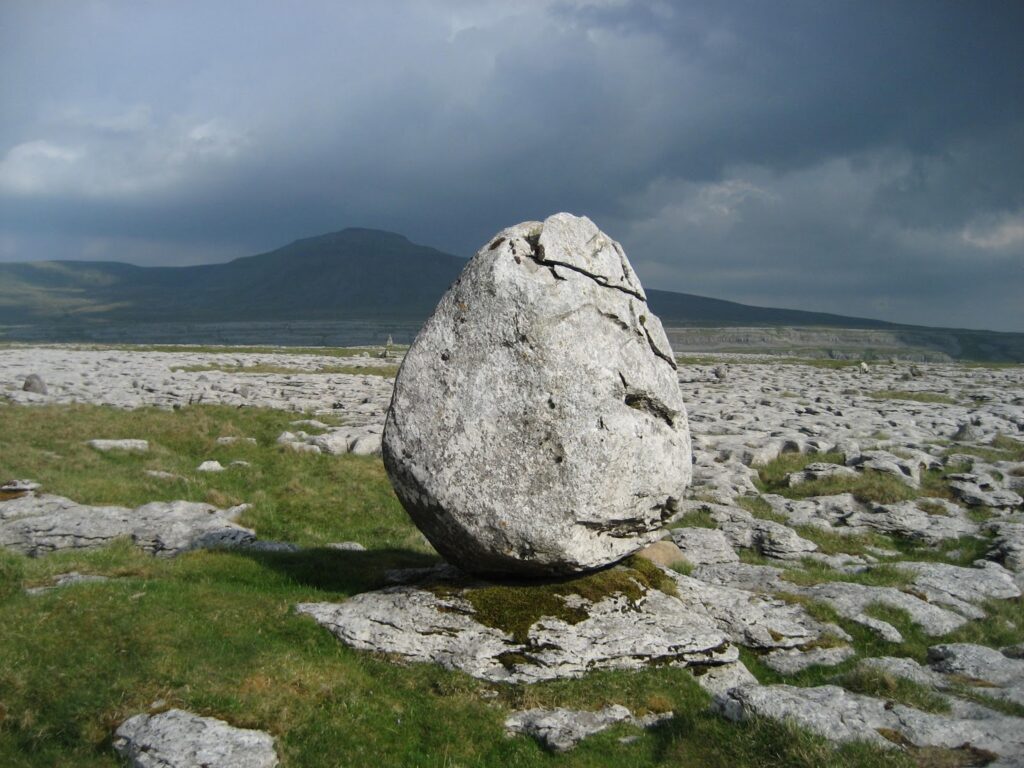
AN ENGLISH ERRATIC: The famous ‘Obelisk’ on Scales Moor – where limestone rests on limestone. Scales Moor is a broad limestone plateau located in the Yorkshire Dales National Park, North Yorkshire. Grasmere, where Wordsworth lived, is just 37 miles away. Photo by Stephen Oldfield