
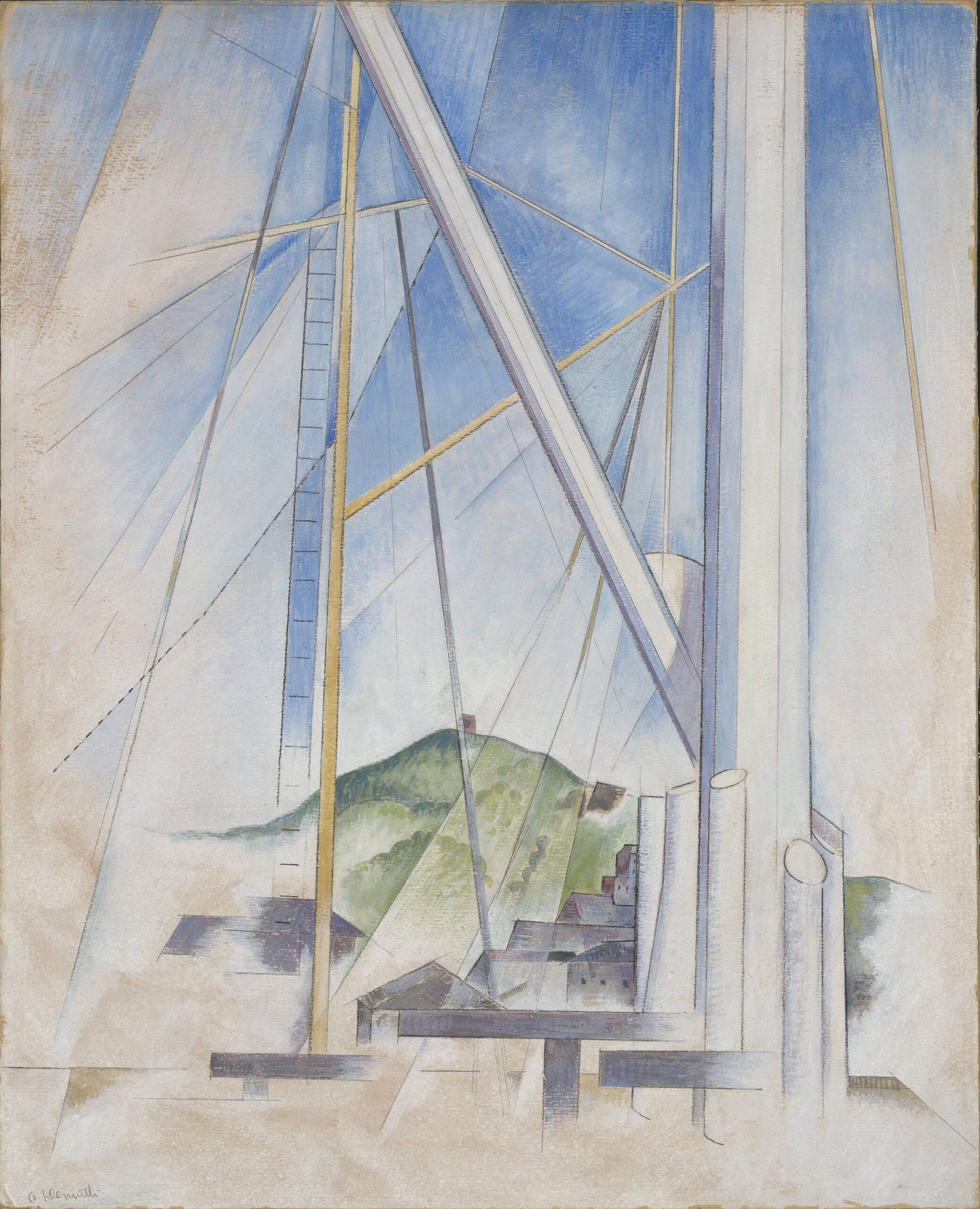
A superlative private collection of American paintings is currently on show at the Museum of Fine Arts, Houston.
The collection of philanthropist and Texas native Charles Butt, more than 90 works are on display in a series of large rooms. For any fan of American Modernism, it is both breathtaking and jealous-inducing. While very few can amass a world-class collection, it’s nice to know someone can! These paintings are being shown to the public for the first time.
The museum has organised the works into five thematic sections to reflect the ever-evolving adventure of American Modernism from the late 19th century to the 1980s:
- Intimate Perspectives | Works by Marsden Hartley, Edward Hopper, and Georgia O’Keeffe highlight the vitality of human connections.
- The Language of the Sea | A fundamental motif in the history of American art, images of the sea also reference Butt’s childhood near the Gulf of Mexico in Corpus Christi.
- The American Scene | Artists like Charles Burchfield and Arthur Dove subverted landscape conventions to chart journeys that were more personal.
- Painting in the Machine Age | The urban and rural post-industrial scenes of Jacob Lawrence, Jackson Pollock, and Charles Sheeler pair with trailblazing geometric abstractions by Blanche Lazzell and Alice Trumbull Mason.
- New Directions | Reconsidering what it means to be an American artist, the exhibition closes with work from Jasper Johns, Ellsworth Kelly, Mark Rothko, and Alma Thomas.
It must be noted that this 5-part division is not reflected in the printed catalogue. The catalogue consists of 2 essays, and then plates from pages 52-159. An interview with Charles Butt concludes the book. “The twenty-first century is proving to be a stressful time,” says Butt. “Perhaps art can play a small part in lifting the mood. It would be wonderful if the arts could bring us together.”
In such a disparate collection, a full study of it here is quite impossible. Therefore, I have selected three examples to delve more deeply into.
The opening essays in the catalogue are ‘America as Landscape’ by art historian Erika Doss, and ‘A Precedent for Modern Art’ by Shirley Reece-Hughes, curator of the exhibit. “America’s vast and diverse landscapes,” Doss writes, “was endorsed as an exceptionally potent subject for American moderns of all styles and interests.” One of these strands of expression is known as ‘Precisionist landscape.’ The photo I have chosen for the lead comes from this school: In the Key of Blue was done around 1919 by the homosexual artist Charles Demuth (1883-1935). It was painted in Gloucester, Massachusetts, and “depicts a landscape of buildings, trees, and hills viewed through the triangulated framework of a tall ship’s rigging. The painting’s azure sky is filtered through a scrim of billowy white sails comparable to the theatre backdrops that Demuth painted when he worked for the Provincetown Players in the mid-1910s.”
While it is not obvious when one gazes at the painting, there is an important layer of meaning, starting with the title of the work. It was “taken from an 1893 essay on aesthetics by the British author John Addington Symonds, whose prose and poetry also featured overt homosexual content. Avant-garde in both form and content, Demuth’s landscape In the Key of Blue conveys his distinctive style of early American modernism and alludes to his sexual identity and desires.”
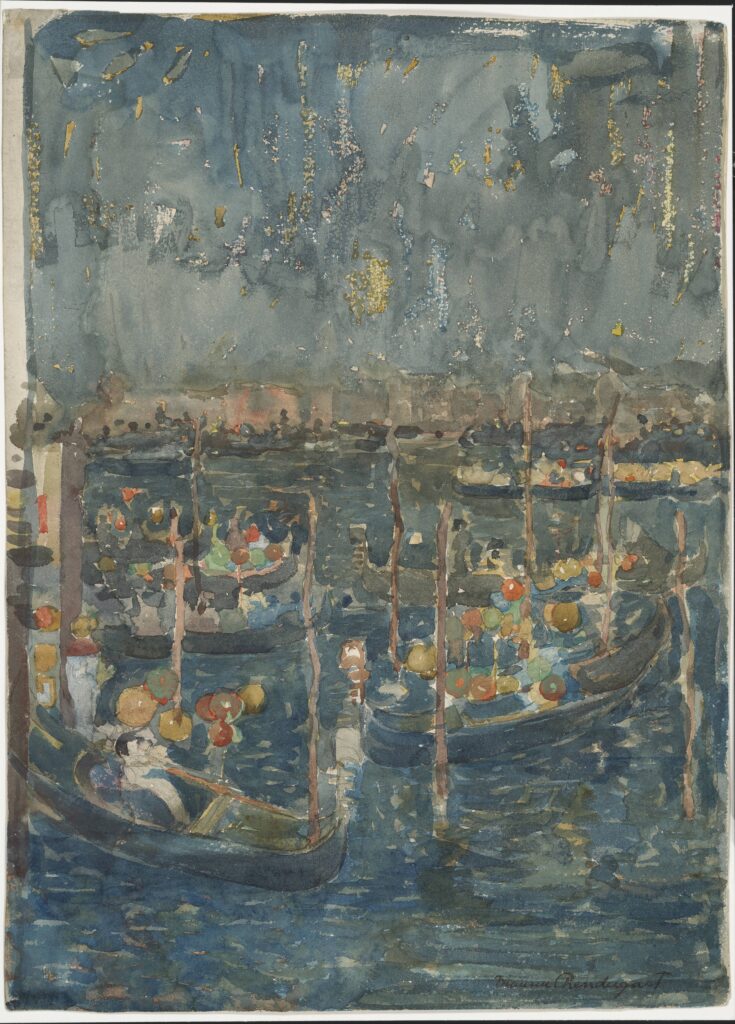
By contrast with the extensive analysis of Demuth, the work of Maurice Brazil Prendergast (1858-1924) is merely reproduced. Nothing whatever is said about it, or the artist, in the catalogue. This is most unfortunate. An entire book was written about him 1990, which stated his Venetian watercolours (including Festival, which I show here) are among his most appreciated works in the 21st century. Festival was painted during his 1898-1900 visit to Venice. He is known to have painted other watercolors that capture the Festa del Redentore (Feast of the Most Holy Redeemer), a massive religious and civic festival celebrated annually on the third Sunday of July in Venice. This is almost certainly one of works inspired by that festival, whose climax is a world-famous fireworks display. Nearly the entire upper register of the watercolour on view is dominated by fireworks to mimic the flash of the fireworks reflecting off the dark lagoon and the face of the onlooker below in a decorated boat in the foreground.
While Demuth and Prendergast are hardly household names, Jackson Pollock is. His work shown here, Camp with Oil Rig, is from the early years of the Depression. And It was also selected here for its connexion to Texas!
As Doss explains, Thomas Hart Benton was an “artist adventurer,” born in Missouri. “We Americans are restless,” wrote Benton. “We cannot stay put.” One of his artistic forays was to Texas, and the result was a major contribution to the “Machine Age” category.
“Acknowledging the promises of the Machine Age,” states Doss, “Benton challenged its dehumanising effects. Jackson Pollock, who took Benton’s classes while studying at the Art Students League in the early 1930s, modelled for some of America Today’s scenes (a series of works Benton created).
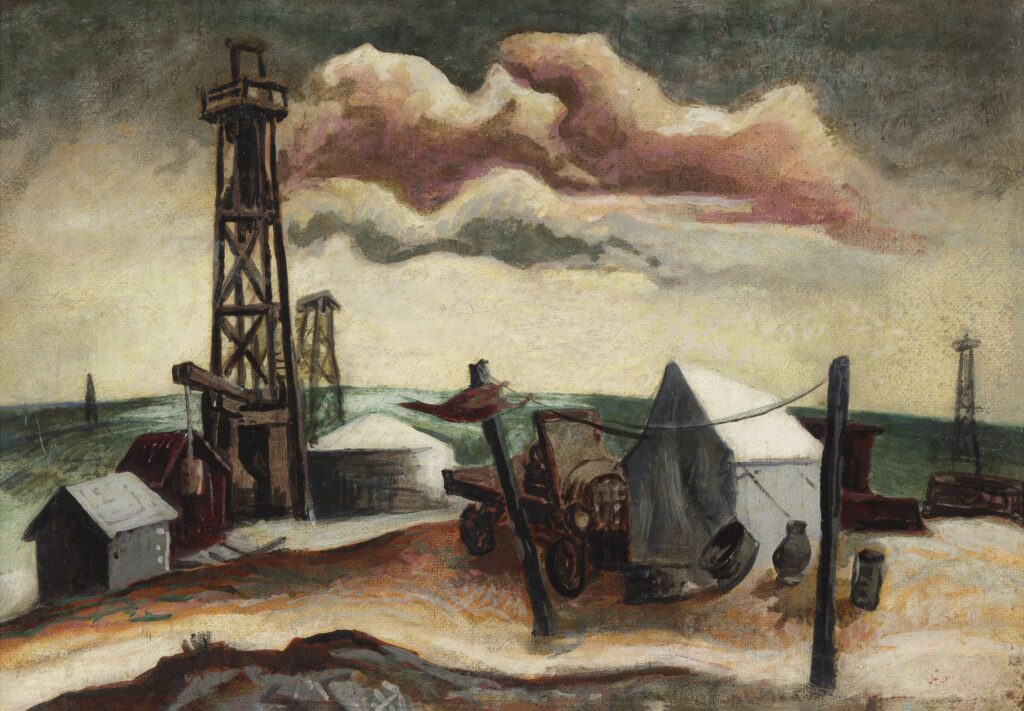
“Pollock’s landscape Camp with Oil Rig was based on Benton’s sketches and paintings of Borger, Texas (45 miles NE of Amarillo), where the town’s population soared from zero to 45,000 after the discovery of ‘black gold’ in 1926.” The helter-skelter nature of the vision we see, with structures at dangerous angles and an ominous red cloud overhead, exemplifies the rough-and-tumble nature of the makeshift oil rigs in Texas of the 1930s.
A tremendously rich exhibit, I highly recommend viewing American Modernism; and by all means see it the same day as the Winslow Homer exhibit. The very first work you will encounter in the Modernism exhibit is another Homer watercolour, which nicely complements the ones you will see in his major exhibit (also reviewed in SunNewsAustin.com)
IMAGES:
Maurice Brazil Prendergast, Festival, Venice, c. 1899. Watercolour and pencil on paper.
Charles Demuth, In the Key of Blue, c. 1919. Tempura and pencil on board.
Jackson Pollock, Camp with Oil Rig, c. 1930–33. Oil on board.
AMERICAN MODERNISM is on view thru Jan. 18, 2027
https://www.mfah.org/art/exhibitions/american-modernism-from-the-charles-butt-collection
Winslow Homer in Houston: