
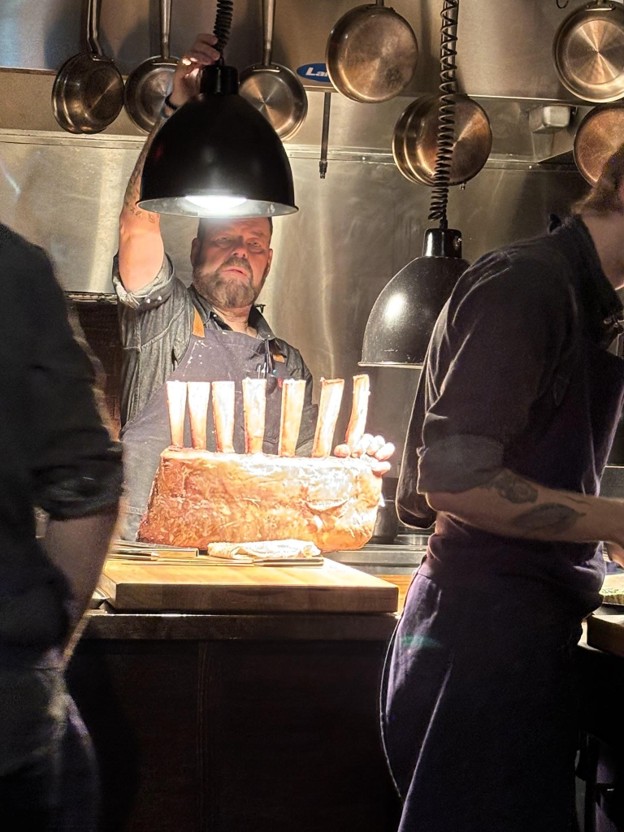
At Big Slick in East Austin, chefs Phillip Frankland Lee and Margarita Kallas-Lee bring together the traditions of the steakhouse, the theatre of live-fire cooking, and an unexpected choice of beef purveyor. The result is a dining experience that is as much about atmosphere and conversation as it is about the steak.
Lead Photo by EK: I call this the Menorah Steak
There is a particular pleasure in discovering a restaurant that understands the importance of atmosphere before the first plate arrives. Big Slick, the latest venture from chefs and husband-and-wife team Phillip Frankland Lee and Margarita Kallas-Lee, is a gorgeous interpretation of Texas luxury. It has the rustic charm one expects in this part of the world, but the materials, natural woods and carefully considered details give the room a refinement that never feels stiff or overworked. It is earthy and elegant at the same time. I happen to love that combination.
Finding the restaurant is part of the experience. On East Sixth Street, the entrance is discreet, almost secretive. You ring the bell and are welcomed into a candlelit bar. Beyond the curtains, the dining room reveals itself around a wood-burning hearth. The transition creates a sense of arrival, a small departure from the street outside and an invitation into another world. There is warmth in the light, texture in the materials and a sense that the room has been designed around the pleasure of gathering.
The hearth is the natural center of attention, but it also shapes the way people sit together. The intimate seating around it brings diners into close proximity, creating opportunities for conversation with neighboring guests who are open to it. I found this particularly appealing. Restaurants can sometimes make sociability feel like an obligation, or leave everyone enclosed in their own private space. Here, the arrangement allows something in between. You can enjoy your own company and your own meal, but there is also the possibility of exchanging a comment with the people beside you, sharing a discovery or simply acknowledging that you are all part of the same evening. It gives the experience a convivial quality that feels refreshingly human.
Big Slick is not trying to be a casual neighborhood steakhouse. There is theatre here, but it is connected to the craft of dining: the hearth, the preparation, the service and the pleasure of watching a meal unfold. The menu is à la carte, allowing diners to create their own progression rather than submit to a fixed tasting menu. That freedom is welcome, particularly when the kitchen offers so many different ways to explore its approach to ingredients.
The most provocative decision, however, is the beef. In Texas, steak is more than a meal. It is part of the state’s cultural identity, a source of pride and, occasionally, a subject of fierce regional loyalty. A survey conducted by Beef Loving Texans with the Texas Department of Agriculture found that Texans considered steak more iconic than the state’s official dish, chili. Against that background, Big Slick’s decision to source all its beef from Lobel’s of New York is an interesting departure from expectation.
Lobel’s is a Manhattan butcher with a history stretching back more than six generations. The family has built its reputation on selecting exceptional meat and applying the patience and expertise of traditional butchery. The choice does not mean that the beef itself necessarily comes from New York. Lobel’s sources its USDA Prime beef from carefully selected cattle raised in the American Midwest, while its American Wagyu comes from Texas ranches. What matters here is the relationship between the restaurant and a specialist purveyor whose standards and selection are central to the final result.
It is an intriguing proposition for an Austin steakhouse. Rather than rely on the familiar shorthand of Texas beef, Big Slick makes its case through selection, aging and preparation. The restaurant dry-ages its beef in-house, then cooks it over the live-fire hearth. The question becomes less about where the steak comes from and more about what the kitchen does with it.
I ordered the Big Slick, the restaurant’s 40-ounce tomahawk, while my dining companion chose the Texas T-bone for two. The tomahawk was a substantial centerpiece. What impressed me more than size was the character of the meat. There was a subtle smokiness, although not the conventional, assertive taste of smoke. The marbling gave it a buttery richness, and the texture was extraordinary. Each slice seemed almost to form itself around the tongue, as though the meat had a shape and softness that invited you to follow it. I described it to myself as something like a cloud, or a form-fitted pillow. That may sound fanciful for a steak, but the sensation was real. It had a dreamlike quality, while retaining the depth and unmistakable flavor of excellent beef.
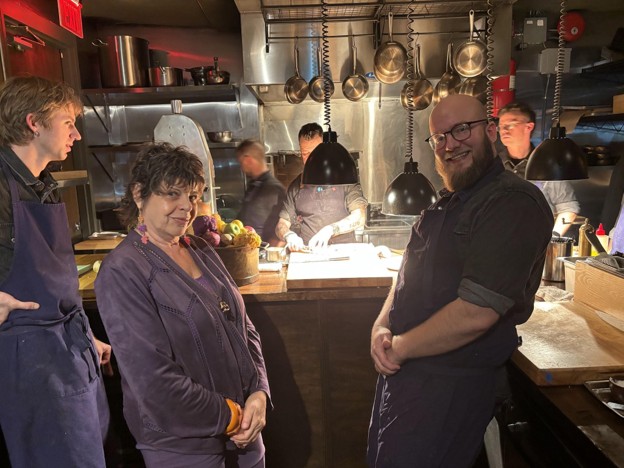
Photo: Me with Chef de Partie “Phill” Reinhart to the right
The international character of Big Slick’s kitchen is also reflected in its team. Phillip “Phill” Reinhart, a Berlin-born chef and music producer, brings a background that extends beyond the restaurant kitchen. Since relocating to Austin, he has worked in several local food operations, including Jeffrey’s. At Big Slick, he works as a Chef de Partie, responsible for a particular section of the kitchen and the precision required to execute its dishes consistently through service. Outside the kitchen, Reinhart has pursued a parallel career in music as a songwriter and producer, working under the name Phill Peedie Reinhart. His dual creative life adds an unexpected dimension to the restaurant’s international mix of talent.
The sophistication was in the balance. The steak did not need elaborate embellishment. Its flavor, texture and the work of the hearth were enough. It was beyond delicious, and unlike other steak I have eaten. The T-bone offered my companion a different cut and experience, but the tomahawk was the one that made the strongest impression on me.
The meal had begun with a sequence of details that revealed how seriously the kitchen takes ingredients that are often treated as routine. The sourdough and butter service, for example, could easily be dismissed as the obligatory opening to a steakhouse dinner. At Big Slick, it has its own story. The bread is made with local wheat from Barton Springs Mill in Dripping Springs. Its sourdough starter was given to Margarita in 2013. It was already 46 years old and had originated in Tuscany. The bread connects a local grain with a living piece of culinary history that has travelled across generations and continents.
They produce the butter in-house with cream from Dripping Springs Dairy. The kitchen separates the buttermilk, which is then used in other preparations, including the sweetbreads. The butter itself is aged for at least two weeks in a dry ager before it is served. The restaurant makes it several times a week, in quantities sufficient to supply the kitchen’s needs. Several pounds are used daily, not simply for the bread service but throughout the restaurant. There is something satisfying about this level of attention. Butter is one of those ingredients whose quality can quietly determine the character of a dish, yet few diners stop to consider how it is made or how much work goes into it.
The theme song for the restaurant could be “In the Tallow” sung to the tune of “In the Shallow”.
The cheese cart carries that same philosophy into another part of the meal. Rather than presenting a generic selection of imported cheeses, Big Slick offers Central Texas producers, including Goatalicious in New Braunfels and L’Atelier Fromager in Waco. I particularly liked the idea of a cheese cart that tells a local story. One of the cheeses, associated with Waco and known as I-35, gives the selection a geographical personality. It is a reminder that the food landscape around Austin is full of producers whose work deserves a place at the table.
Among the dishes we tried, the dry-aged filet mignon tartare stood out for its texture and deeply aromatic flavor. The chef cut the beef into small, distinct cubes rather than working it into a fine, almost uniform mince. The pieces retained their identity. It was a direct, confident expression of the ingredient rather than an attempt to disguise it.
The pan-roasted sweetbreads were another example of technique doing the work. They arrived with caviar and apples, and the exterior had a delicate texture that initially made me think they had been breaded. Phillip later explained the preparation. The sweetbreads are first soaked in buttermilk made from the restaurant’s own butter, then lightly dusted in local flour and cooked à la meuniere in beef tallow and homemade butter, finished with private reserve caviar and local apples. The combination brings together richness, acidity, and a little sweetness, while the cooking produces the lightly crisp exterior I had noticed. It is an elaborate process, but the result does not feel fussy.
What ties these dishes together is a consistent interest in making things in-house, working with regional suppliers and applying classical techniques with a contemporary sensibility. Phillip identified Barton Springs Mill as the source for the restaurant’s flours, Hill Country Creamery for dairy, Capra Farms for lamb and Texas Olive Oil Company among its local suppliers. The kitchen also works with local ingredients such as Austin-grown black pepper and eggs from an Austin-area farm-to-table wholesaler. These are not simply names added to a menu to signal local virtue. They are part of the way the restaurant thinks about food.
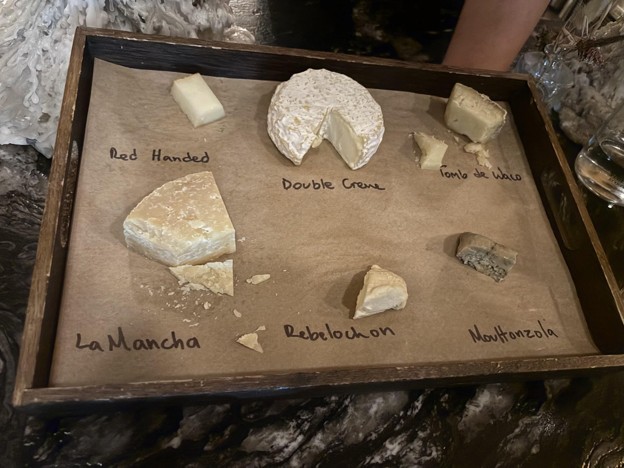
Photo: The I-35 Cheese Plate
That approach reflects the professional partnership behind Big Slick. Phillip’s route into the restaurant business began in Los Angeles, where he worked his way through demanding kitchens after starting as a dishwasher. He opened Scratch|Bar in Beverly Hills in 2013 with Margarita, who had developed her own path through pastry, catering and a deep interest in cooking. They built their first restaurant around the idea of doing things from scratch, an approach that became the defining thread of their wider restaurant group. They went on to develop Gadarene Swine, a vegetable-focused restaurant, and later moved Scratch|Bar to Encino, where the concept continued to evolve.
Margarita is a pastry chef and co-creator of the business, with a culinary sensibility that runs through the restaurants. Her Latvian background and childhood memories of cooking with her grandparents helped shape her relationship with food. Phillip’s experience in ambitious restaurant kitchens and his appetite for creating new concepts found a natural counterpart in her attention to pastry, detail, and the pleasures of making things by hand.
Their move toward Austin came through an unexpected combination of timing, opportunity, and a little serendipity. The couple had already visited the city for a pop-up in 2014 and liked its energy. In December 2020, when pandemic restrictions made operating their Los Angeles restaurants increasingly difficult, they returned with a sushi pop-up. The initial plan was temporary. They needed to keep members of their team working and find a place where they could continue serving diners.
The pop-up was operating in a borrowed space and had attracted attention when an unlikely introduction changed its fortunes. Joe Rogan’s wife heard about the restaurant through her best friend, who had received the couple’s newsletter. She and Rogan came to try the sushi. Rogan was impressed enough to post about it to his enormous social media following, describing it as the best sushi he had ever eaten. The response was immediate. Reservations disappeared, and a waiting list grew dramatically. Phillip later joked that the couple had become overnight successes after eleven years in the business.
The episode helped turn a temporary move into a new home. Austin had offered them an opportunity to keep their team working, but the response to the pop-up showed them that the city could also become a place to build. Their subsequent projects expanded the Scratch Restaurants’ presence here, with concepts spanning sushi, pasta, live-fire cooking and burgers. Their restaurant portfolio now stretches far beyond Texas, but they maintain the fundamental idea that each concept should have its own identity and that they must make the food with intention.
Big Slick is a particularly fitting expression of that philosophy. It takes the familiar idea of the American steakhouse and gives it a more intimate, theatrical setting. It draws on old-world technique without becoming nostalgic, embraces Texas ingredients without making local sourcing a rigid rule, and looks beyond the state for the beef it believes best suits the restaurant. Its use of Lobel’s is not a rejection of Texas. It is a reminder that culinary confidence can include looking elsewhere.
I left thinking about the relationship between the room and the food. The hearth gives the restaurant its physical center; the small seating arrangement creates the possibility of connection among strangers; the handmade butter, aged beef, local cheeses and carefully prepared dishes give the meal its substance. There is a sense of craft throughout, but also a sense of play. Big Slick understands that dining out should be an occasion, not simply the delivery of food to a table.
And perhaps that is the most appealing thing about it. In a state where the steakhouse comes with its own mythology, Big Slick has found a way to respect the tradition while making it its own. The steak may arrive from a legendary New York butcher, but the experience belongs to Austin: its ingredients, its independent spirit, its appetite for something different, and its willingness to make room at the hearth for a conversation with someone you have never met.
- Address. 1017 E. 6th St., Austin, TX 78702 (next to their sister spots, NADC Burger and Shokunin). Ring the bell to be admitted. The door is black.
- Hours. Open Wednesday through Sunday. The lounge opens at 5:00 p.m. (staying open until midnight Wed–Thu and 1:00 a.m. Fri–Sun), while kitchen service runs from 5:30 p.m. to 10:00 p.m.
- Getting In. Dining room reservations release 60 days in advance via Big Slick’s website and fill up quickly. If you can’t snag a table, the front lounge welcomes walk-ins where you can order from the full dinner menu.