
What happens when technology advances to where people consider being human a disadvantage? Is this where we’re at now in 2026? I often ponder that as I’ve witnessed the dumbing down of Western civilizations since I was a child in the 1960s.
When emotions interfere with intelligence, individuality becomes an inconvenience, and the next step in human evolution might involve implanting a chip in your brain? Welcome to the peculiar, rather brilliant world of THE EGG, an original play by Noah Masterson, produced by The Zahir in Austin.
Part science fiction, part dystopian nightmare, and part stand-up comedy routine, THE EGG takes its audience into a future where AI, corporate control, and the diminishing value of human connection have become an unsettling reality. To me, that future has already arrived. When I look at the people leading the technology revolution, including Sam Altman and other influential figures in the AI industry, I see echoes of the corporate mentality that Masterson explores through Agnes, the play’s central villain, played by Danu Mara.
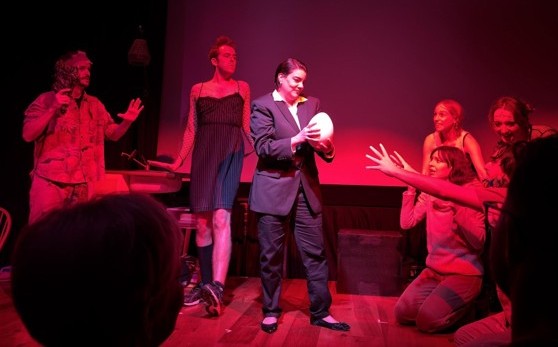
Agnes is a formidable, dominatrix-like CEO whose world revolves around control. Her costume, designed by Scarlett Teague, is a defiant expression of the character, as are the costumes throughout the production. Each is a glorious representation of the personality inhabiting it. The characters, their expressions and their visual identities are sharply drawn, giving the production an originality that makes the absurdity all the more entertaining.
Agnes has an unusual relationship with her dolls, three AI creations she calls the Dollums. Masterson tells me he based it on Golom. She bosses them around, manipulates them and eventually cries to them. During my conversation with Masterson, I asked whether the Dollums were evil. His explanation added another dimension to the story. They are projections of Agnes’s consciousness, extensions of herself that allow her to outsource different parts of her thinking and behavior. She created them because she felt she had too much going on in her brain and bad at delegating. Doot represents thoughts, Ah represents feelings, and Bootay represents actions.
Agnes has divided herself into manageable components. The irony is delicious. A woman intent on controlling everything has created artificial extensions of herself, yet remains caught in her own emotional contradictions.
The play unfolds through a series of skits, each with the rhythm of a stand-up comedy routine. Every segment becomes its own mini-act, while the characters and recurring themes hold the larger story together. There is an actual stand-up comic in the production, but the humor extends well beyond that character. Masterson uses absurdity to introduce ideas that are often uncomfortable, allowing the audience to laugh while considering where the world might be heading.
One of the funniest lines was “Frank Lloyd Wrong.” I assumed it was scripted. Masterson told me it was an ad-lib. In fact, the actors improvised much of the dialogue during the transitions. While the crew moved the set between scenes, the actors filled time, turning a practical challenge into part of the comedy.
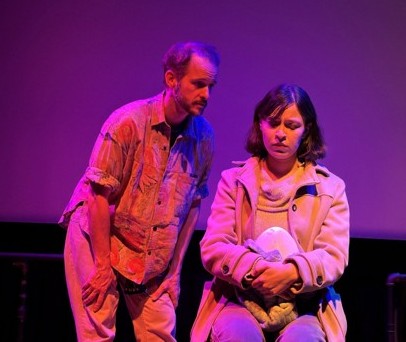
Among the characters is Mavis, played by Jessica Brynn Cohen, an intellectual introvert and art historian who finds comfort in books. She eventually encounters Raymond, played by Delan Crawford, a technician and hacker. Their relationship takes an extraordinary turn. They have intercourse, and Mavis gives birth to an ostrich-sized egg.
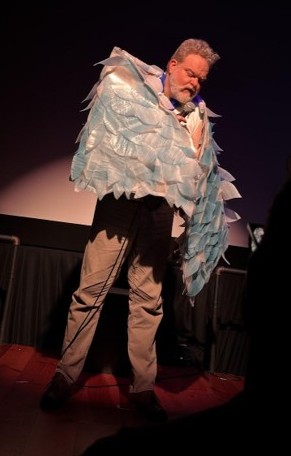
What exactly does the egg represent? I wondered whether it was a mutation, a new form of life, a metaphor for the consequences of technological intervention, or something else entirely. Raymond himself develops feathers, adding another layer to the surreal transformation. I asked Masterson about the feathers, wondering whether there was a connection to the idea of a birdbrain. He declined to offer a definitive explanation because he had not fully considered that interpretation himself.
I rather like that answer. The egg remains an open question, inviting the audience to bring its own imagination to the experience. Masterson told me that audiences project different meanings onto the play, and he welcomes that. There is no single correct interpretation.
Another important presence in Mavis’s world is Soraya, the AI therapist, played by Laura D’Eramo. Her convincing costume, a black leotard outlined in chip-like circuitry, combined with her distinctive, controlled bodily movements, established her as one of the production’s pivotal characters, even though she delivered limited dialogue. She embodied the increasingly blurred boundary between human presence and artificial intelligence. Through Soraya, the play raises an unsettling question: what happens when people turn to technology for understanding, reassurance, and emotional connection?
That openness relates closely to how he approaches writing. Masterson told me he never set out to write a play about artificial intelligence. The earliest version involved a translation app. Having recently visited Mexico City, he had imagined a multilingual play in which people fraudulently claimed to speak languages they did not know. The idea evolved through successive drafts into something quite different.
He described his creative process as a matter of starting with a lot of bad ideas and iterating until they become better ones. The first draft, he said, was nothing like what eventually appeared on stage. He spent about a year writing that first version and another two years developing it. The result is a play that raises questions about technology, identity, and human behavior without delivering a lecture.
When I asked whether the objective of the technology in the play was to eradicate emotion, Masterson offered a different perspective. For him, the central themes are control, surveillance and the commercial selling of technology. In THE EGG, people connect to the internet automatically as soon as they are born. Technology gives them the means to tell others precisely what they want to hear, encouraging more people to become enriched by downloading the technology.
Masterson drew a comparison with the way AI can reflect a user’s own opinions back to them, reinforcing what they already think rather than challenging them. He also raised the idea of AI as a fake therapist, a system that can appear to offer understanding while simply repeating what someone wants to hear.
The playwright highlights an interesting observation in a play where technology increasingly mediates human relationships. The question becomes whether convenience and constant connectivity are bringing people closer together or making genuine human contact increasingly disconnected.
The supporting cast helps build this strange universe. Frank Rivera plays Chuy, Laura D’Eramo plays Soraya, the digital therapist, Meg Hobgood plays Hortensia, and Beau Paul plays Falco. Each character contributes to the play’s shifting atmosphere, moving between comedy, menace and the peculiar logic of a world in which the boundaries between human and artificial life are becoming harder to recognize.
There is also a larger story behind the production. Masterson and L.B. Deyo formed The Zahir about a year before THE EGG reached the stage. They met through an Austin writing group, where members gathered monthly to share work and offer feedback. Both had written plays dealing with dystopian futures and technology. Deyo’s was Apprehension; Masterson’s was The Egg. Their initial thought was to present the two works as a double feature. Eventually, after seeing how difficult it could be to find the right route to production, they produced their own work rather than wait for someone else to do it.
Masterson possesses a diverse background. He studied screenwriting at the University of Miami, worked in alternative weekly journalism in Albuquerque and New York, and was involved with a theater company in New York as a sound designer and live music accompanist. He has played guitar and sung in rock bands since he was nine, and has toured in a van. After raising a family and putting his creative work aside for a period, he reconnected with two values that had always motivated him: collaboration and creativity.
His professional life in technology has also found its way into the play. He works at Adobe and previously spent ten years at a security company. That experience informed some of the technical details woven into the production, including references to passive RFID technology, access control systems and sensors. These minor details give the imagined future a recognizable foundation.
Ultimately, THE EGG succeeds because it leaves the audience with more questions than answers. It is funny, provocative and occasionally unsettling. Beneath the absurdity is a serious examination of what happens when technology becomes the organizing force of human life, when people outsource their thinking and emotional needs, and when the ability to connect becomes confused with the experience of being connected.
The irony lies in the fact that actors sharing a stage with an audience and responding to one another in real time bring a play about an increasingly artificial world to life through the most human of experiences. No algorithm can quite reproduce that exchange. At least, not yet.
The story may not be over. Masterson is bringing audiences back into the world of THE EGG next summer with Madness, a prequel that follows Agnes from her mid-twenties to the woman we encounter in this play. If THE EGG has left you wondering how humanity arrived at this peculiar crossroads, Madness promises to take us back to where it began. I’ll be watching for what Masterson does next.
THE EGG, written by Noah Masterson and directed by David Ritch, ran at The Rosette in Austin from October 29 through November 21, 2026. Presented by The Zahir.
Photos by Elie Krentzel