
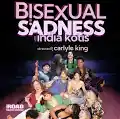
There is an interesting play struggling to get out of Bisexual Sadness, India Kotis’s exploration of sexual identity, belonging, relationships and the emotional complications of choosing whom we love. Unfortunately, the production never quite manages to bring the full complexity of those subjects to the surface.
Directed by Will Gibson Douglas for Jarrott Productions, the play revolves around Faye, played by Kelsey Mazak, a bisexual woman preparing to marry a man she genuinely loves. The catch is that part of her wishes he were a woman. Marrying him means confronting the possibility of losing her place in the queer community that has long been part of her identity.
Around her are her former lover and best friend Genevieve (CB Feller), her fiancé Alex (Christopher Gonzalez), her older sister Miranda (Catherine Woodiwiss), Miranda’s daughter Naomi (Violet Bolton), and Lillian (Jacqui Calloway).
The premise offers plenty of material for an intelligent examination of identity, sexuality, family dynamics and the complicated business of belonging to more than one world. But interesting subject matter does not automatically translate into interesting theatre.
The language is, for the most part, surprisingly mundane. Much of the dialogue feels like ordinary conversation that never quite develops into anything more substantial. Characters circle around their feelings, offer half-formed responses, and frequently resort to variations of “you know” rather than articulating what they actually mean.
There is a curious emotional reticence throughout. The characters seem perpetually jumpy, wistful, nervous or defensive, yet their underlying motivations remain frustratingly obscure. Touch, intimacy, the approaching wedding, pronouns, sexual choices and family histories are introduced as though they carry considerable emotional weight, but too often the play leaves the audience to supply the missing psychology.
Why is Faye so uncomfortable with being touched? What is the significance of certain seemingly incidental details? Is guilt attached to her sexual choices? Why does a reference to twenty years of therapy tell us so little about the person who supposedly underwent it? These questions suggest possibilities that the play never adequately develops.
The family relationships are similarly underexplored. Miranda, the mother of the teenage Naomi, seems to have her own considerable reservoir of suppressed emotions. Her joking suggestion that she might be a lesbian adds another layer to an already complicated family dynamic, particularly with her sister Faye’s bisexuality and uncertainty about marriage.
These suppressed emotions seem to contribute to an entire undercurrent of oddness within the family. The adults appear unable to deal comfortably with their own feelings, much less those of the people around them. Miranda struggles to engage meaningfully with her sister’s emotional turmoil, and the family seems to navigate its relationships through awkwardness, humor and avoidance.
And Faye’s impending marriage is perhaps the most puzzling example. Given the depth of her misgivings, I found myself wondering why she was getting married in the first place. What does she actually want? What is she afraid of losing? Is this a relationship she wants, or a decision she is trying to convince herself to make?
A character can be conflicted, contradictory and uncertain, but the audience needs to understand the emotional logic behind those contradictions. Here, I never quite did.
Another increasingly irritating feature was the sheer amount of eating. The characters seemed to sit down to eat five or six times throughout the play. And I found myself wondering why we needed to watch them actually consume so much food.
Was this meant to convey intimacy, family ritual or simply provide something for the characters to do while avoiding the conversations they weren’t prepared to have?
There may, in fact, be a psychological metaphor here. Eating can be a form of emotional displacement, a way of filling an internal void or suppressing feelings that are too uncomfortable to confront. In that sense, the repeated meals could represent the family’s collective tendency to consume rather than communicate, to fill the silence rather than address what is actually troubling them. If that was the intention, it needed to be developed more deliberately. As presented, the repetition became tedious rather than illuminating.
There are moments when the characters appear to be performing the correct vocabulary of contemporary identity politics rather than speaking naturally. The language can feel self-conscious, as if everyone is monitoring what they say and how they say it. The intention may be sensitivity, but the effect is sometimes awkwardness.
And then there is Naomi.
Played by Violet Bolton, the teenage daughter is, quite simply, the most compelling character in the production. She has an authenticity that the rest of the cast rarely achieves, not because she delivers grand speeches or profound psychological revelations, but because she seems to inhabit the actual experience of being a teenager trying to understand herself.
Her movements, pauses, expressions and sometimes reluctant responses feel genuine. She understands the emotional rhythms of adolescence. She can be awkward without making a performance of awkwardness. She can say she is rambling without actually rambling. There is an honesty in her presence that makes you pay attention.
One particularly telling aspect of the play is how the teenager seems more capable of acknowledging the elephant in the room than the adults. Her humor provides relief, but it also reveals something about how young people sometimes navigate uncomfortable family situations: they see what everyone else is avoiding and find a way to say it. The joke becomes a way of relieving the tension, even as it exposes what everyone else is unwilling to discuss.
Bolton brings an ease and naturalness to the role that makes the character stand out. She was the highlight of the evening and, for me, the one performer whose dialogue consistently felt as though it came from a recognizable human being rather than a constructed theatrical character.
The play’s central subject is genuinely worth exploring. Faye’s sense of loss is understandable, and the possibility that an outing or a change in how one is perceived can be both liberating and unsettling is fertile dramatic territory. But Faye herself remains difficult to penetrate. Her uncertainty is evident; its deeper origins are less so.
The physical environment offered another impression. The dark, grayish appearance of the theatre ceiling, with its somewhat dirty, filtered quality, did little to lift the atmosphere. It could certainly use some attention.
Ultimately, Bisexual Sadness has an intriguing premise but an underdeveloped script. Its characters could have benefited from considerably more psychological depth, more distinctive voices and dialogue that trusted the audience to recognize what was happening beneath the surface.
The comparison is not necessarily with the grand dramatic architecture of Ibsen or Dostoevsky, but with the basic theatrical principle that human beings become interesting when their contradictions, motivations and emotional lives are allowed to emerge through what they say and do.
Here, too much remains implied, and implication without sufficient development becomes abstraction.
There is a good deal of discussion about identity, but considerably less discovery. The characters speak, but rarely surprise. Their emotions are announced more often than they are experienced.
Except for Naomi.
Violet Bolton gives us a glimpse of the play that might have been: one in which people actually sound like themselves, where silence has meaning, awkwardness is organic, and emotional truth doesn’t require a running commentary.
Sometimes the youngest person in the room understands the assignment better than everyone else.