
Having known Prof. Determann for a decade, I was eagerly looking forward to his latest book. As the topic is largely about Isaac Asimov (who I met) and Star Trek (which I appeared on as a Starfleet officer in Deep Space Nine), I had high expectations for this look into how science fiction has been used to teach science. That is typically a dangerous attitude to have, as I am easily disappointed (!), but no fears in this case.
The book under review is written in a free-flowing style that greatly enhances its readability. This is the definitive book to date on its topic. However, even the author admits there is more to explore, notably the theatrical depiction of science fiction. “There remains much material for future studies on the history of teaching science with SF,” he writes.
In 1968, Asimov wrote an article for The Physics Teacher magazine. “Why should not every science teacher in the secondary schools be interested in science fiction?” he poignantly asked. “Such as Asimov’s authority that his article would be cited by educators even half a century later,” states Determann.
This comes on page 11 of the book, and serves as the springboard for nearly all subsequent discussions in the following 190 pages. As the book does not have an index, I can’t say how many times Asimov’s name appears, but it must be close to 50.
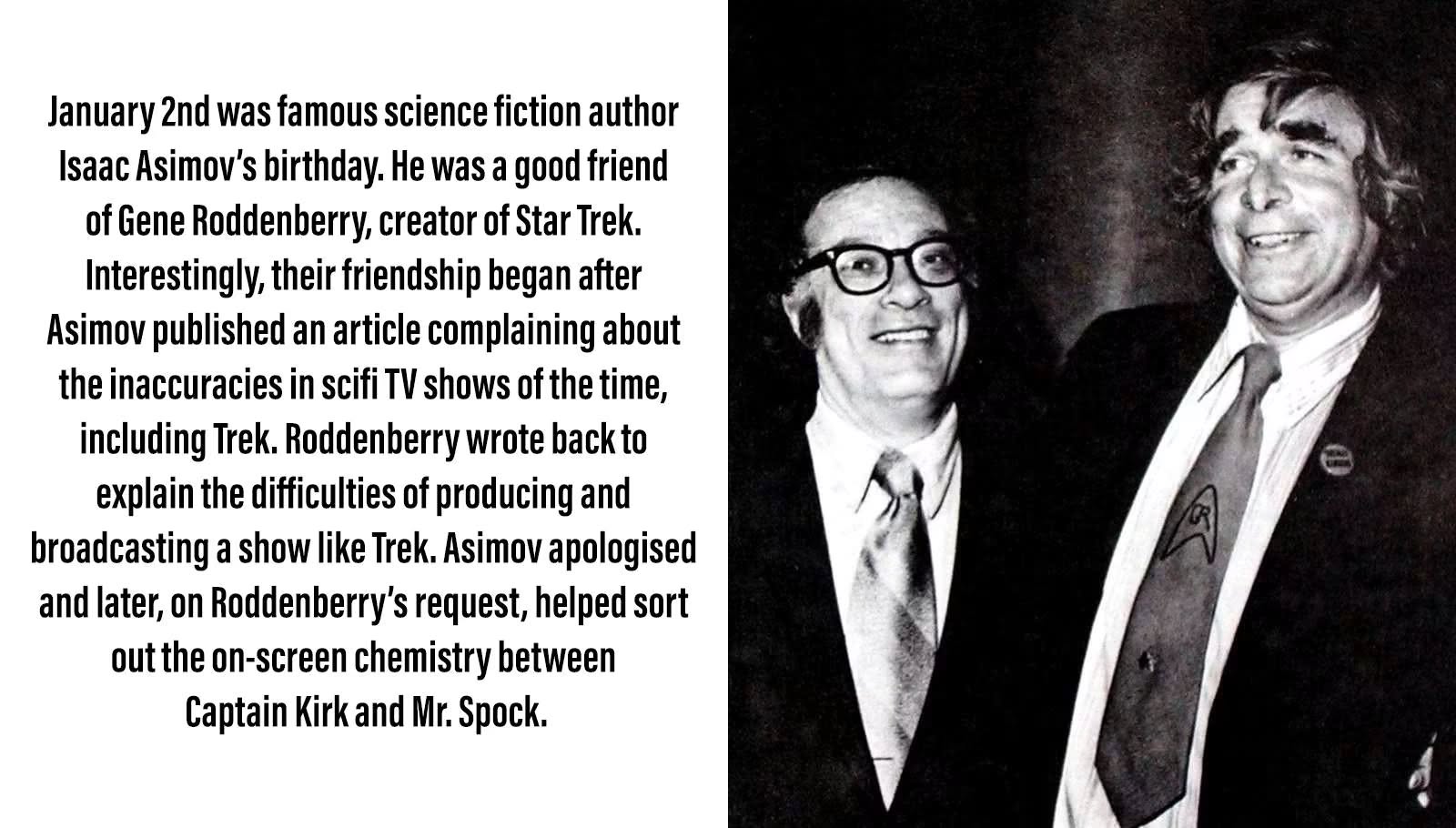
Chapter 4, for example, begins with this line: “The relationship between Isaac Asimov and Gene Roddenberry was not off to a good start.” In 1966, Roddenberry hosted a screening of the second pilot of his TV show Star Trek. “Asimov and his retinue” entered the screening room in a loud manner. “The nervous Roddenberry snapped at them to be quiet. An audience member rushed to defend the famous author: ‘You’re dead, you just insulted Isaac Asimov.’”
Luckily for Star Trek and science fiction, “Asimov’s relationship with Star Trek changed over time.” Asimov eventually realized what all of us know. He stated the it is “the most sophisticated example of science fiction on the television screen.”
The importance of Star Trek was made clear by none other than the world’s most famous scientist, Stephen Hawking. “Science fiction like Star Trek,” he stated, “is not only good fun but it also serves a serious purpose, that of expanding the human imagination. Today’s science fiction is often tomorrow’s science fact.”
The only glitch I found in the book was with regard to Hawking (who I also met). His interest is Star Trek was so great he actually appeared in a 1993 episode of Next Generation as himself!!; this important fact, which would have tied it all together in the book, is missing.
There is a Texas angle to the book. Dr. Arlen R. Zander was a physics professor at East Texas State University in the 1970s. Determann tells us that in 1974, “Zander described a course on ‘Science and Fiction’ that was developed by a physicist (himself), a poet, a psychologist and a literary scholar…After the class had proven to be successful the English department agreed to cross-list it.” It’s not clear by what measure success was achieved. As a post-script, I note that in 1978 and 1979 Zander gave public lectures about UFOs, but this is not mentioned in the book. Determann does explore the UFO topic later in the book, especially as it relates to films such as Close Encounters; and aliens are further encountered in a look at the TV show Dr. Who, which started in 1963 and may return in the coming years. (I entertained Jon Pertwee, the third Dr. Who, in my apartment in Canada).
So was the scientific community onboard with this idea of using SF to educate the public about real science? In general, no. And neither were prominent writers. In 1955, Lionel Lamlin (Association of Science Writers of France) told a conference “Although SF is of practically no direct value in scientific education, it does create an atmosphere that encourages a taste for science and progress.” This is actually not far from what Hawking stated decades later, when he made mention of the ‘human imagination.’ And the two iconic editors of 20th century pulp fiction magazines, Hugo Gernsback and John Campbell, “did not always agree on what was science and pseudoscience…Campbell published the work of L. Ron Hubbard and promoted his movement of Scientology. Gernsback derided it as ludicrous.”
A political scientist, Martin Greenberg, wrote a series of books in the 1970s about the supposed synergy between SF and a host of things, such as politics, schools & society, psychology and American government. In assessing such books, the American scholar Joanna Russ wrote the most scathing possible review. “Students faced with this kind of numbing gorp will instantly flee into pornography or anything septic.”
As for the intellectuals in universities, the issue was fraught with danger. In 1967, Mark Hillegas wrote of his experience teaching SF courses at Colgate University and Southern Illinois University. He explained the main reason “why professors of English usually dislike science fiction: the deep hatred of most literary intellectuals for science and technology.” He characterised it as “a blind furious hatred.” Wow! Despite this, SF courses were established at American universities, but “interest in possible futures reached a height in the early 1970s among students and teachers alike.”
There are many riches in this book, far more than I can explore here, but I will mention the changing role of planetariums. In the good old days, they would just display the night sky and point out the stars and constellations. By the 1970s you were just as likely to see a show developed from an Asimov story, or one about a “spaceship commander who attempts to stop a rogue planet from colliding with Earth in 2039.” The voice of the space commander was none other than Star Trek’s iconic Capt. Kirk: William Shatner himself! (In the interests of full disclosure, Mr. Shatner has given me 80 autographs over the years, in person).
There are a few minor typos: “he late” should be “he later” on pg. 13; “of the payroll” should be “off the payroll”, also pg. 13; “event” should be “ever” pg. 162; “kwon” should be “known” pg. 166.
Image: Asimov (l) and Roddenberry at a 1972 Star Trek convention.
About the author:
Jörg Matthias Determann is a Professor in the Department of Liberal Arts and Sciences at Virginia Commonwealth University in Qatar. He serves as Associate Editor of the Review of Middle East Studies and as Book Review Editor of the Journal of Arabian Studies. He holds a doctorate from the University of London and two master’s degrees from the University of Vienna. Determann is the author of five books, including Diversity, Equity, and Inclusion in Astronomy: A Modern History (Springer, 2023); Islam, Science Fiction and Extraterrestrial Life: The Culture of Astrobiology in the Muslim World (I.B. Tauris, 2021); and Space Science and the Arab World: Astronauts, Observatories and Nationalism in the Middle East (I.B. Tauris, 2018).
Teaching Science Through Science Fiction: A Story of Innovation in the Classroom and Beyond, is by Springer. It lists for $22.50 (softcover).
This book is the latest in a series Springer is publishing: Science and Fiction. The series has 12 editors.