
My Halloween book feature of the year is a scholarly look at witchcraft in the 18th and early 19th centuries.
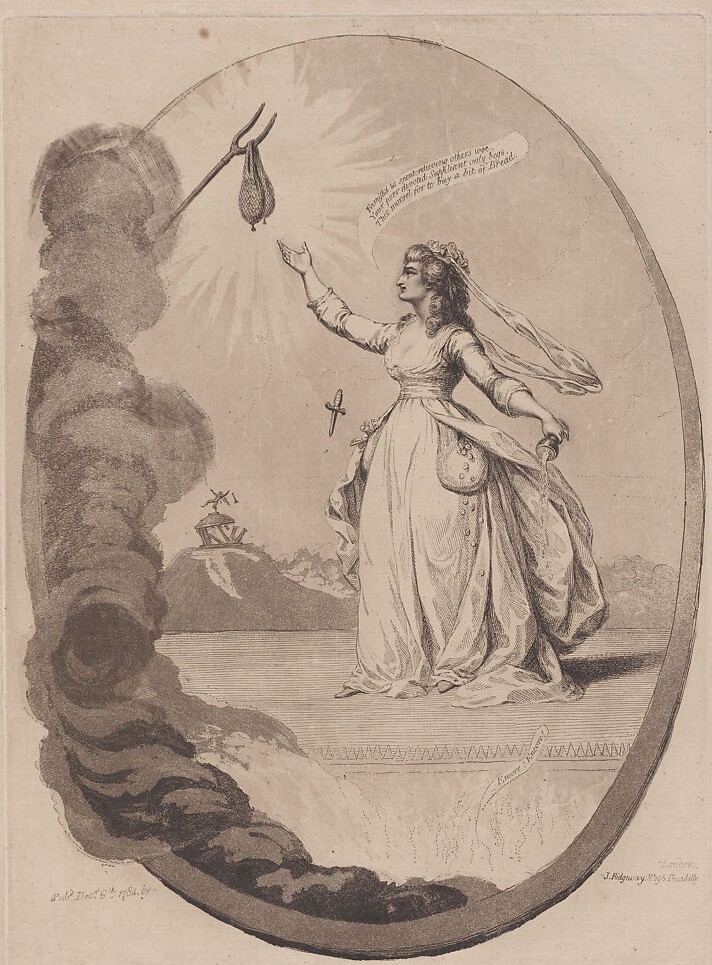
The “emasculating potential of the female demonic” is perfectly illustrated by the satirist James Gillray in a 1784 drawing that shows the actress Sarah Siddons (page 67 in this book, and the lead photo here). Her stage role as Lady Macbeth was legendary, making her the most famous actress of the century.
She reaches for a purse that is hanging from a pitchfork thrusting out of a billow of black smoke. But it’s not any ordinary purse. It is actually what our author diplomatically terms “the most vulnerable part of the male body.” In British language: Bollocks! The dagger she drops “signifies the threat she poses to the (male) body politic.”
Author Orianne Smith draws a parallel between the Gillray satire and an illustration in Witches’ Sabbath, a 1510 book by Hans Baldung Grien. It also depicts a billow of black smoke (page 33 in this book) and depicts “the malignant power of female sexuality.” In the 1510 print, a witch “reaches out toward a row of phalluses lined up like sausages.” Separated by nearly three centuries, the “emasculating potential” of women is the same, and points to the main reason almost every witch burned at the stake was female. They were all executed by men.
Another key threat aspect Smith unlocks is Revolution. “The Romantic-era fascination with witchcraft and the proliferation of witches in literature and art at the end of the eighteenth century attest to the association of witchcraft with threat – or promise – of revolution.” The violence of hags in the French Revolution was related in revolting detail in Great Britain. Edmund Burke wrote about how the King and Queen of France were treated in 1789, as they were hauled back to Versailles after attempting to escape:
“The royal couple moved along amidst the horrid yells, and shrilling screams, and frantic dances, and all the unutterable abominations of the furies of hell, in the abused shape of the vilest of women.”
The newspapers of the day were just as lurid. Relating that during the storming of the Palace in 1792, “French women, at the massacre of the Swiss soldiery, literally tear the dead bodies to pieces, and practice with them the most shocking indecencies. The floors were flowing with blood.”
With such reports shocking the British public, it is easy to see the association of witchcraft with revolution.
Smith explores the role of witchery in many novels of the period, looking at novelists still famous today, and others more obscure. In the latter category we meet Catherine Smith, who write Barozzi; or The Venetian Sorcerer in 1815. It features “a mother-turned-sorceress who uses her purported magic to protect her daughter from the machinations of a murderous marquis.” In other words, a good witch!
Mary Shelley incorporated the “historical phenomena of witchcraft” in her books, and Walter Scott’s novels “team with witches.” His most famous literary witch was named Meg Merillies; she appears in his book Guy Mannering. Meg became so famous that her character led to “Meg-mania” in England; she featured in plays in 1816, and was depicted in subsequent editions of the Guy Mannering book. “The most famous artistic response was John Keats’s poem ‘Old Meg she was a gypsy,’ composed during his walking tour of Scotland.” Siddons comes to the fore again here too. After reading Scott’s book, “she altered her performance of the role of Lady Macbeth, channeling the complexity of Meg as a figure of the female demonic disrupting patriarchal narratives of male authority and privilege.” According to a dramatist, writing in 1815, “Meg had explained to Siddons Shakespeare’s idea in the witches.”
So, if you are wondering this Halloween if witches are real or fantasy, consider the effect of Meg Merillies on the British public and the greatest actress of the age. Truly, the power of witchcraft!
A great book for Halloween, or any night when the Moon is full. Highly recommended.
There is a typo: “upon on” should be “upon” on page 101. Photographic reproductions could have been better: the painting on page 41 is blurry and not in colour.
About the author:
Orianne Smith is Professor of English and Affiliate Professor of Gender and Women’s Studies at the University of Maryland, Baltimore County. Her first book, Romantic Women Writers, Revolution and Prophecy: Rebellious Daughters, 1786 –1826 (2013), also published in the Cambridge Studies in Romanticism series, received the British Association of Romantic Studies (BARS) Biennial First book Award in 2015.
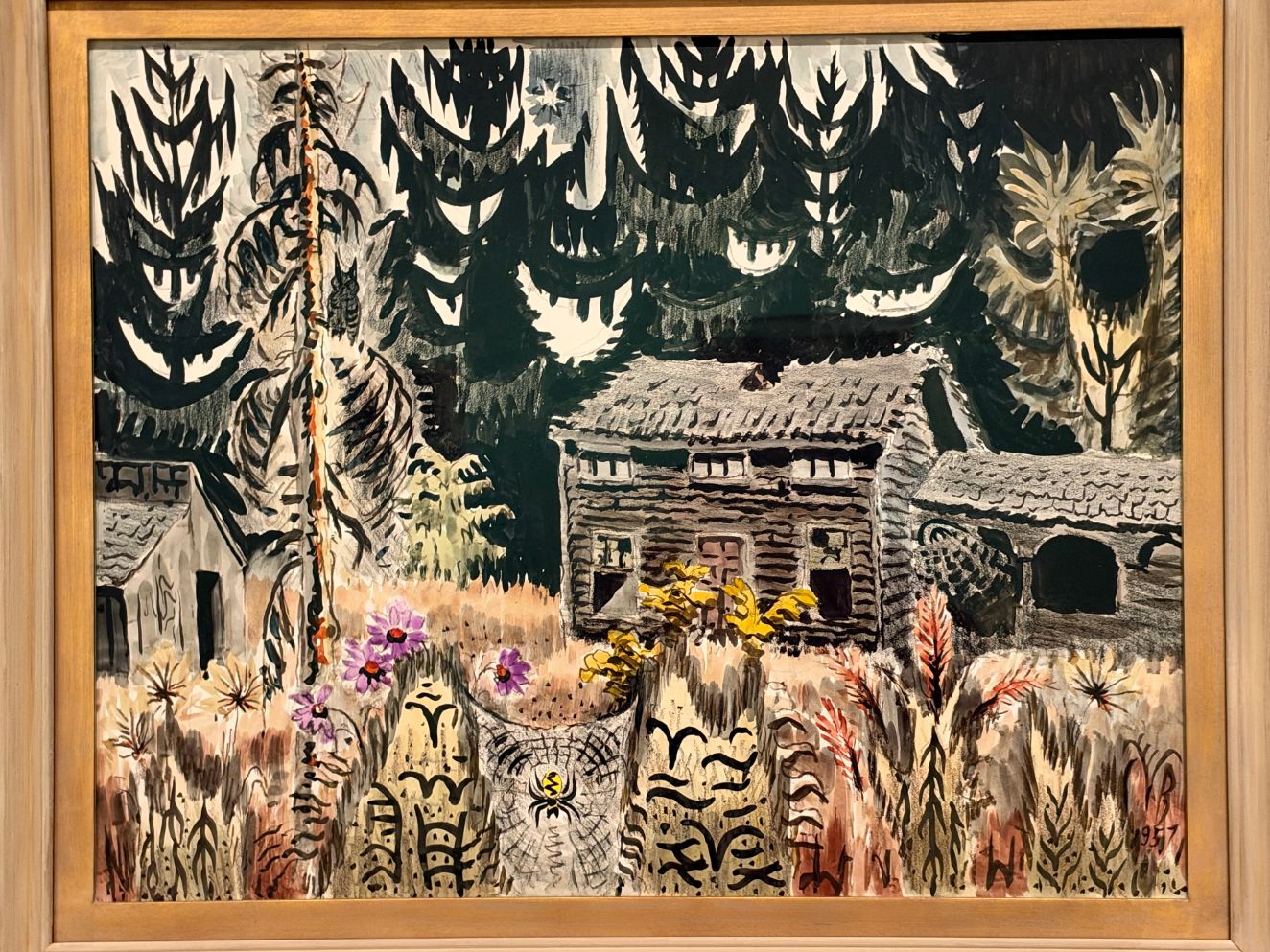
Lead Photo: ‘Haunted Twilight’ by Charles Burchfield (1955). Currently on display at the Museum of Fine Arts, Houston.
Illustration: a 1784 work by James Gillray, depicting Siddons as the deity Melpomene.
Romanticism Bewitched: Witchcraft, Revolution and the Female Demonic, is by Cambridge University Press. It lists for $130. This is vol. 157 in the series Cambridge Studies in Romanticism.