
My headline comes from the pen of Percy Shelley, one of the foremost English Romantic poets. It appears in this book by Alan Jacobs, who writes that Shelley “seems almost to imagine Milton as what he himself would have been had he been born two hundred years earlier.”
The topic, of course, is Milton’s 1667 prose poem Paradise Lost, the bedrock publication of English literature. Jacobs subtitles this look at PL as a “biography.” In a compact 203 pages, he sets out to describe PL in a way no one else has fully engaged with: “I prefer to see the poem as a series of musical movements,” he writes.
Books I-III are Andante, Presto; Books IV-VIII are Allegro; Book IX is Largo maestoso; and Books X-XII are Andante. “My proceeding here discerns a musical structure less like that of an opera and more like that of a late Beethoven string quartet.” Like nibbling on madeleins while reading Proust’s In Search of Lost Time (a method I highly recommend), perhaps the best way the approach the daunting PL is by listening to Beethoven!!
It has often been noted that Satan has the best lines in PL, and is really the focus of the story, even more than Adam and Eve. “We see through the eyes of Satan: we perceive what he perceives.” In some sense, Jabos opines, “we (humans) are more like Satan than like Adam and Eve.” In the Andante in the First Movement, we “see” the Earth through the eyes of Satan: a “pendant world” (as Milton wrote) filled with creatures ripe for the plucking. This makes way for the Presto section, where we trade the “darkness visible” of Hell for the glorious brightness of Heaven’s courts.
In the Second movement, Jacobs discerns “a fiercer martial music” as the archangel Raphael explains the War in Heaven to Adam. It was not between God and Satan, “but rather between an army or righteous and obedient angels, led by Michael, and an army of arrogant and rebellious angels, led by Lucifer, later to be called Satan.”
In the Third movement (as defined by Jacobs), we find Milton actually using a musical analogy: “I now must change/Those notes to tragic.” This tragedy is nothing less than The Fall, where Adam and Eve “jointly succumb to the allure of disobedience,” the same allure that so attracted the angels of Lucifer.
The Fourth Movement “contains one of Milton’s wittiest musical moments that marks the end of Satan’s story. After relating “the account of my performance,” Satan is greeted not by applause but by “a dismal universal hiss.” The second theme our author discerns in the Fourth is “paradisal music” that heralds the redemption of Adam and Eve.
I did qualify my initial introduction to musical analogy by stating no one “fully engaged” with that approach to PL. Jacobs wisely includes a quote from William Blake, from 1822: “Milton almost requires a solemn service of music to be played before you enter upon him. But he brings his music, to which, who listens, had need bring docile thoughts, and purged ears.” Jacobs follows this quote with his own pithy summary: “Music, not theology.”
Thus, Jacobs reaches a high note in his analysis. While almost all theories about PL get bogged down in theological analysis, Jacobs makes us aware there is another way, one much easier and perhaps more fruitful for the vast majority of potential readers to adopt.
Jacobs uses this musical mindset to explain even noted criticism of PL. The Romantic poet John Keats famously wrote “Paradise Lost though so fine in itself is a corruption of our Language – It should be kept as it is unique – a beautiful and grand Curiosity. I have but lately stood on my guard against Milton. Life to him would be death to me.” Jacobs parries this potentially fatal thrust with his own rapier wit: “This is purely a matter of being tempted by the grandness of Milton’s music; a poet of that era could scarcely have been more thoroughly post-Christian than Keats was.”
A tremendously engrossing look at Paradise Lost, this book can be recommended as the finest introduction for those who have been tempted to read PL, but have shied away from it. But resist temptation no longer! Whether you are Adam or Eve, taste the fruit of this book and write your own score.
There is a typo on page xx: “will be find” should be “will find”
About the author:
Alan Jacobs is Distinguished Professor of Humanities in the Honors Program at Baylor University. His many books include Breaking Bread with the Dead and The “Book of Common Prayer”: A Biography (Princeton). His writing has appeared in leading publications such as The New Yorker, Harper’s Magazine, and the Atlantic.
Paradise Lost: A Biography is by Princeton University Press. It lists for $24.95
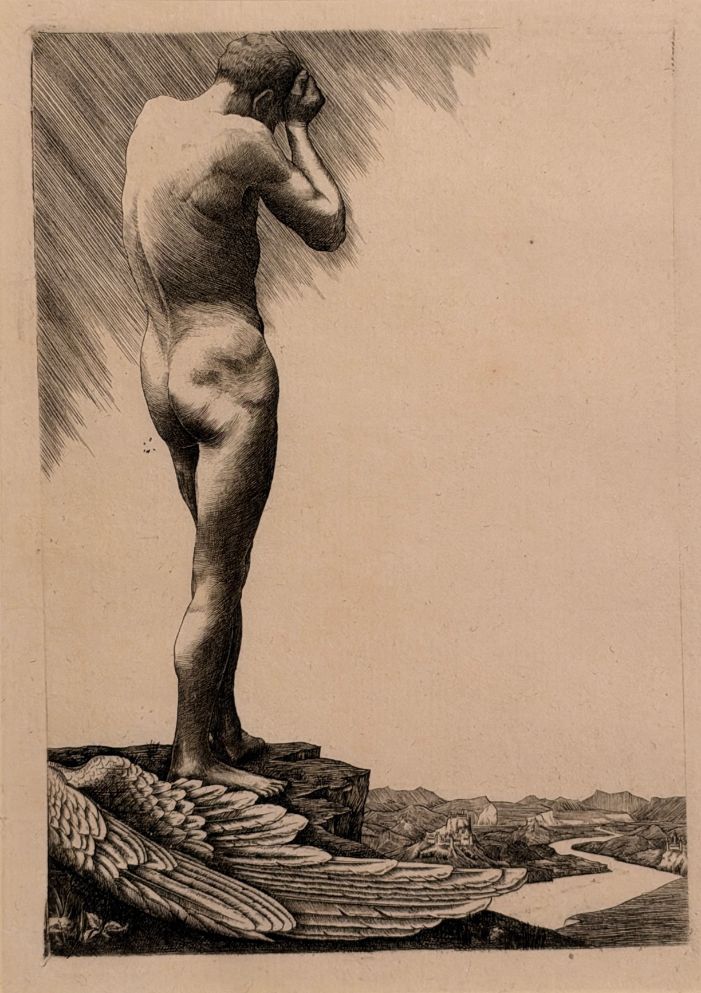
Image: Lucifer, fallen. An original etching by Lord Henry Badeley (1880-1952). In the private collection of C. Cunningham.