
After his death, Jackson believes he gave him something else: the ability to paint. Four years ago, grieving the man he describes as a second father, Jackson picked up a rough piece of discarded wood and saw a canvas. He had never painted before. That wood came from packaging his father had discarded while assembling exercise equipment. Nails were sticking out of it. Nothing about the material suggested a precious object, yet Jackson felt compelled to use it.
That same day, he went to Michaels for paints and supplies, then began a portrait of his grandfather, Edward. While painting, Jackson looked down and recognized the face taking shape. The likeness astonished him. Making the portrait became what he calls his greatest out-of-body experience, when grief and discovery arrived together. He painted part of the face fading into clouds, giving form to the departure he had witnessed at the hospital.
He remembers the pain his grandfather endured, and the relief of knowing that suffering had ended. Missing him was another matter. By the time his grandfather’s face emerged from beneath his hands, he was crying.
“It looks like he gave me a gift that will never go away,” he said.
That first painting will never be for sale. Jackson would exhibit it, but it belongs to the relationship that brought it into being. The work remains a way of honoring the man whose death opened an unexpected passage into art.
I encountered Jackson’s work at Fragments, a one-day pop-up exhibition at Canopy in Austin. While visiting another artist’s exhibition nearby, I stepped into his almost by accident. The paintings caught my attention, as I could see from behind the veneer of stylistic differences a truly great artist emerging. Many prominent artists have absorbed another’s visual language, transformed it, and eventually developed their own. Van Gogh drew inspiration from Millet, Delacroix, Rembrandt, and Daumier, as well as Japanese ukiyo-e prints.
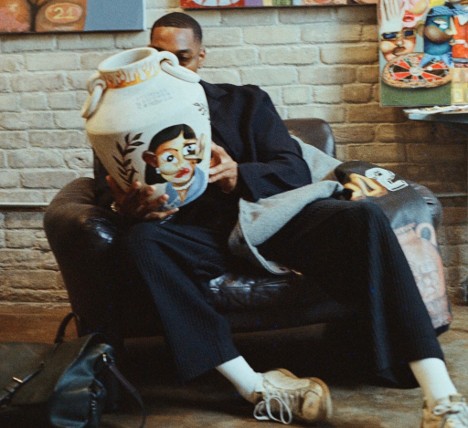
Here was someone extending a visual language across canvases, painted vases, and clothing, bringing several creative pursuits into a developing whole.
The title describes how Jackson understands the range. Each medium carries a unique piece of him. Painting expresses an inward conversation, while clothing draws on his pleasure in presenting himself well. Vases bring his imagery into another dimension and into the home. His earlier experience designing shoes belongs to the same expanding vocabulary.
Music connects these pursuits to his grandfather. Jackson credits Edward with cultivating his broad musical appetite and speaks enthusiastically about vinyl and artists such as Sade. Listening continues to influence his paintings through the feelings it produces, sometimes moving him beyond ordinary awareness.
That sensitivity extends to the people around him. Jackson notices shifts in mood, the atmosphere of a room, and the energy exchanged between people. At Fragments, watching visitors respond to his work gave him another moment of heightened awareness. Standing back, he saw something created in private becoming an experience shared by others.
“It felt like it just didn’t go unnoticed,” he said.
For an artist who has been painting seriously for only four years, that recognition matters. Fragments was his third show. His first honored his grandfather, whom Jackson describes as a cowboy and slave from East Texas, and the family’s Western roots. The exhibition became, in his words, a kind of monument to Edward.
One of Edward’s sayings stays with him: don’t take any wooden nickels. His grandfather respected uncommon talents, even though their conversations did not revolve around painters or art history. The influence was personal and practical, rooted in how he lived and the guidance he offered.
Other family gifts remain alive in Jackson’s daily life. His grandmother taught him to cook, and his enthusiasm rises when he discusses grilled lamb chops, chicken, and penne. He enjoys feeding people and his eyes light up at the topic. Family knowledge survives in these ordinary acts as surely as it does in the objects he exhibits.
Born and raised in Dallas, Jackson describes himself as romantic and optimistic, determined to retain hope when events appear to be moving against him. He speaks with conviction about building the artistic career he envisions.
Beauty enters our conversation through surroundings and the people inhabiting them. When I describe the importance of having both a beautiful environment and good company, Jackson responds by talking about peace. He looks for the brighter side of a situation and pays attention to the surrounding atmosphere. A home, in his view, should offer safety and a place to recover that peace.
On the canvases, his artistic influences remain visible. Our conversation touches on Bosch, Picasso, Jean-Michel Basquiat, and George Condo. Jackson identifies Basquiat as his foremost inspiration, particularly the example of a Black artist finding his way through New York’s art world and establishing a place of his own.