
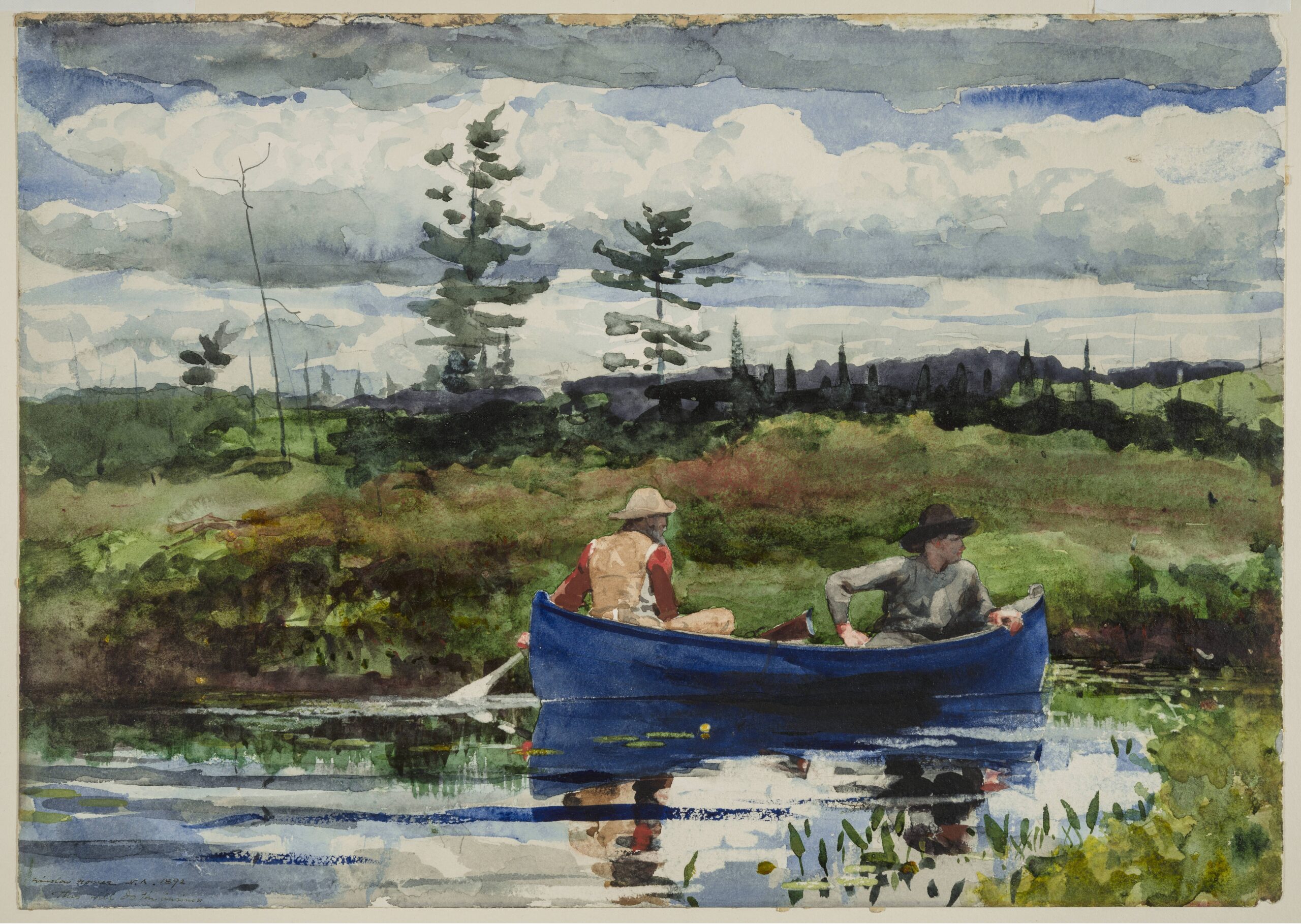
The most comprehensive exhibit ever mounted of watercolours by Winslow Homer is currently on view at the Museum of Fine Arts, Houston.
Homer (1836-1910) ranks among the most famous of American painters in the late19th and early 20th centuries. While this exhibit does include his very last painting, which is extraordinary, it focuses on his watercolours. These are all in the collection of the Museum of Fine Arts, Boston, which also has 11 of Homer’s oil paintings.
Due to their fragile nature, and potential damage from light exposure, visitors to the museum in Boston will not see this amazing collection of 50 watercolours. Thus, this exhibit represents a once-in-a-lifetime opportunity to view these works which span his career from the 1860s to 1909. A special treat is a display of Homer’s watercolour box, the one he used from 1900-1910.
Kaylin Haverstock Weber, the MFAH’s Lora Jean Kilroy Curator of American Painting and Sculpture, gave a lecture on Oct. 31. What you will see, she said, are “Masterpieces in watercolour, with 40 years of innovation. They show how Homer revolutionised watercolour through his experimentation, his bold use of colour, his dynamic compositions, and the range of techniques he employed.
“The star is The Blue Boat, the signature image of this exhibition (lead photo here). Blue Boat demonstrates his confident brushwork, and his very sophisticated understanding of atmosphere. Here, two Adirondack guides served as models for the figures. Homer inscribed the reverse of this sheet: ‘This will do the business.’ Homer believed his watercolours would be his most lasting legacy and achievement. This exhibition certainly underscores that.” There is a special treat in store for visitors: the museum has set up a canoe and paddles against a huge backdrop, so you can have your picture taken as if you were inside a watercolour!
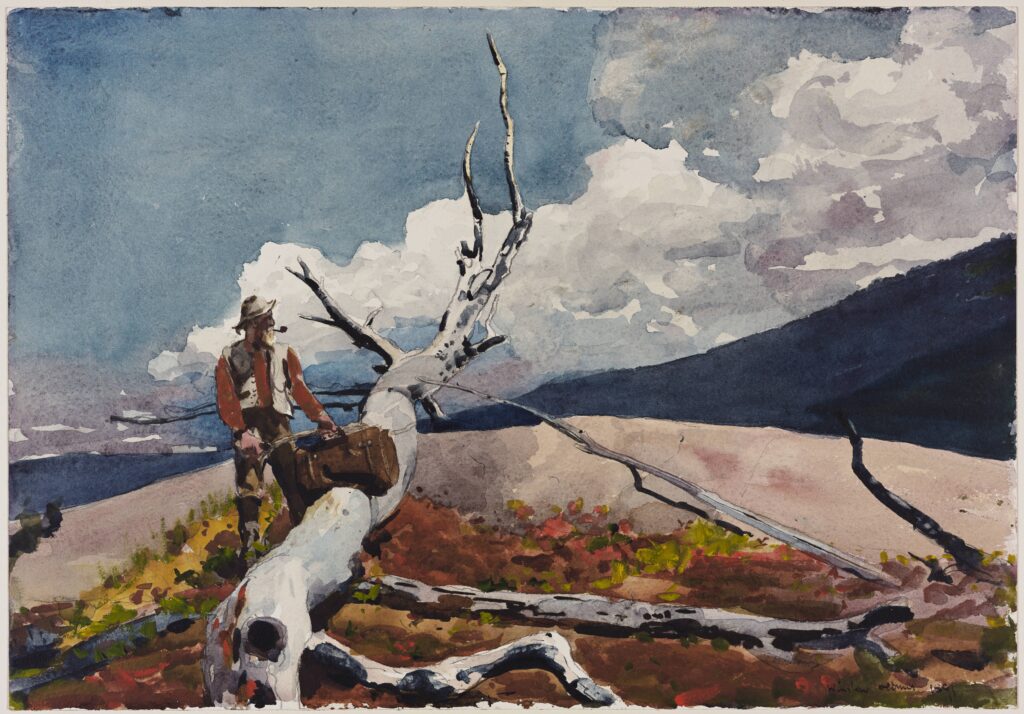
In her remarks on Woodsman and Fallen Tree, Weber noted “the very dramatic diagonal of the fallen tree and the autumn colour which explodes off the composition. It really explores humanity’s place in nature. He did so here by exploring his use of colour: the saturated surfaces are built layer upon layer in this incredibly unforgiving medium. He blends the guide into the surrounding environment while also setting him apart. The guide’s warm-toned clothing echoes the autumn foliage and the clouds drifting over the mountain seem to rise like smoke.”
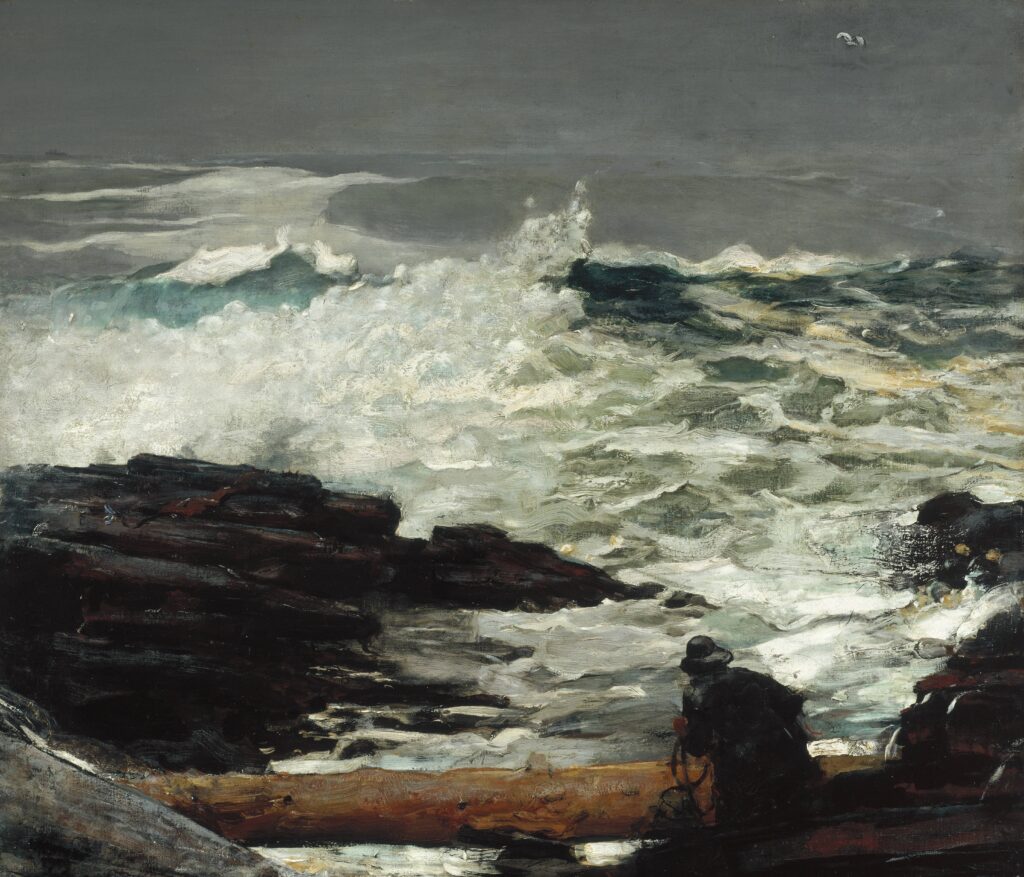
On his 1909 painting Driftwood, (Homer’s last work), Weber said “Art historians love to interpret this as a meditation on aging and endurance, probably because there is this solitary seafaring figure in foul weather. It is certainly possible that it’s a self-referential nod by the artist, but the figure looks out at the waves and rocks and he clings to that rope wrapped around the large piece of driftwood. He’s anchoring himself against the crash and movement of the ocean, and perhaps the march of time.” Whatever it’s meaning, “it is an extraordinarily powerful oil painting and one of the largest works in the show – a fitting conclusion to our exhibition.”
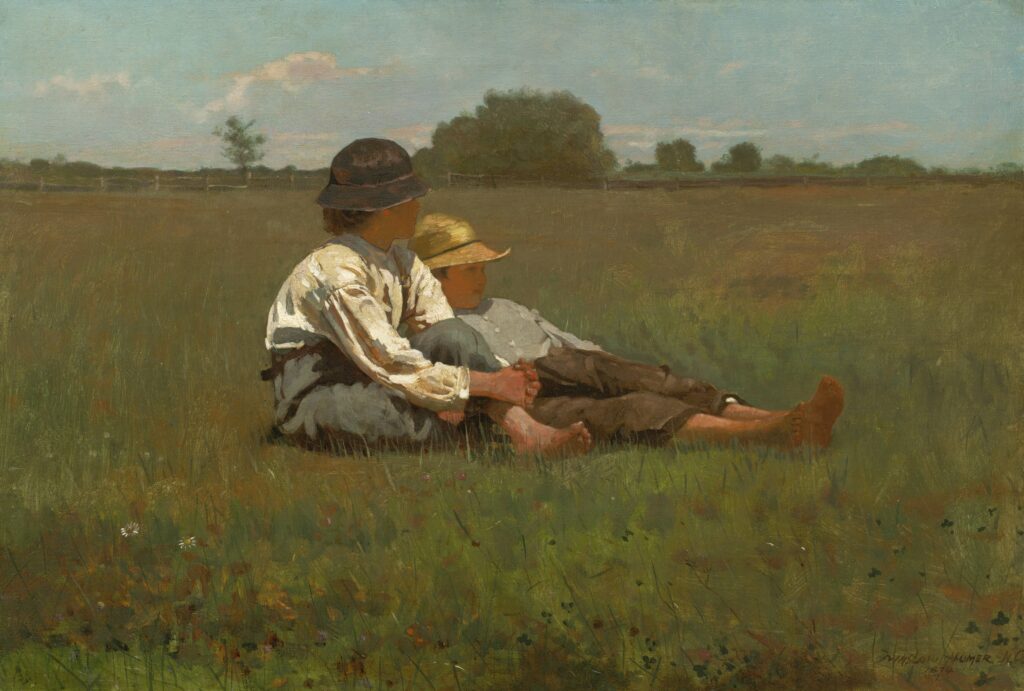
Thirty-five years earlier Homer created Boys in a Pasture, a truly idyllic composition. They seem oblivious to the sun-burn developing on their exposed skin as they become one with the simplicity of Nature. As is typical of Homer’s subjects, they either look away from the viewer, or off into the distance. They thus become archetypes of humanity, rather than identifiable individuals. I think it is this artistic (dare I say, poetic) distance that makes them timeless. We can view them now more than a century later and recognize ourselves. This immediacy of engagement will forever ensure that Homer’s masterworks are always regarded as masterpieces. An important and richly-rewarding show, this is one that no visitor to Houston should miss.
The catalogue for the exhibit is excellent, and can be purchased in the gift shop, which also sells amazing jewelry. The book measures about 9.5 by 10.5 inches. In 148 pages it includes fine colour reproductions of every work on display, along with the methods he used to create the watercolours. Each section, such as The North Woods (which includes his Canadian works), and Florida and the Caribbean, begins with 1-2 pages of text describing why Homer visited various places and what he did. In that section, for example, we read “First travelling to Florida in 1886, Homer returned more frequently during the early 1900s for fishing trips and to escape harsh Maine winters.” His home in Maine, on the water’s edge south of Portland, can be visited.
All photos: copyright Museum of Fine Arts, Boston.
Boys in a Pasture (1874). Charles Henry Hayden Fund.
Woodsman and Fallen Tree (1891). William Sturgis Bigelow Collection.
The Blue Boat (1892). William Sturgis Bigelow Collection.
Driftwood (1909). Henry H. and Zoe Oliver Sherman Fund and funds by exchange from the gift of Maxim Karolik for the M. and M Karolik Collections of American Paintings. Ellen Kelleran Gardiner Fund, bequest of David P. Kimball, bequest of Maxim Karolik, gift of William H. Lane Foundation and the Hayden Collection. Charles Henry Hayden Fund.
Winslow Homer exhibit runs thru Feb. 7, 2027. Houston is the only travel venue for this exhibition, following its debut last fall in Boston.
https://www.mfah.org/art/exhibitions/of-light-and-air-winslow-homer-from-the-mfa-boston