
The power of speech has been a great focus of discussion for several years now, as we have seen it used in political discourse for the most nefarious of purposes. The ancient Romans, who produced many great orators, were well aware of the force of declamation, so it’s nothing new, but this book by Alice Rhodes (Univ. of York) breaks new ground in the study of voice in the Romantic era.
Materialism may sound benign, but in late 18th century England it could get you run out of the country, jailed, and even executed. “Materialism,” explains Rhodes, “allows for an understanding of the world in which ideas, imagination, poetry and speech have physical agency and power of their own. A mere utterance can be turned into physical forces which move and move others with all the power of a body or a machine.” As Percy Bysshe Shelley (1792-1822) concludes, poetry ‘moves.’
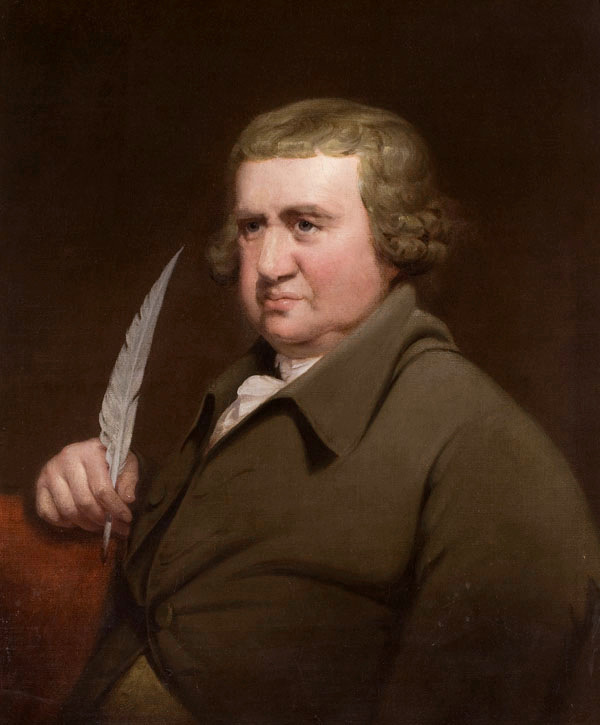
He is one of the three Romantic-era figures Rhodes studies in this deeply engaging book, the others being John Thelwall (1764-1834) and Erasmus Darwin (1731-1802; lead photo). Thelwall is known only to specialists now, but he was one of the most prominent British orators (following in the ancient Roman mold) and writers, but for this book the author concentrates on his work as a speech therapist and poet. Before Charles Darwin, there was his grandfather Erasmus, whose poetry and philosophy was so influential in the late 1700s. His creation of a ‘talking head’ in 1770 is key to his inclusion here, and the first chapter is devoted to him. All three writers, Rhodes tells us, “maintained a belief in poetic expression as a progressive force for change.”
The Dulcet Symphony of Words
Darwin’s artificial speaking machine was “built in the shape of a head or mouth and made of wood, leather, and silk ribbon.” He used bellows to replicate the lung’s role in speech production. His ideas about speech “manifest across his writing,” states Rhodes. It was Darwin’s link between a machine and the human body, and it raised the question as to whether “human mind and will can likewise be understood as mechanical in their operation.” With the rise of robots and AI now, the question is very much of the moment.
In the 1770s this all sounds rather quaint. But Rhodes discerns the dangers. “Exploring the similitude of anatomy and mechanics, whether through personification in poetry or the construction of automata, held radical implications for his more conservative critics. It signalled to these readers a mechanistic philosophy associated with atheism and Jacobinism.” Either one could get you a not so very nice, long prison term. The Jacobite rising of 1745, which attempted to overthrow the King of England in favour of a Scottish Catholic, was still fresh in the memory. The great chemist Joseph Priestley unwisely published a book in 1777, in which he sought to separate materialism from mechanism. He wrote that in humans the matter which constitutes life or mind is not inert, but consists of ‘active matter.’ His radical views, which spilled over into support for the American and French Revolutions, incited a mob to burn down his laboratory. He fled to America.
Darwin, in his poetry, thus became very circumspect. The culmination of his scientific theories was not published until after his death: The Temple of Nature (1803) includes 40,000 words of notes, a quarter of which deal with the theory and structure of language. It was only in this publication that he finally made public the construction of the talking head. He describes the development of human language in The Temple:
Thus the first Language, when we frown’d or smiled,
Rose from the cradle. Imitation’s child;
Next to each thought associate sound accords,
And forms the dulcet symphony of words.
Not everyone was impressed with The Temple of Nature. The notoriously acerbic Edinburgh Review stated that Darwin “appears to have lost himself in that gulph which will probably for ever separate the sciences of matter and of mind.” The attacks severed the link between Darwin’s natural philosophy and medical practice: his grand project arrived stillborn, but at least he was not alive to see its demise.
Truth’s Glowing Image on the Heart
While Darwin’s conflation of physiology and metaphysics did not give rise to Frankenstein’s monster (more of Mary Shelley later), Thelwall was highly influenced by Darwin’s work. In 1820, he declared “We are nothing but mere machines – speaking automatons whose very words are breathed thro’ is, as thro’ an organ-pipe inflated by some exterior agency.” This, as Rhodes notes, “invokes the idea of Darwin’s speaking machine.” It does not take much imagination to wonder what most people of the time thought of Thelwall. Even now, on the edge of AI-powered robots on our streets, few people would agree they (i.e. the humans) are actually a machine.
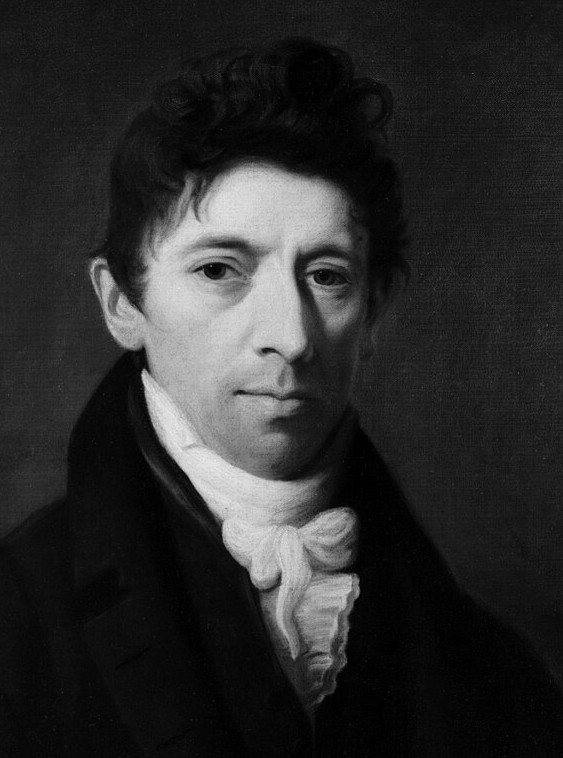
Thelwall’s “texts consistently advocate a materialist model of speech, where both external power and internal will stand in the way of unimpeded utterance. This model of speech has decidedly political resonances.” For him, “freedom of speech is not just a right, but a fundamental physical law.”
Rhodes encapsulates his approach: “Science, Art and Taste are all ways of understanding the body for Thelwall. The function of science is to understand the physical laws by which the speaking body operates, and the function of mechanic art is to analyse and replicate the movements which the body produces as a result of these laws.”
A key word that Thelwall employs is ‘energic’. It is characterized both by force of expression, capable of impressing an idea upon an audience, and something that engages in work or action that produces effects. Rhodes quotes from Musalgia, which Thelwell wrote from 1822-1827. Here he uses “his elocutionary theory of rhythmus, in which the materialist science of the body informs the practice of poetry, to present the transformation of immaterial thought and feeling into physical movement. A portion of what Rhodes gives us of this remarkable composition:
While shapes & hues to thee appear
Thro an etherial atmosphere
Or, rapt beyond the visual bound.
Thro intellect’s occult profound.
Giv’st thou, with intuition warm,
To dim Abstraction sentient form –
Embodying to the outward sense
The tongueless mind’s significance –
Thy shapes & influences illume
The labyrinths of the ideal gloom;
While trope and metaphor compress
Induction’s slow diffusiveness,
And stamps, with prompt energic art,
Truth’s glowing image on the heart.
While Rhodes does devote a paragraph to discuss this, I wish she had spent at least a couple of pages on it. Nothing is said of the line about the tongueless mind, which really is a central facet of the book. Was this a reference to Darwin’s talking head? I find even this short passage amazingly provocative and deep.
A Poet is a Nightingale who Sits in Darkness
A key point for Percy Shelley is Prometheus. Everyone has regarded that deity as the one who gave man the gift of fire, but for Shelley he gave us something more important: speech.
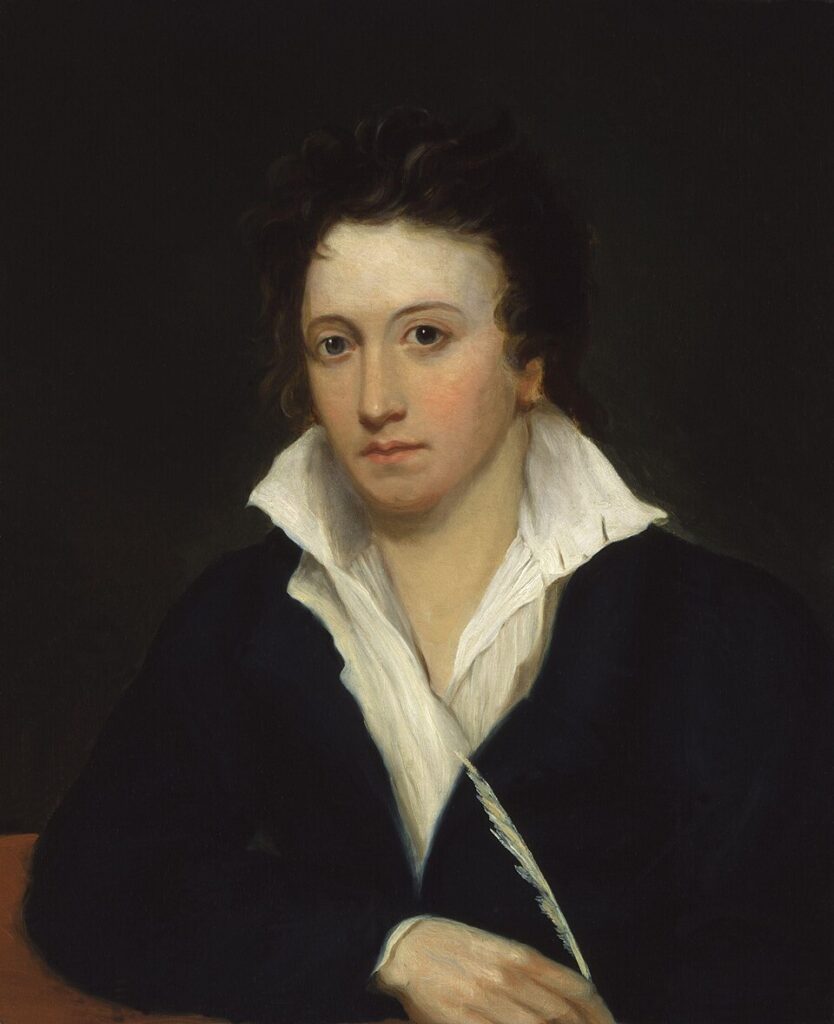
“Shelley positions the human body as the starting point of the cycle of matter,” writes Rhodes. He “shifts the emphasis of the materialist theory of atoms from its implication that living bodies are made of the same matter as inanimate objects, to the suggestion that all matter has been part of a living human body.” A great insight, and one of the most critically important of the book. It leads to the “conception of speech as a materialist physiological action.”
Rhodes addresses a scholarly imbalance here. “While Shelley’s engagement with ideas about communication and the voice has often been noted, the subject of speech itself has received surprisingly little attention.” Rhodes offers a “re-reading” of Shelley’s poetry, one that “does not overlook the importance, and the consequence, of speech as a physical action for Shelley.”
In his A Defence of Poetry (begun in 1821), Shelley “physicalises imaginative poetic composition and suggests that poetry can be understood in the same way as materialist conceptions of life or mind…As Shelley makes explicit in the Defence, self-awareness, on the part of the speaker or the audience, is neither a necessary nor indeed a desirable feature of socially effective poetry. He writes that ‘a Poet is a nightingale who sits in darkness, and sings to cheer its own solitude with sweet sounds.’”
Rhodes also offers a new interpretation of Shelley’s poem The Mask of Anarchy, which features a ‘voice from over the Sea.’
“Shelley suggests that the voice has already had an aural and physical impact before becoming language, emphasizing his familiar point that speech need not be intelligible to be effective.”
The Causes of Life
A Coda is usually rather dry stuff, but Rhodes has packed a lot of TNT into this one, looking at Mary Shelley, wife of Percy. While others have “briefly noted resonances” between Mary Shelley’s Frankenstein and Thelwalls’ poem A Letter to Henry Cline, Rhodes sees more.
“I want to go further, to make the case that, if Shelley is indeed drawing on Thelwall’s Letter to Henry Cline, she does so not merely in the figuration of scientific discovery, but also in her depiction of the creature’s [Frankenstein’s monster] acquisition of speech.” Both Shelley, in describing the fictional Viktor Frankenstein’s discovery of the causes of life, and Thelwall, in his description his method of analysis (rhythmus), use nearly the same language. Both are suddenly bathed in a ‘flood of light’ that reveals previously unknown secrets of nature.
A tremendously impressive book.
This title is number 153 in the series Cambridge Studies in Romanticism
British Romanticism and the Matter of Voice is by Cambridge Univ. Press. It lists for $120.