
At Wally Workman Gallery, painter Lance Myers talks about family, insects, scale, technique, and the mysteries that can hide inside a painting.
Walking through the last day of Lance Myers’ exhibit at Wally Workman Gallery with the artist, I constantly stopped to look more closely. His paintings play with scale, beauty, historical references, and visual styles, but the conversation made the work come alive.
We began with Somber Elegant Eventualities, a large painting of a woman. I asked Myers whether she was someone he knew? Her face struck me as somewhat unusual, especially the eyes, which were not typical of his other portraits. He explained that family is often the starting point for his figurative paintings because they play such a major role in his life. But he almost never paints portraits as such.
“I’m attempting to sort of paint more of a mood, or a moment, rather than an individual,” he told me. A photograph or person may provide the reference, but Myers changes what he sees according to what feels right. He does not intend the result to be a likeness, but an amalgamation of characteristics, feelings, and moods.
As we moved through the gallery I noticed the paintings seemed to share a remarkably similar palette, as though Myers had used the same set of colors throughout. He said he begins with essentially the same colors, based on a modified Zorn palette, with phthalo green, Indian yellow and sometimes alizarin crimson added. He does not necessarily set out to create that consistency. “This is what they’re drawn to,” he said.
Then I started noticing the insects.
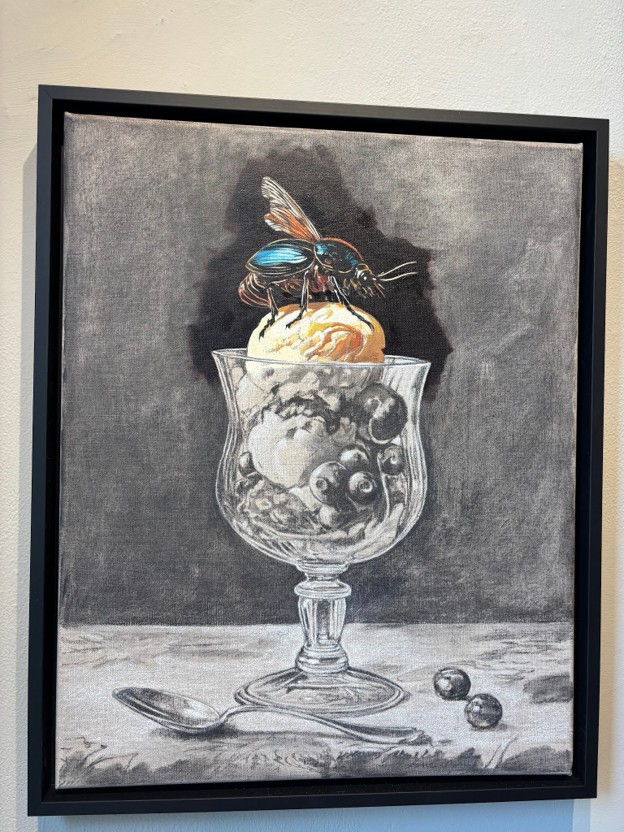
I asked why insects had become such a recurring element, particularly because they are so familiar from 16th- and 17th-century Dutch and Flemish paintings. Myers’ first answer was delightfully uncomplicated: “They’re cool because they’re fun.” He likes the technical challenge of painting the way light plays across an insect’s shell, but he is also interested in the human reactions to them. An insect can make us fascinated or repulsed, creating a foil for the beauty of flowers and human figures.
I pointed out that butterflies seemed to belong to another category, since they can elicit the same sense of beauty and fascination as flowers. Myers has also painted birds and goldfish, but insects have led him into larger questions. What is life? What is the experience of something as small and seemingly insignificant as an insect? Where is the line between something with conscious experience and something without it?
The scale of the insects makes those questions harder to ignore. I pointed out the enormous rolly-polies in one painting, almost as large as the vase beside them, and asked whether the size was intentional. Myers said he wanted them “big enough to make a difference.” The idea came from a walk with his daughter, when he photographed the creatures and later began playing with them in the studio. He also enlarged the ladybugs.
Scale shifts again in Floral Uprisings, where flowers become something almost architectural. Throughout the exhibition, Myers enlarges, isolates, or alters an ordinary element of life, compelling us to reconsider it. Another painting, The Thunder About Me, immediately reminded me of a 1940s movie poster. Someone at one of Myers’ artist talks had compared it to the cover of a magical or fantasy novel. But beneath that cinematic quality is a very personal story.
Myers’ uncle was an artist, enormously talented but troubled by alcoholism. He lived as something of a hermit, and the family didn’t know him well. After he died, they went through his trailer and discovered many photographs of him with a woman none of them had ever met. His uncle had never been married.
I asked whether the painting was based on the photograph. Myers explained it was less about reproducing the photograph than about the experience of discovering that an entire relationship had existed in his uncle’s life without the family knowing anything about it. The image became a way of exploring that mystery, rather than simply illustrating it.
Myers’ technique is equally distinctive. I asked whether he starts with a black canvas and builds the paintings through layers. “There are no layers,” he corrected me. “I don’t paint in layers.” He begins with a dark red, brick or rust-colored primer, then draws the entire composition in pencil, usually white Prismacolor, sometimes black. The primer functions as an intermediate value. He draws the details but does not do much shading at that stage, so the preliminary drawing can look almost like a paint-by-number map of the finished work.
A smaller painting featuring charcoal and oil on raw canvas attracted my attention. I asked why he had combined the materials. Myers cited painter Edward Povey, whose work had inspired him to try the tannish raw canvas with drawing and selective painted elements. But the experiment caused a technical problem, since oil should not be applied directly to raw canvas. Myers repeatedly fixed the charcoal with spray fixative, then applied clear gesso before adding the paint.
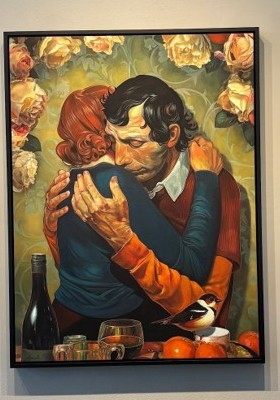
As we continued, I noticed another visual device: the strong outlines around some of the forms. I told Myers they reminded me of animation, where an outline can make a two-dimensional image feel more three-dimensional. We talked about Banksy and even the cartoon-like visual style of cafes in Tokyo where everything seems outlined. Myers had been looking at an illustrator contemporary with Norman Rockwell who used artificial outlines similarly. It was another example of how a historical visual language can suddenly feel contemporary.
Then there was Pinky, which offered a completely different lesson about making art.
Myers called it “a troubled child.” He had painted the face and loved it, but could not make the background work. So he put it away. His wife kept telling him to finish it. He tried several times and eventually, shortly before the exhibition, returned to it and “resuscitated” the painting. It became one of his favorites.
That immediately resonated with me. I told him I have books sitting in what I call my “vault,” unpublished projects that sometimes wait for years before I return to them and realize that ten chapters need to be rewritten. We both recognized the same creative problem, and even the same business lesson: sometimes you keep working because something is worth saving, and sometimes you know when it is time to cut your losses and throw something away.
By the time we finished walking through the gallery, I noticed how his paintings encouraged us to view something mundane in a new way the main reason for creating art in the first place. A flower can become monumental. An insect can become a question about consciousness. A family photograph can open up an unknown relationship. A face can suggest a person without actually being a portrait.
And the outlines, scale, and unusual combinations of materials show an artist who is willing to experiment until something feels right. Myers gives viewers plenty to look at, but more importantly, he gives us reasons to look again.
That second look is where the conversation begins.
Visit him at www.lancemyersart.com
Follow Lance on IG @ lancefevermyers
email: lancefevermyers@gmail.com