
“Sicily, it its peculiar relationship to the mainland, in its literary portrayal, in its history as a site of civil war and as reputed first province, stands as an emblem of empire.”
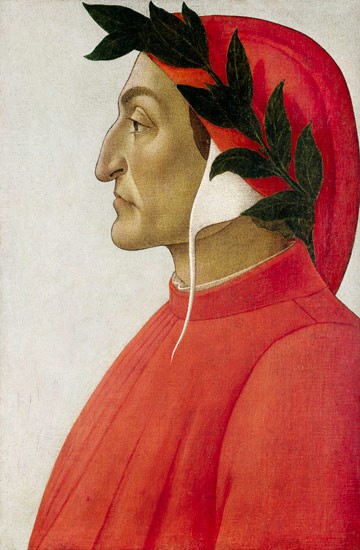
That quote is from this book by Sarah Spence, Professor Emerita at the Univ. of Georgia. This book ranges widely from ancient Rome to Dante, the span of more than a thousand years. For Vergil, Sicily is a model of unity; for Ovid, Sicily is a land torn apart; for Cicero, the island is a repository of ancient virtues; for Dante (pictured here), Purgatory is Sicily. Having been to Sicily three times, I can attest it is all these things.
“My purpose here,” writes Spence, “is to trace how the myth of Proserpina guides the relationship of poetry, poetic competition, and definitions of empire in the changing political worlds from Vergil to Dante.”
The poetic competition she refers to is that between Vergil and Dante (in his Inferno, part of the Divine Comedy). The myth of Proserpina is among the best-known in ancient mythology: she was abducted to the Underworld by Pluto, whose realm it is. Alas for Proserpina, she ate a bit down there, which condemned her to live in Hades forever. However, her mother Ceres negotiated a settlement, whereby Proserpina would be allowed to recover her freedom for half of each year. Vergil “stages his myth of empire in the time between Proserpina’s loss and recovery.” Not a bad deal really – she got to be Queen of the Damned (to use the title of an Anne Rice book) for 6 months a year (Spence does not make this comparison!)
So what does this great myth have to do with Sicily? “Since, at least from the time of Cicero on, the site of Ceres’ loss and her journey [to find her daughter] were identified with Sicily.” For Cicero, this very much played into his real-life job in the court of Rome: the governor of the island of Sicily was the nasty Verres, who was put on trial for his misdeeds. Cicero made the case against him; the texts that have come down to us are famously known as the Verrine Orations.
“For Cicero, the past is presented as golden, and the myth of Proserpina is written as a myth of return: once extricated from its corrupt governor, Sicily will again become the model province,” explains our author. Cicero and Vergil present the situation differently. “Vergil captures Ceres in a state of eternal grieving, and plays out, on an epic scale, the ramifications of the anxiety expressed at the start of the Georgics.” Vergil paints a poetic picture “with images of loss and the impossibility of recovery.” He ends his story with the fate of Proserpina sealed in Hades; no deal struck by Ceres is mentioned.
The richness of the argument so cleverly pursued by Spence can be sensed in this passage:
“The suggestion made in Helenus’s prophecy that Sicily’s relationship to the mainland is emblematic of empire is expanded as Sicily becomes marked by a complicated exchange among a number of poets: through the lens of Lucretius and Empedocles, the epic poems of Homer, Apollonius, and even Vergil come to be viewed as poetic cosmologies.”
This quote from pg 41, however, highlights an important negative. Who is Helenus? His name first appears on page 18, but he is not identified, and is not in the Index! It would take a well-read person to remember that Helenus was first mentioned by Homer as a great seer, or augur. Captured by Odysseus (Ulysses in Latin), Helenus (son of the Trojan King Priam) tells him how to capture Troy. Later (as related by Vergil), Helenus prophecies that Aeneas (another Prince of Troy) will found the city of Rome.
“By the fourteenth century,” Spence writes, “the return of Proserpina had taken on a new turn and was closely allied with the notion of Purgatory,” which became identified with the volcanic Mt. Etna. For Dante, Etna is a place of poetry. And this sets the stage of Spence’s tour de force!
It has long been understood that in Dante, in Inferno XXVI, Ulysses sails past the Pillars of Hercules, which we know as the Strait of Gibraltar. Spence is at her best here: “Where Ulysses goes, literally, is not as important as how we read what he says. Ulysses, in short, is not as important as the poetry about him and the way it is read. If we take his story literally, we enter a trap; if we interpret the higher meaning, as Seneca urges us to do, we see how poetry can illuminate.”
If one could peer into the ‘trap’ Spence warns us about, I suspect we would see hundreds of lost souls of former scholars who were oblivious to the ‘higher meaning’ of it all. I also suspect Dante would be smiling that he has trapped so many know-it-alls.
Just as the ‘ghost’ of ancient Vergil led Dante through the Inferno and out of it to a place of understanding, so Spence leads the reader through this journey, and by avoiding the trap she finds something remarkable. The ends of the earth are not anywhere near Gibraltar. The end of the known world is not the Strait of Gibraltar, but the Strait of Messina. Ulysses got no further than Sicily itself!!!
“This is something Vergil tries his hardest to make clear to Dante without actually calling Ulysses a liar, since Ulysses does not lie.”
In conclusion, I will warn the unwary student of another way to fall into the trap. If you go to Google and type “Ulysses and the pillars of Hercules,” you will be told by the AI Overview (without equivocation) “Ulysses (Odysseus) and the Pillars of Hercules represent a classic tale of boundary-pushing, where Hercules set the limits of the known world (Strait of Gibraltar).” WRONG!
A tremendous book, and the result of a lifetime of study, this should be read by anyone interested in ancient myth and poetry, and also anyone even remotely intrigued by Dante’s Inferno. Quite aside from that, it is a case study in how the ‘received wisdom’ of the past several centuries cannot be taken as fact, as I myself showed by proving the ancient Greek Hipparchus did not invent the numerical six-magnitude system of stellar brightness. That was done by the Roman Manilius. Vergil would be pleased with me, just as Dante would be pleased with Spence.
The Return of Proserpina: Cultural Poetics of Sicily from Cicero to Dante, is by Princeton Univ. Press. It lists for $120 (hardcover), or $39.95 (softcover).
Image: Portrait of Dante by Botticelli, 1495.