
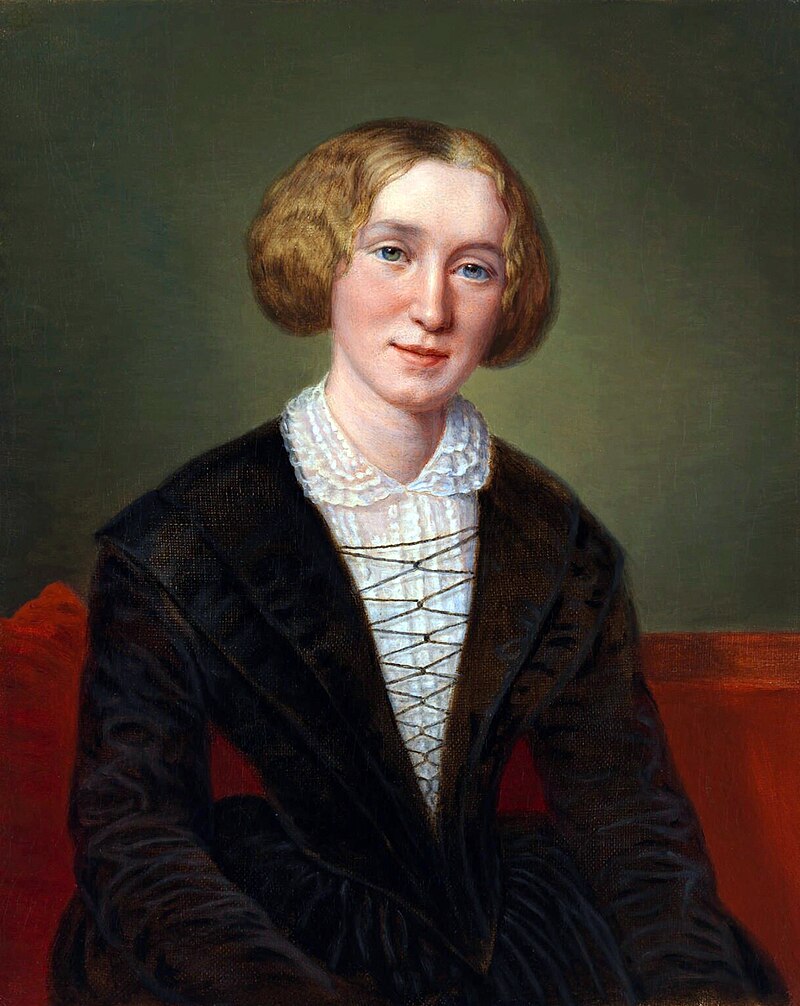
Even before Shakespeare wrote “hap by hap may” in Taming of the Shrew in 1623, Raphael Holinshed employed the phrase “the hap of things” in his famed 1587 book Chronicles. The phrase was often employed as a marker of the uncertain (‘come what may’ as we would now write instead of ‘hap by hap may’). When George Eliot expounded about an “inclination to rest in uncertainty,” she was tapping into this world inhabited by Elizabethan writers.
Eliot (pictured here) is but one of four Victorian novelists forensically examined by Daniel Williams (Bard College, New York) in this amazingly insightful book about the concept of uncertainty (he has a fine discussion of ‘hap’ on page 6). Indeed, the book’s title raises its use to an art: The Art of Uncertainty. It is the dualism of art and uncertainty to which I will next turn.
In 2008 Ruth Yeazell wrote a book relating Dutch painting to realist novels; Williams does reference it here. A review of Yeazell’s book by Simon Joyce (2009) emphasizes the relationship between ‘art’ and Victorian realism by quoting from Eliot’s 1859 novel Adam Bede. Both Joyce and our author focus on a key phrase from that novel: “In which the story pauses a little.” Williams uses this “hesitation – hiatus, suspension” aligned with realism for leverage to explore the character Gwendolen in Eliot’s 1876 novel Daniel Deronda. This proves fruitful, as it allows us to see how Eliot inserts her knowledge of probability gleaned from the astronomer Richard Proctor’s 1872 article Gambling Superstitions. While in this timeless ‘pause’, Gwendolen ponders two likelihoods. “Akin to the object cast in a geometric probability trial (Eliot lifts the image from Proctor), or perhaps the ball in roulette, Gwendolen is poised between likelihoods whose value she dare not tilt toward either outcome,” writes Williams.
This certainly advances his argument in the book, but if we look to the review Joyce wrote, we can see that Williams elides an opportunity here to explore not just uncertainty, but the other key word in the title of the book: Art. Joyce states that after the ‘pause’ in Adam Bede, Eliot goes into a “lengthy excursus that highlights the many ways in which Victorian realism and so-called ‘genre paintings’ worked in common: their shared focus on a ‘monotonous homely existence,’ embodied by Eliot’s image of ‘old women scraping carrots; their resistance to classical abstraction, idealization, and the didactic purposes by which art is made untruthful to lived experience.” There is clearly much to explore in the interstices between ‘art is made untruthful to lived experience,’ and the realist novels under study here. While Williams does not explore classical abstraction or make the artistic connexion here with the novels of Eliot (which would have enhanced his already deep analysis), he does introduce the idea of “narrative art” in his discussion of the works of Thomas Hardy (pictured here).
He finds much of existing scholarship on Hardy to be lacking. After quoting five Hardy experts, Williams is clearly exasperated; he finds some solace in ‘probability’, the same concept he used in the Eliot section. “The extent to which defenders of realist aesthetics and critics of its ideological artifice converge on topics like chance, coincidence, and probability remains striking. Yet such critics often fall into the patterns of the English gambler: they believe at once in a system governing chance operations and, inconsistently, in luck.”
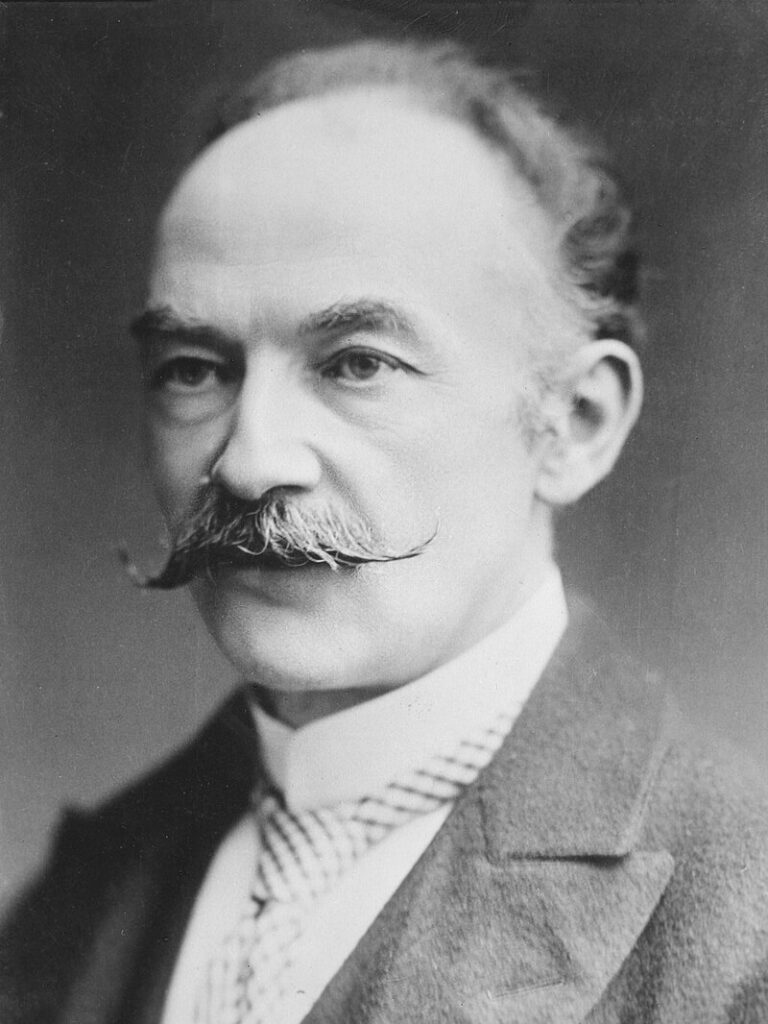
To rescue Hardy scholarship from this quagmire, Williams “canvasses Hardy’s many comments on the nature and function of narrative art to show how his concepts, figures and examples coalesce in an account of realism grounded in probability as a complex representational issue.” In fact, Williams declares, Hardy exemplified “the most achieved and self-conscious version of what I am calling probable realism.” If the intrepid reader can scale the heights of page 200 in this challenging, but most worthy tome, he or she will be amply rewarded. Understanding Hardy’s take on probable realism will make much of the earlier portion of the book seem all the more necessary: like being at the summit of a mountain and gazing back down as base camp. But like most supremely challenging summits, I do recommend an oxygen tank to get you there: in this case, take a break to breathe the fresh air that can be found in the pages of the novels of Eliot, Hardy, and the two other authors Williams studies: William Thackeray and Wilkie Collins (most famous for the 1868 book The Moonstone).
Williams actually arrives at a momentous conclusion on page 105, just halfway through the book (think of it as the midpoint between base camp and summit). After noting that the character Daniel Deronda himself abandoned plans to read mathematics at Cambridge and studied the law instead, and considering the uncertainty inherent in the ‘not proven’ verdict available to juries in Scotland, Williams writes
“At the fulcrum between individual and aggregate, I end here by venturing that, given the allure of statistical tools and ‘trial by mathematics’ in both literary studies and the law, it would be worth reflecting on how the uncertainty that plagues so many accounts of human action seems to call out for a correspondingly uncertain mode of reading.” Invaluable advice for how to read a Victorian novel, if you dare.
A superlative book that embodies what Gwendolen thought of herself: idiosyncratic brilliance.
Reference: Joyce, S. (2009). Review of The Art of the Everyday by Yeazell. Nineteenth-Century Literature 64 (2): 261–264.
The Art of Uncertainty: Probable Realism and the Victorian Novel is by Cambridge University Press. It lists for $110.