
This fact-filled book had been called “essential reading for anyone visiting the Louvre─for those who already know it inside and out and for those who have never been”. This book about the Louvre has been shortlisted for the 2025 French Heritage Society Award and named as one of the Economist’s Best Books of the Year. The American author Elaine Sciolino lives in Paris and knows all aspects of the museum, even its secrets. Sciolino is a journalist and has written five additional books, including the best sellers, The Only Street in Paris and The Seine. Published by WW Norton, the story of the Louvre reaches 352 pages and is priced at $29.99; it is illustrated with 53 back-and-white photographs.
Along with a discussion of the glorious works of art that the museum holds, the author explores its grand galleries, its medieval basement, its lofty rooftops, obscure wings and elaborate gardens. She gained information from those who enable the museum to run efficiently: the curators, the conservators, the docents, the shopworkers, the firefighters and the night guards. They were all enthusiastic and glad to tell her their stories. Visitors, too, confessed their likes, their dislikes, their confusion and their complaints. The museum employs over 2,300 people who work in all areas of the sprawling edifice.
Commissioned by King Phillipe Auguste (1165-1223) as a medieval fortress, the Louvre’s original construction was begun along the Seine almost 800 years ago, designed to house and protect kings. Through the centuries the massive foundation, begun as a defensive castle, was enlarged and adapted over and over to become an enormous luxury palace for kings and royals, as well as a power center of the European world. That held fast until the reign of Louis XIV who preferred to live at Versailles. The famous building holds the long history and intrigues of the French royal families as well as the history of Paris. The labyrinth of enormous art-filled exhibition rooms, endless corridors and confounding stairways of the Louvre lead to almost inevitably getting lost in the vastness within its ancient walls.
The Louvre opened to the public as a museum on August 10, 1795, the first anniversary of the French Revolution. For the first time the people of Paris could actually see the vast amount of royal art, the luxurious rooms, lush decor and extravagant articles that had been amassed within, mostly at their expense. The collection of that earlier era grew rapidly with additions from the palaces of guillotined aristocrats, from Versailles, from churches and monasteries. The Louvre holdings expanded greatly with artworks gained through French conquests and plunder of third- world cultures, especially Napoleon’s conquest of Egypt. (Napolean hung the Mona Lisa in his bedroom.) The aged structure contains over 400 rooms, each with a variety of decorative styles. These exhibit halls display about 30,000 artworks from its collection of a half million holdings.
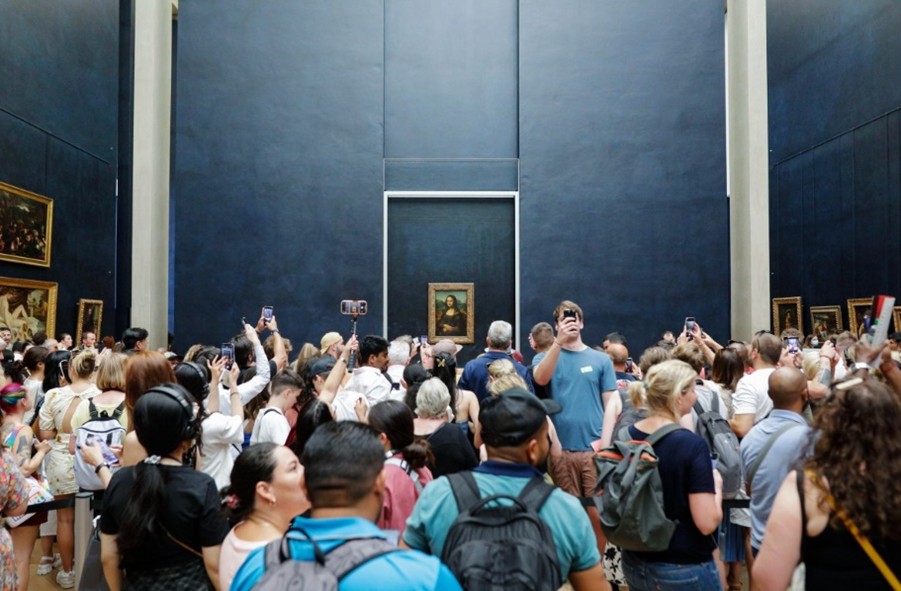
The book discusses some of the artworks in the museum but spends more time on the top three, the Mona Lisa, Venus de Milo and the Winged Victory of Samothrace (Nike) which draw the most visitors. Many head for the big three; then the goal is accomplished and they bypass works just as beautiful. The author devotes an entire chapter on the most famous painting in the world, the Mona Lisa, which is desperately in need of cleaning, but to take her from view would be a sacrilege. There are three other Leonardo da Vinci paintings in the same gallery but they are totally ignored because of the huge, overwhelming crowds intent on capturing an image of that small painting.
Because the Louvre is badly in need of repairs and suffers from overcrowding, President Macron has presented renovation plans to bring the museum up to modern standards and heighten security. The museum averages 30,000 people per day and often surpasses that. The restoration will take nearly a decade to complete and will include a new entrance on the river side of the building and a nearby dedicated room for the Mona Lisa and the other Leonardo paintings.
The book reaches into some of the more contentious situations concerning the museum. The Louvre has extended its presence in the world by an arrangement to loan its name and some works of art to Louvre-Abu Dhabi which has upset many people. There are museum possessions that are thought to have been looted during WWII and are awaiting to be reunited with owner families. Other valuable artworks and artifacts that may have been obtained from looters are under investigation. The initiative to return certain artworks to their original homes is powerful and very controversial. The Louvre even contains some marble relief carvings from the Parthenon which have not been requested back yet. Don’t tell Greece.
“The Louvre is an ageing, organic structure, ever changing, adapting, expanding, deteriorating.” The origin of the name ‘Louve’ is ancient, used for that area before the fortress was built, but lost to time. It is the largest museum in the world; a walk through every room would requite nine miles of exercise. Their collection is not universal; it is limited to European cultures and those that it derived from, Greece, Rome and Egypt. Their European art dates mainly up to 1848; artworks created after that period can be found in the Musee D’Orsay and other Paris museums. To truly enjoy the Louvre and its countless stimulating artworks, you need to take your time, avoid the guided path and wear comfortable shoes.
lead photo: crowds in front of the Mona Lisa, on display at the far wall.