
Placing Julie of Saxe-Coburg in the tangled web of European royalty is actually quite easy: she was the niece of England’s Queen Victoria. And she came very close to being the Empress of Russia.
This engaging portrayal of her life is by Helen Rappaport, an expert in Imperial Russian history, and NY Times bestselling author.
Like other women born royal or aristocratic in the 18th century, Julie had no choice in who she would marry. Catherine the Great, Empress of Russia, decided it was time for her grandson Constantine to marry. Since Catherine herself was born a German (Princess of Prussia), she naturally looked to Germany for a suitable bride. There were several to choose from, and religion didn’t matter: if one married a Romanov, one had to convert to the Russian Orthodox church.
When Julie arrived in St. Petersburg, she entered the Winter Palace “full of paintings statuary, furniture and artefacts collected by Catherine over the past 33 years.” No palace in Europe was more splendid! This contrasted mightily with her home in Saxe-Coburg, which was but a poor and rather small duchy.
When Catherine met Julie, the Empress was 66 years old and in the last year of her life. But she knew how to throw a party. “Catherine laid on a spectacular masked costume ball for 7,000 at the Winter Palace to honour her guests before their departure.” These guests were Julie, her sister (also in contention for the bridegroom) and their mother Auguste. As a parting gift, Catherine have Auguste 60,000 rubles, which was several times the entire annual income of Saxe-Coburg! This was in addition to a fabulous suite of diamond and pearl jewellry worth an untold fortune. Julie received a diamond bracelet, and not too long after that an invitation to become a Grand Duchess: she was to marry Constantine.
The main focus of the first half of this book is her disastrous marriage to Constantine, who was an unbalanced monster. His thoughts were only military, and his idea of using cannons was firing live rats of out them. His “despicable cruelty to animals” went far beyond that, but I will forbear from repeating it here.
“The violence extended to Julie; he dropped her into a huge Chinese vase and proceeded to fire his pistol at it.” Eventually, Julie used the pretext of visiting her mother in Saxe-Coburg. She left Russia, and never went back. Fate nearly changed that resolve: in 1825 Constantine was proclaimed Emperor of Russia, but within days he abdicated. For that short time Julie would have been Empress, except for one thing: her marriage had been annulled in 1820.
After 1820 her life changed dramatically, sensitively portrayed by Rappaport as she gives us much detail that is contained in archive letters that have never before been accessed. Julie very secretly had 2 or 3 children out of wedlock, one of whom became Baron von Löwenfels. In a very curious twist of fate, he accompanied Prince Albert for his 1840 wedding to Queen Victoria; it is thought Victoria was unaware this handsome young man was actually her great-nephew. He is shown in a photo among 8 plates of images, mostly in beautiful colour.
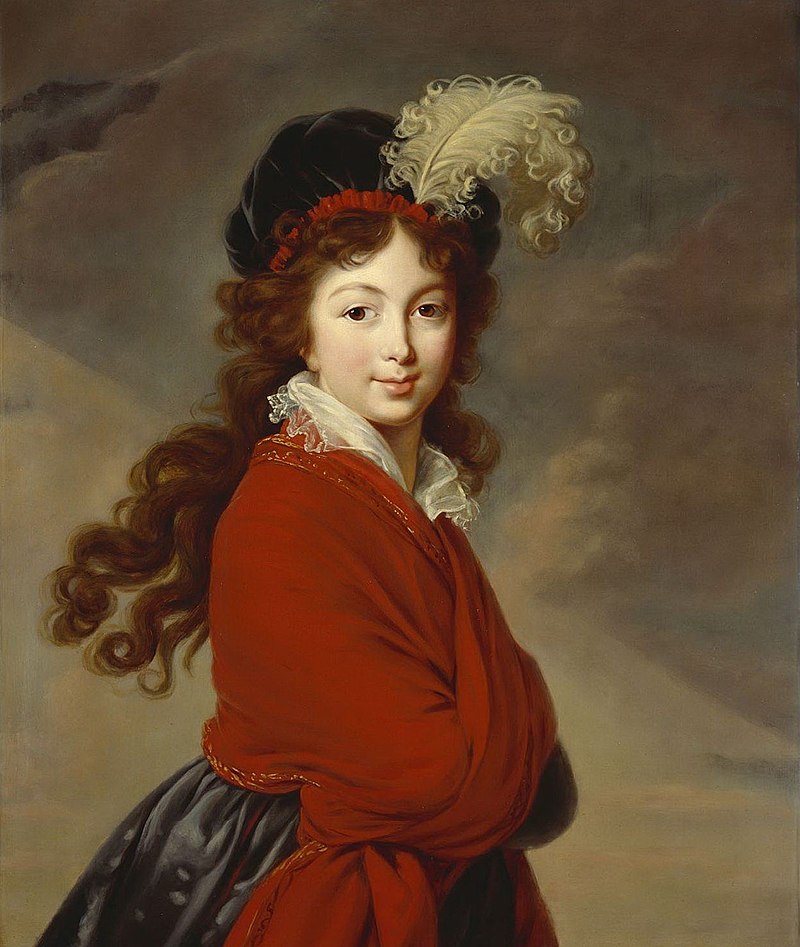
In 1814, Julie moved to Switzerland, outside Bern. Her house, dubbed Elfinau, became a magnet for visitors from all over Europe. Prince Albert visited her there in 1837. By 1843 Julie’s brother had become King of Belgium, and she first met Queen Victoria there that year. They spent two heartfelt days together. Victoria wrote of Julie that “She is so cut off from her relatives, her position is so painful and unfortunate, that I feel most deeply for her.” Strangely, “no image of Julie is to be found anywhere in Victoria and Albert’s vast collection of family photographs.” The painting shown with this review does, however, capture her spirit very well.
In her final years Julie moved to ever-smaller residences in Switzerland; the last had also been lived in by the composer Richard Wagner in 1856; and from 1862-63 by the writer John Ruskin. Upon her death in 1860, she was buried in Bern. “Prince Albert, in a sentimental gesture, commissioned a noted local professional to take photographs of Julie’s grave.” Just a year later, Prince Albert himself died young. Fate was not kind to Julie even in death. In 1913 her coffin was moved to a cemetery a mile way, only to be “swallowed up in a landslip. A small commemorative plaque bearing the words of the original marble slab has been placed in the vicinity.” A beautifully-written book.
Ultimately a sad and depressing tale, the author has shone a light here on what life for royalty was really like during the period. In a tumultuous 78 years, Julie experienced the highest highs and the lowest lows. Although Rappaport does not refer to it, Julie’s existence recalls to my mind a few lines from Shakespeare’s Hamlet:
To die, to sleep—
No more—and by a sleep to say we end
The heartache, and the thousand natural shocks
That flesh is heir to. ’tis a consummation
Devoutly to be wish’d.
Portrait of Julie by Elisabeth Le Brun, done in 1795; now in the Pushkin Museum in Moscow. In the public domain.
The Rebel Romanov: Julie of Saxe-Coburg, The Empress Russia Never Had, is by St. Martin’s Press. It lists for $32.