
It is typical for an author to summarise the chapters of a book in the Introduction. Sort of like a film teaser, where you get a glimpse of the best parts, inducing you to actually pay to see what the director has created. Michael Maas (Professor of History at Rice University) has done just that here. It is particularly valuable in this case, because the stakes are so high: he investigates “How the rich matrix of classical antiquity in the Roman Mediterranean developed into what we label the medieval world.”
As Maas warns at the outset, there is no single cause. “No timely asteroid struck to finish off the dinosaurs of the classical world.” To explore the evolution of this ‘rich matrix’, Maas offers, instead of a smouldering crater, 269 pages of analysis. Add in all the notes, bibliography, and index, and the book swells to 432 pages. Maas focuses on the period from the third through the seventh centuries CE.
This book is a study in ethnography, and while the word has Greek roots, it was not actually coined until 1767. However, he states, “Ethnographic interest, by which I mean displaying curiosity about foreign people and developing shared ideas about their differences,” does have ancient origins, likely all the way back to the origins of humans.
But more to the point here is the intersection of the Roman Empire and Christianity. “Romans believed that barbarians could become civilized and included in the Roman social and political order. Romans also created the framework in which Christianity developed.” As time went on, “faith became the prime marker of an individual.” Up until then, the salient characteristics were defined in terms of one’s natural environment. “The explanatory shift added up to nothing less than an ethnographic revolution.”
At a philosophical level, “the Christian imperial community required breaking the natural bonds of the stars and earth.” This ‘astral determinism’ was often expressed in what we call astrology. At a practical level, “Christianity offered a kind of liberation for people trapped by the stars or geography. We find the emergence of an ethnography in which prayer was efficacious, baptism nullified the influence of the zodiac, conversion to another way of life was possible, and humans could choose whether or not to follow the correct teachings of their faith. This was the imperial ethnography of a nondeterministic universe.” Heady stuff indeed!
But astral determinism was not the only one at play. “The initial phase of environmental deterministic theory began in the fifth century BCE, when Greek writers tied the natural environment to the political and cultural character of human communities.” For example, it was thought that “a hot climate makes men cunning.” (Persians lived in a hot climate)
Maas identifies the Roman historian Polybius as writing “the first known extended discussion of how what we might call ethnic characteristics can result from environmental factors.” Polybius discussed the Arcadians (in central Greece), which was his own homeland. He showed through their example that people can introduce new institutions and customs to transform their societies and escape the grip of natural forces. “It is a powerful idea that took deep root in Roman imperial views and would flourish well into the sixth century at Constantinople and beyond.”
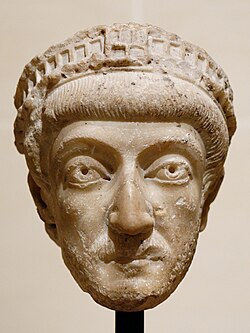
One of the key factors that shaped the Roman Empire was its relationship with Persia. There are so many accounts of war between Greece, and then Rome, that it comes as surprise to learn what happened in the 5th century. By this time, power had shifted to Constantinople, in what became the Byzantine Empire. In the year 508, the emperor Arcadius, realizing he was approaching the end, needed to find someone to protect his infant son Theodosius. “The emperor devised an ingenious plan. In his will he named Yazdegerd I of Persia to be Theodosius’ guardian, urging him to preserve the empire for his son.” Amazingly, the Persian king agreed, “and there was no warfare between Rome and Persia” during the king’s reign, which ended 12 years later. Theodosius II (pictured here) lived for 49 years (Arcadius only made it to 31), 42 of those years as sole Emperor. It is one of the amazing stories related by Maas in a survey of how the Romans dealt with a host of foreign peoples on its enormous border.
So what is the ‘conqueror’s gift’ that is the book’s title? “Roman ethnography set terms of order for imperial activity,” writes Maas. “It offered conceptual guidelines for familiarizing the unknown, and it animated the judgements about non-Roman peoples required in everyday governing.” Built up over centuries, this “infrastructure as a whole, that is, the corpus of ideas it sustained, was the conqueror’s gift.”
A landmark study that synthesizes a vast array of data, this study reveals clearly for the first time details of how the Roman Empire (both East and West) engaged with foreign peoples. The processes of assimilation, exclusion, war and peace, astral and environmental determinism all have resonance with how our world of the 21century is being shaped. This is a book for their time, for our time, for all time.
There are two typos: on page 76, “in the year 408” should be “in the year 508”; on page 178: “one of use” should be “one of us”
Image: Bust of Theodosius II. Held at The Louvre. Courtesy of Wikimedia Commons.
The Conqueror’s Gift: Roman Ethnography and the End of Antiquity is $49.95. It is by Princeton Univ. Press.