
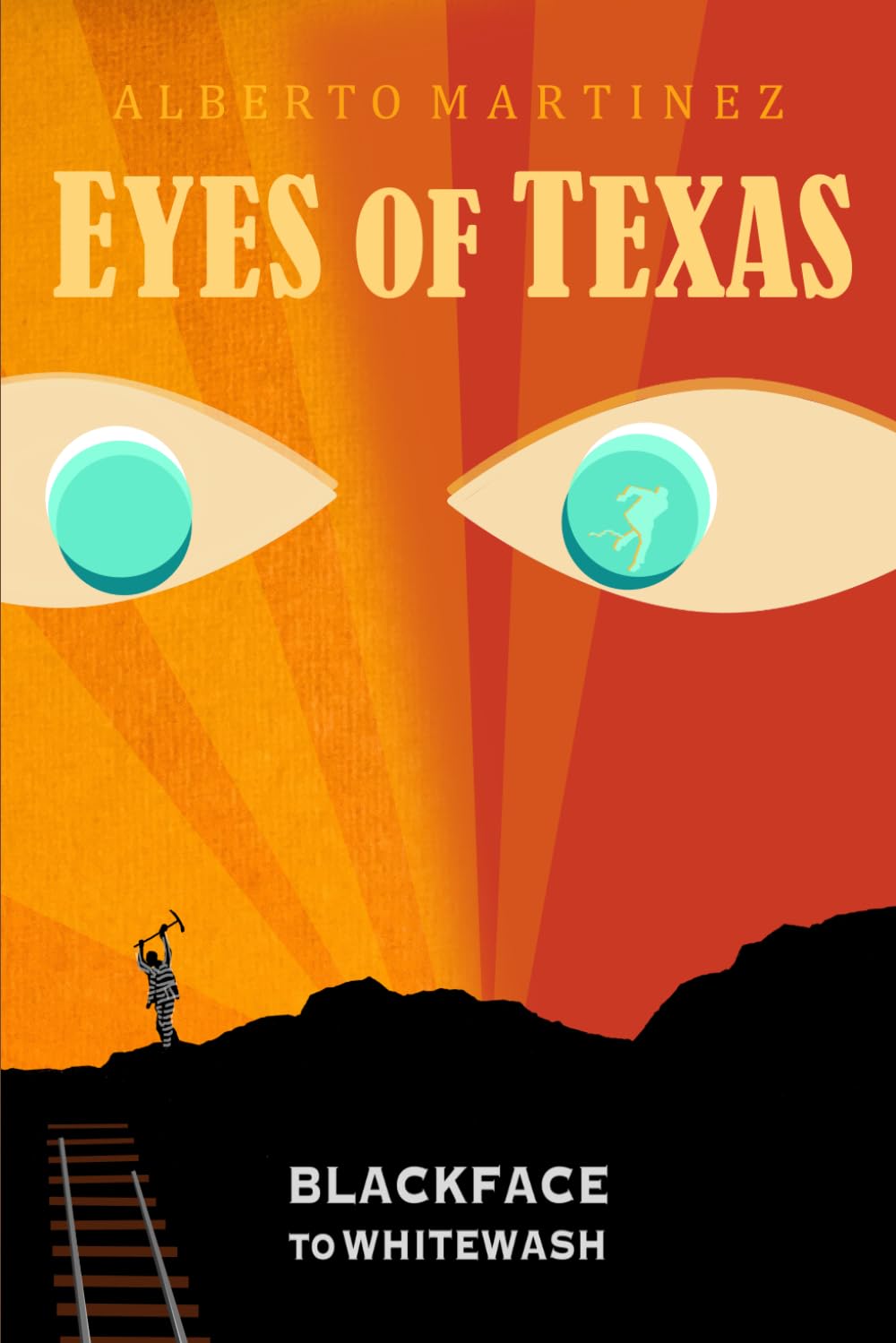
“I knew that the song was strangely creepy,” said University of Texas Austin Professor Alberto Martinez in his book talk at Livra Books this week. He was referring to the well-known tune The Eyes of Texas, the subject of his latest book. This is not just another book about Texas: it is essential reading for anyone who cares about this state.
Just a few years ago, “There was a move to delete the song, but UT president Jay Hartzell decided to keep it. He didn’t consult the students, he didn’t consult faculty council, he didn’t consult the staff council. He just decided to just keep the song.
“And I know because I asked him, I asked him on faculty council: was it your decision? He’s like, ‘yeah’. And he said that he would create a committee to analyze the history of the song, but the song stays.”
“And that sounded very weird because I would have thought that if the song is offensive, then maybe we should do the analysis first and the decision later, but of course, the business class does things differently. And of course, Hartzell was dean of the School of Business here and they have different priorities.” [following a 2024 vote of no confidence by the faculty, Hartzell announced he is quitting UT this year]
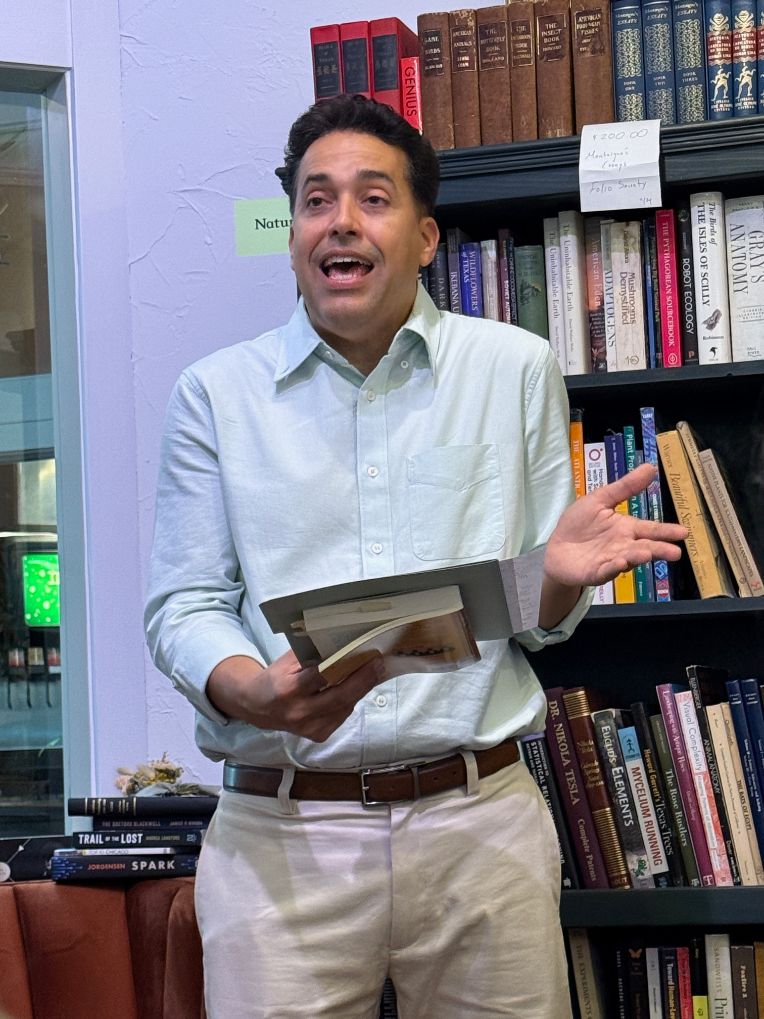
“So eventually committee report came out in March of 2021,” Martinez explained at Livra Books (pictured below). “I’m reading this thing and saying to myself, this doesn’t make any sense. For example, the report didn’t say exactly who wrote the song. Is it one character or two guys? It didn’t say exactly who were the first people to sing it, or where it was first sung. And so, there were several ambiguities. So, what I wanted to know boiled down to one thing: was the song written for a racist event? Was it written with a racist purpose? And the answer to that was not clear at all in the report.”
Martinez began searching online historical records, old newspapers and archived letters. He published some articles on this research, but after he realized the mass of information was so large, it merited a full book. The first edition of the first printing is dated 31 May 2025.
The song was written, in Austin, for a blackface minstrel show in 1903. “Now minstrel is a very old word that sounds like it’s something like a musician from the Middle Ages, but what it was at the time was an American entertainment genre in which mostly white people painted their faces black to make fun of black people.”
John Sinclair wrote the song, but not by choice. Lewis Johnson was president of the Glee Club at UT; together with other Glee Club members they literally locked Sinclair in a closet and told him to write a song for the minstrel show. Martinez found letters by the author, Sinclair, admitting again and again that he wrote the song for the minstrel show and only for the minstrel show. That didn’t appear in the official UT report.
In 1920 UT’s official faculty committee of musical organizations banned and censored the song. It was already recognized as vulgar and not dignified in 1920! Even though the song The Eyes of Texas has been embroiled in controversy for a century, it is still being used at the University of Texas.
In the book, Martinez records that between 1890 and 1899, at least 108 black persons were lynched in Texas, and it continued for years after that. Even writing a letter to a white woman was enough for the death penalty. How could this happen, since slavery was abolished in 1865? Martinez explained to the gathering at Livra Books that laws were passed in the 1870s making vagrancy a crime. So newly emancipated slaves who did not have a job were arrested, became convicts, and were fined. But of course, they had no money to pay the fine, so they were ‘hired’ by the same people who owned them as slaves. But now that the ‘convicts’ were free for the taking, they had no value, unlike the worth they possessed as a slave. In 1902 a joint committee of the Texas legislature set out to document how (mostly) black people were being treated.
This second investigative committee went to see what’s actually happening in these railroad camps (the front cover depicts a convict, wearing prison stripes, labouring to build a railroad track; they were also used to build the State Capitol building). The committee discovered the lives of convicts were valued less than the lives of dogs. In other words, they declared it as an official discovery.
“They found that the average life of a convict was a terribly short seven years. So they were not just being tortured, they were being killed.”
“The report explained, and I quote, 1902, ‘Convicts are shot down on the least provocation.’ So, it’s not just overseers making sure you don’t get away: it’s men with rifles.” The best time of day to escape the daily terror show was at night or early in the morning, but most were recaptured anyway.
Just a year later, The Eyes of Texas was written, and in light of what was happening in Texas at the time, the horrific meaning of the song finally becomes clear. Here are the lyrics:
The eyes of Texas are upon you,
All the livelong day
The eyes of Texas are upon you,
You cannot get away.
Do not think you can escape them,
At night or early in the morn,
The eyes of Texas are upon you,
Till Gabriel blows his horn.
These are the lyrics that the Texas Attorney General, in 1936, said could not be copyrighted because it would be “like copyrighting the four Gospels” – of the Apostles of Jesus Christ. “Till Gabriel blows his horn” means death, in this case by murder.
“This is striking,” Martinez writes in the book,” because it shows how a public joke in a racist comedy, which got uproarious laughter, evolved in some people’s minds to become instead a cherished, holy ritual.” Truly, a level of sickness that is so depraved, words fail to describe it.
In 1928, Lewis Johnson referred to The Eyes as having gained “a more sacred position than the Star Spangled Banner.” The sanctification of the song is but one of 11 layers of whitewash that Martinz has identified and exposed in this book, which I would rate as the most important Texas history book you will ever read.
UT head coach Tom Herman respected the concerns of the UT Longhorn band in 2020, when more than half of them refused to play the song at football games. Herman further allowed the football players the right to step off the field when it a recording of the song was played (since the band did not play it live). Herman, who had a $6 million salary, was fired in 2021. He was replaced by Steve Sarkisian, who said to the media “The Eyes of Texas is our school song. We’re going to sing that song. We’re going to sing that proudly.”
The Eyes of Texas: Blackface to Whitewash is available on Amazon for $13.95
Photo: Dr. Martinez at the book launch, at Livra Books. Photo by C Cunningham
Visit Livra Books in Austin, which has a wide range of intellectual titles:
Livrabooks.com