
Much more than a book about Roman theatre, this book represents a seismic shift in our understanding about the origin of Rome. For many if not most scholars, this new understanding will only be reluctantly accepted.
Cicero famously set the date of 240 BCE as the beginning of Roman theatre. This was not the case according to Peter Wiseman (professor of classics and ancient history, Univ. of Exeter). Wiseman is not some newly-minted professor trying to upset the applecart: he has been a professor for 50 years, and this book represents his truly expert conclusion based on a lifetime of study.
He points us to a certain Dionysus of Halicarnassus, who wrote a history of early Rome between 30 and 7 BCE. “His aim was to show that Rome had been a Greek city from the very beginning, and he was unaffected by any Roman prejudice in favour of virtuous frugality.” The idea of the ‘poverty of ancient Rome’ was just a convenient myth.
“Modern historians,” explains Wiseman, “are reluctant to believe in Lucumo as a real historical figure, but it seems to me that such doubts are unnecessary.” Lucumo was the son of Demaratus from Corinth in Greece, and he became the fifth king of Rome in 616 BCE under the Latin name Lucius Tarquinius Priscus. All this is relevant because, among other improvements to the city of Rome, Lucumo “founded the annual festival, known as ‘great games’ because of the great expense involved, that later became the ludi Romani.” (the Roman Games)
So where did all this money come from, if the Romans were supposed to be so poor? Dionysus tells it was the vast wealth Demaratus brought from Corinth, which was inherited by his son. Wiseman then lays down a marker that will challenge many scholars who have relied on the histories as written by Cicero and Livy: “So yes: surprising as it seems, Dionysus did have better information about early Rome than either Cicero or Livy. And unlike their romantic idea of virtuous poverty, it is wholly consistent with the material evidence for prosperity and architectural splendour that has emerged in the last fifty years.”
For those not familiar with the halls of academia, all this will come as a great shock. But without giving even a moment’s break, Wiseman doubles down in the very next sentence. “The notion of Rome as a Greek city, apparently so paradoxical, turns out to be perfectly credible. There is no reason to think that Rome had any kind of urban identity before the arrival, in the second half of the seventh century BC, of wealthy Lucumo.”
Within a few pages he discounts the conclusions of certain scholars (who he names) on the history of Roman drama. He points to a major exhibit in 1990 that was the first to assemble material for the sixth and early fifth centuries BCE. “It is now clear that Rome at that time was an integral part of the archaic Greek cultural world…Even the best scholarship on Roman drama has been reluctant to take account of this shift in historical understanding.” This should be a wakeup call to the academic community, but more important, it should be a clarion call to young people just entering the academic field: don’t waste decades of your career on false premises and supporting the status quo. The field of classical studies can move ahead rapidly instead of glacially. It’s been 36 years since the 1990 exhibit, and the academics are still dragging their feet. Preposterous, and unscientific.
While this book is very much about the development of Roman theatre, it is equally about such scholarly ineptitude. It was not until the 1870s that classical experts “first considered the possibility that Roman historians drew on plays as sources for their own narrative. Given that Livy actually states that the murder of Servius Tullius was a subject for tragedy, it was surprisingly late that this story was cited as evidence for a lost historical drama.” The first “full argument” was made by Henry Wright in 1910, “but even the best ideas can be forgotten,” laments Wiseman.
It was another 40 years before Henry Bardon surveyed lost Latin literature, but he “brushed aside the whole notion of plays detectable in historical narrative. Things got even worse in 1965,” writes Wiseman, when Robert Ogilvie stated “It is certain that Livy does not depend Ennius or an unknown Roman tragedian. With a profound interest in psychology, he is writing tragedy not copying it.”
At this point Wiseman expresses profound exasperation. “That was two generations ago. Are we still content to accept dogmatic authority, or should we decide on the basis of the evidence? I think the latter is preferable.”
Even though the treatment of Roman satire by Suetonius is ‘lost,’ our author shows us that it has been possible to recover enough of it “to see that it contradicted both Livy and Quintilian. By taking Suetonius’ view seriously we can dispense with the modern dogma that Roman satire was a non-Greek and non-dramatic genre created by Lucilius in the 2nd century BCE and consisting of four authors only.” Wiseman contends the serio-comic performance tradition may extend all the way back to the Roman festivals founded by the Tarquins, which includes Lucumo.
Current scholarship has also completely misrepresented the nature of Roman satire. “The modern orthodoxy that Roman satire was written solely to be read in books, not delivered to an audience, fails to account for the fact that ten of the forty poems in the Horace, Persius and Juvenal collections were composed in dramatic form.” Suetonius understood satire as a performance genre, it is only the highly-educated classicists of our time who can’t comprehend it for what it is!! Wiseman is emphatic: Satire “was always for performance.”
By examining all the Greek quotations in Cicero’s letters, Wiseman concludes that Doric Greek poetry was familiar to Romans of the late Republic because they heard it performed on the stage in Rome. This gives us yet another glimpse into “the lost world of Roman public entertainment.”
A book of tremendous worth. If you already have a library of books about the Roman theatre, I suggest you take them to Half Price Books. You won’t get much for them, but since are worthless after this magisterial work by Wiseman, you will actually be getting something for nothing.
The Lost History of the Roman Theatre is by Princeton Univ. Press. It lists for $22.50.
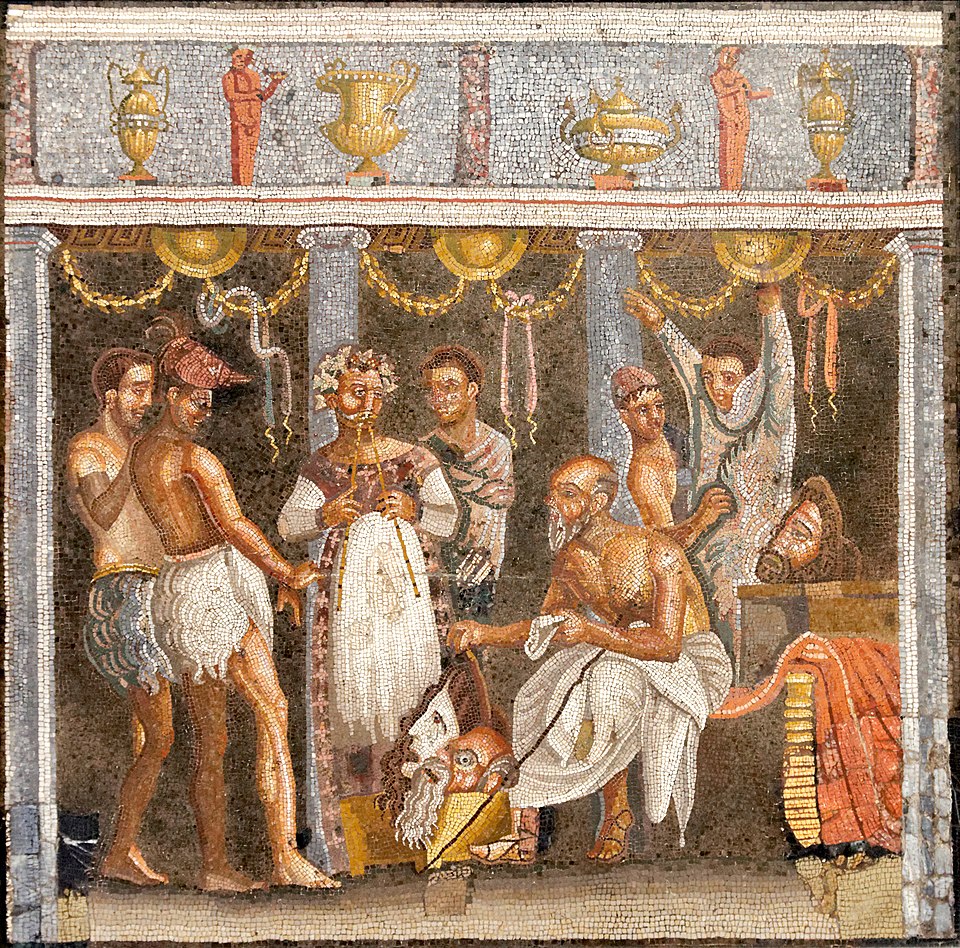
Image: From the House of the Tragic Poet (VI, 8, 3), Pompeii. Roman mosaic depicting actors and an aulos player. Courtesy of Wikimedia Commons.