
This fascinating historical study of representations of masculinity is edited by Konrad Eisenbichler, a professor in the department of Italian Studies at the University of Toronto. He has received numerous honours from both Italy (a knight commander in the Order of Merit, in 2014) and Canada (the Order of Canada, in 2023). The book is written by 10 expert scholars, but curiously, the editor wrote only the acknowledgments. The period covered in the book is roughly 1435-1735.
A “primary signifier of maleness,” writes James Saslow (City University of New York) in the Introduction, was facial hair. This got a kickstart in 1511, when Pope Julius II started growing a beard “as a classical sign of mourning for his military defeats. But his temporary grooming model was copied far, fast, and long because it answered a need for substitute outward signs of virile masculinity to compensate for those that were disappearing. If men could no longer be eagles, they would at least be peacocks.”
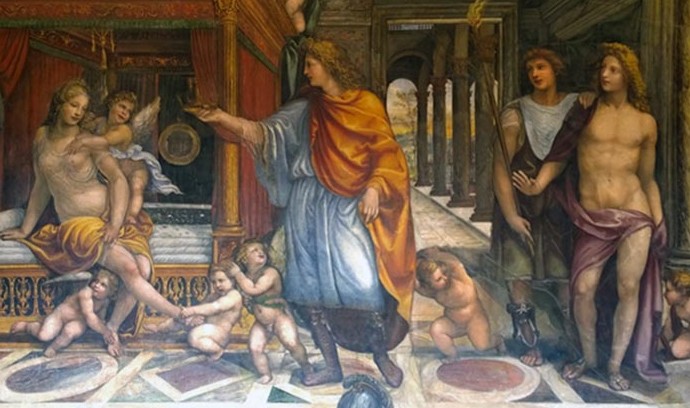
Saslow writes that 2019 he “published a study of the Italian artist Sodoma, more conclusively homosexual than Botticelli.” The photo with this review shows one his most infamous works, The Marriage of Alexander the Great and Roxanna. The key figure here is not Roxana, but Alexander’s boyfriend Hephaestion, standing nude at the right. He looks longingly at Alexander, wishing himself to be the one about to be married. It certainly brings to mind the Christian mythology of “John the Baptist graciously giving way to the greater destiny of his near-twin, Jesus.”
“My initial intuition,” states Saslow, “wonders whether Sodoma or his learned, often libertine audience, might have had this Biblical text in mind when gazing upon his scene of passionate bisexuality. Here, as with the Baptist and the Evangelist, Classical and Christian, body and spirit, male and female swirl together into a dense cloud of fluid, overlapping gender possibilities yet to be fully unpacked.” [don’t mention this to any Red state governor, lest they ban the book, after getting a copy for their own library].
One look at Leonardo’s painting of Saint John the Baptist (page 53) will set masculinity alarm bells ringing. “The beauty of John’s fleshly appearance” is diametrically opposed to the concept of masculinity in the modern era, exemplified by mythical figures such as Superman.

“The depicted body of Saint John,” writes Anne Williams (Univ. of Hong Kong), “is undeniably sensuous. This has led to modern interpretations that cast the saint as not only androgynous but even blasphemous, while the image’s religiosity is overshadowed by a desire to see the saint’s beauty as a reflection of Leonardo’s alleged homosexuality.” But the intent of her chapter is to explore whether this modern view is misplaced. She explains that “John’s fleshly appearance according to a period understanding is substantiated particularly by Protestant critics of the Catholic cult images, as well as by the painter and critic Giorgio Vasari writing in the mid-sixteenth century.” She concludes that period conception and Leonardo’s own notes “both suggest that the perception of any ambiguity between spirit and flesh is a misinterpretation.” John’s beauty is not just an expression of Leonardo’s appreciation for “the beautiful, young male form.” It must, instead, “be understood within the context of its theological function, which would certainly encourage the ’homoaffective,’ not just the homoerotic.”
How all this played out in real life is explored by Laura Smoller (Univ. of Rochester) who notes the charged relationship between a monk’s vow of chastity, and a key “marker of manliness, the fathering of children.” The answer created by the Church Fathers portrayed the “struggle to maintain one’s chastity in military language, with clerics fortified by spiritual armor.” Nothing is more masculine than the military! “The potentially fallible, eroticized male body, thus, was the crucial foil to the cleric’s heroic virtue.” This charade did little to persuade many that it was merely a cover for sodomy. The city of Florence actually created the Office of the Night because the city had acquired the “reputation as a hotbed of sodomites!!” That was in 1432. That the Catholic Church still grapples very publicly with this issue centuries later proves it was not just a rumour.
The effeminate masculine type was grist for the mill in Florence. The author and singing performer Margherita Costa (1610-1658) was the most successful female writer of the age. In her chapter on Costa, Sara Diaz (Fairfield University) writes that she “consistently presents the gallant’s studied beauty as a non-normative construct that threatens the comfortable limits of prevailing gender binaries.”
Luckily, there was someone who gave advice to men with “a soft womanish voice” to take on the marks and tokens of a gentleman. Levinus Lemnius (1505-1568) explained “His manner and conversation, honest and virtuous, his nature quiet, courteous, subject to no ill affections…In him plentifully appeareth humanity, gentlenesse, frugality, equity, modesty, and a continent moderation of all affections.” Lemnius goes on to list other aspects of a masculine man, such as “portly dignity” and a “bolt body upright.” (Sounds a lot like Superman) This chapter by Tiffany Hoffman (Univ. of Toronto) also explores Shakespeare’s works. All the actors in his plays were male, even though many of the roles were female. The “performative construction of masculinity” on the London stage was of great importance.
“The Shakespearean stage helped to advance an idea of early modern manhood already evolving in the court circle as a gendered category virtuously conditioned through the curb of modesty and the public performance of civilized masculinity.” But, she warns, the new definition of modesty “could challenge the proper development of a man’s identity.”
As this brief survey shows, the book is replete with insights into the development of masculinity that is still very much with us today. A very fine addition to the scholarly literature, this edited volume deserves to be widely read and carefully studied.
There are several illustrations in the book; unfortunately, none are in colour.
The study of masculinity is a very active one, not confined to the Early Modern era of this book. I refer the reader to a paper by Mashaekh Hassan (2025) in the reference below.
Lead Image: detail from The Marriage of Alexander and Roxane, a fresco by the Italian Renaissance artist Giovanni Antonio Bazzi, also known as Il Sodoma, completed around 1518. It is in the Villa Farnesina, Rome.
Second image: St. John by Leonardo. Courtesy Wikimedia Commons. Held by The Louvre.
Masculinities and Representation: The Eroticized Male in Early Modern Italy and England is by University of Toronto Press. It lists for CAN $100 ($73 US)
Reference:
Hassan, M. (2025). Masculinity in Flux: Media Representations and the Shaping of Gender Norms Across Cultural Contexts. International Journal of Research and Innovation in Social Science.