
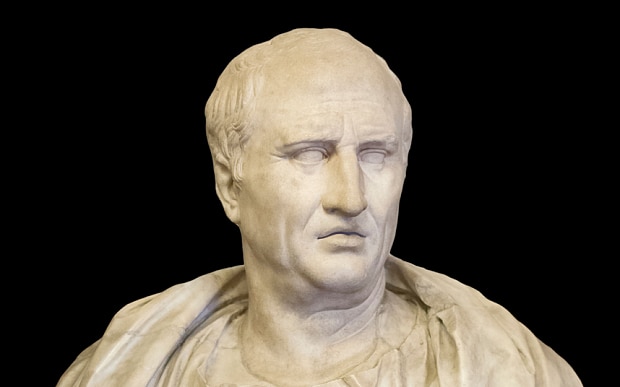
Photo: a marble bust of Cicero
“The existence of a man of immense authority whose anger has political currency threatens the survival of the Republic.”
No, this is not a Democratic talking point for the Congressional elections of 2026 (although maybe it could be). In reality, it was Cicero’s view of Antony (of Antony & Cleopatra fame). The date was 2 September 44 BCE, and it came just about six months after the assassination of Julius Caesar on the Ides of March. If any moment in the entire history of the Western world could be considered pivotal, this was it.
“Cicero refers to Antony as an angry man,” writes Jayne Knight (Senior lecturer in Classics at the University of Tasmania, Australia). Her book is a thorough exploration of anger and politics in ancient Rome.
“Antony’s anger is made even more dangerous by the fact that he is in the habit of using violence to get his way. Cicero makes a proposal to Antony concerning his anger. If Antony cannot prevent himself from becoming angry at Cicero for speaking on behalf of the Republic, Cicero asks that he show his anger as he would to a fellow citizen, and not to a foreign enemy.” As we all know, speaking on behalf of the Republic often raises the ire of men of immense authority.
Cicero himself said “But why should I seek to make an impression on you by my speech? For if the end of Julius Caesar cannot influence you to prefer being loved to being feared, no speech of anyone will do any good.” It’s quite amazing that human nature is unchanged in more than 2,000 years, despite the supposed benefits of the Enlightenment and scientific advances. “What will this man do?” asks Cicero. It is a question many are asking now.
Knight tells us that “Antony’s anger was further inflamed by the First Philippic. By the Fourth Philippic, delivered a few weeks later, Cicero “characterizes Antony as a public enemy.” As history shows, it was Cicero who died first, just a few months after his diatribes against Antony. His murder took place on the direct orders of Antony. The Roman Republic, which seemed invincible after five centuries, fell. Yes, one angry man can topple the Republic.
It was all horribly ironic, as Cicero was earlier in his political career given the title “Saviour of the Fatherland.” During the famous conspiracy by Catiline, Knight relates, “Cicero says that he is willing to incur invidia if it means that the Republic will ultimately be safe from Catiline. He contrasts his self-awareness and devotion to the Republic with Catiline’s disregard for Roman values, laws and emotional norms.” Again, eerily similar to 2026.
Knight does a fine job at telling the story of anger in its many forms. While her focus is on Rome, she often adverts to Aristotle, from ancient Greece, to provide the foundational text on the subject. For example, in a discussion of Cicero’s interest in anger as a tool of oratory, she quotes Aristotle:
“Clearly the orator will have to speak so as to bring his hearers into a frame of mind that will dispose them to anger, and to represent his adversaries as open to such charges and as having qualities that make people angry.”
The great rhetorician Quintilian, who died in 100 CE, advanced a further thought of the kind of psychological manipulation Aristotle wrote about centuries earlier:
“He is rare indeed who can captivate the judge and lead him to adopt the state of mind which he desires and cause him to become angry or shed tears with his words. And yet it is this power that dominates in the courts: here eloquence reigns supreme.”
Cicero was an expert at such psychological manipulation, and he even used it against the prosecuting counsel in court. When Cato was prosecuting a case, Cicero made fun of his “strict philosophical principles. Cicero’s treatment of anger in this lampooning challenges his opponent’s authority by claiming that Cato is not angry enough.”
The Latin word invidia is typically translated as hatred. Cicero wrote “I have always been of the mind that hatred born from a courageous act is in reality glory.”
Anger had a great role to play in the final act of the Republic. Knight tells of Octavian, the nephew of the slain Julius Caesar. “It is clear that anger characterized Octavian’s rise to power in the minds of many authors. His anger was most often understood in the context of revenge: he had a motive to display righteous anger to avenge the death of Caesar.” When Octavian ended Antony’s life, he became the first Roman Emperor, with the name Augustus. The most famous example of Augustus’ anger was directed at the poet Ovid. He said or wrote something (we know not what) that so angered the emperor that Ovid was exiled from Rome for the rest of his life. In a poem written in exile, “Ovid refers to anger 78 times, all but five of which refer to the anger of the emperor.”
The book’s last chapter briefly surveys how anger was expressed in the following four emperors. Augustus had an “extraordinary ability to manage his performances of anger in public contexts,” but his successors were unable to match him in this (or any other) regard. The Roman historian Suetonius wrote that “Tiberius’ anger could be provoked by even the slightest accusations, and the consequences of arousing his anger were often extremely dire.” As for Caligula, “the triggers for his anger were so many and so divorced from Roman emotional norms…that his use of anger is represented as a complete perversion of Augustus’ measured and morally conscious approach.”
Claudius rightly noted that as emperor he should only express anger that is deemed just by his subjects. This is exemplified in a letter he wrote to the citizens of Alexandria in the year 41, where there was a feud between the Jews and Greeks:
“I declare that unless you put a stop to this destructive and insolent anger against each other, I shall be forced to show what a benevolent prince is when turned to righteous anger.”
And finally, we have everyone’s favourite emperor, Nero. Surprisingly, “Nero was not known or remembered for being angry.” This fact tells us something important, Knight states: “It reflects how anger was not considered a vice on its own in Roman thought.”
A fascinating and well-written account, I believe this is the first book to be a stand-alone study of anger in ancient Rome, thus filling a notable gap in our understanding of this important topic. The book forms part of Bloomsbury’s series “History of Emotions.” It began in 2020, and so far 14 books have appeared in the series.
There is a typo on page 183: “him shout” should be “him to shout”
Anger and Politics in Ancient Rome: From the Late Republic to the Early Empire, is by Bloomsbury. It lists for $80.50.