
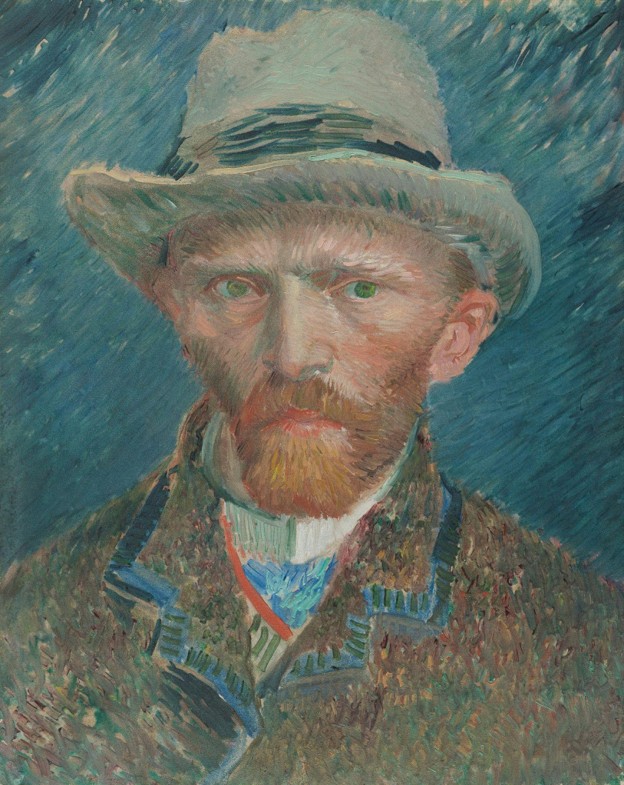
Vincent. Written by Leonard Nimoy, yes, that Leonard Nimoy (Mr. Spock) of Star Trek fame!
Before delving into the play and one of the most memorable performances I’ve seen in 2026, let’s talk about Nimoy’s immense talent for a minute.
Vincent is a one-man play Nimoy wrote about the painter Vincent van Gogh, told from the perspective of Van Gogh’s brother Theo. Nimoy both wrote and performed it, touring the production extensively in the 1970s and 1980s.
Beyond acting, his stage credits included Fiddler on the Roof, Oliver!, Camelot, and Equus. He directed several films, most notably Star Trek IV: The Voyage Home (1986), the most commercially successful of the Star Trek films. He also hosted the television series In Search Of… and authored several volumes of poetry.
He published A Lifetime of Love: Poems on the Passages of Life in 2002, and his famous Vulcan salute, “Live long and prosper” came from the Birkat Kohanim — the Priestly Blessing — performed by Kohanim (descendants of the priestly tribe of Aaron) during synagogue services.
Nimoy recounted that as a boy, his father told him not to look when the Kohanim went to the Bima and began reciting the blessing. He peeked anyway and saw the men with their hands poking out from their tallit in a striking hand sign that he thought was “magical.”
Beth Burns directed this show with precision and magnanimous intention and had the good fortune of meeting Leonard Nimoy. The magic of the writing in Vincent originated in Vincent van Gogh’s own letters to his brother Theo, which were remarkably coherent and eloquent. Nimoy’s interpretation of the brother’s mixed and complex emotions towards Vincent showed his compassion for other artists and an innate protectiveness of the creation of all art forms.
At once electric and exhausting, Theo’s personality and performance as the protector of his brother’s genius, creativity, and sensitivity also suffered. So intense was Nathan Jerkins’ performance throughout the show, I felt my heart palpitating at abnormal rates for most of the show. I too felt depleted like Theo, to the point of visibly yawning throughout. I could only imagine the pain Theo felt for his brother and despite him. In life, I too was a sort of protector to my younger brother, whose insufferable existence made everyone around him anxious, on-edge and anticipating the next tragedy.
Theo’s sorrow was not the same as Vincent’s, whose overzealous battle to live the life of a purist: love (influenced by his father who was a Calvinist minister and disapproved of Vincent’s artistic life) in Vincent’s youth conflated total immersion into poverty. He martyred himself with the poor peasants in a Belgian coal mining town, whose lives were in worse tatters than the garments that barely clung to their frail bodies.
Love, later in Vincent’s life, meant again denying his own needs by idealizing the putridness of his relation with a prostitute and her child until she left him alone and abandoned. He had an insatiable need to live for someone or some cause greater than himself.
Eventually Vincent melded that bigger love into his art – a grandiose purpose so as not to feel smothered by pious professors. And yet, he refused Theo the right to show his work. Vincent was deeply ambivalent about it. “The tempest of my genius was about to burst”, he wrote, and yet he continued to refuse to show his work.
He died in Arles, France, alone and impoverished, ousted by the townfolk who detested and misunderstood him, his disability (epilepsy, although this was never conclusive) convulsions, blackouts, episodes of psychosis. The townsfolk of Arles never understood his art.
One of the last lines in the play brought me to my knees. “We take a train to reach the city and death to reach a star.”
Van Gogh shines his star for the entire world, even if it took his death to achieve the universal love he always sought in life.
The Penfold Theatre is located in Round Rock at 2120 N. Mays Street, Suite 290, 78664. Call 512.850.4849. Contact penfoldtheatre.org for tickets and information. Show runs through June 21, 2026.
A review of the same play, with the same actor, by the same Theatre company, can be found at this link from 2023: