
Review by Professor Marion Dolan
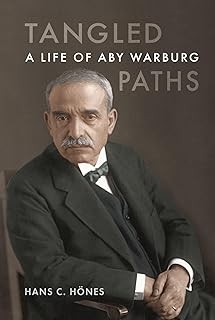
Tangled Paths: A Life of Aby Warburg surveys the difficult and troubled story of Aby Warburg (1866-1929), a major figure in the area of intellectual history. The author Hans C. Hönes, a professor of art history at the University of Aberdeen, has written an extensive, well-researched biography of the art historian Aby Warburg. The book touches on all areas of the highly-honored German-Jewish scholar’s life, including his health problems, his lifelong struggles and his extensive research into all collections of knowledge. The author includes forty-six illustrations along with excerpts from Warburg’s notebooks but does not burden readers with the more technical academic theories in his work.
Even though Warburg was, in his time, little known outside of the Hamburg, Germany intellectual world and never held an academic position, Aby Warburg is considered one of the most important and influential art historians. His method of reaching into topics beyond the artwork itself and synthesizing information from numerous academic disciplines opened new grounds for art historical studies. His efforts have inspired scholars in many different areas to follow his ideas and replicate his wide-ranging research methods.
Warburg’s primary area of study was Renaissance art and his doctoral dissertation was focused on the artwork of the well-loved Florentine artist Sandro Botticelli. His ground-breaking monograph was completed in Florence in 1891. The scholar’s work decoding Botticelli’s ideas, symbols and sources “has been hailed by historiographers as a paradigm shift for his discipline, pioneering a cultural-historical approach to art that had little interest in aesthetic appreciation, but instead dug into a contextual analysis of the mindsets of 15th century Florence”.
The study of art history is a relatively new discipline in academia, considering the seven liberal arts, literature, science and mathematics, which all date back to schools of the Classical period. Surprisingly, until the late-nineteenth century the discipline of art history had not been officially defined as an independent classification of study within any university. Before the work of Warburg and his mostly-German colleagues, the study of civilization’s long production of magnificent works of art was included in humanities, world history, natural science or any appropriate category. Aby Warburg was one of the most essential figures in defining and establishing the guidelines of art historical research and identifying the extensive amount of knowledge that could be acquired through the careful study of artworks from any time period. His specialized studies were essential in the struggle to recognize art history as an independent scientific discipline.
Before Warburg, the study of paintings and sculpture was limited to the design, the color palette, the ability of the particular artist and the features of the artwork. Warburg’s vast study of ancient history, ancient literature, and especially early mythology, not only Greco-Roman, but of many Asian cultures, greatly influenced his writings. Although his published works are not extensive, they encompass great amounts of knowledge by examining meaningful symbols, specific colors, religious influences, even economic conditions of the time. Warburg is considered the inventor of iconology as an art-historical method. He believed that artists drew not only from contemporary models and ideas; they incorporated themes, ideals and cultural archetypes from ancient Classic civilization. He called the symbolism of Renaissance art “the afterlife of antiquity”
Aby Warburg was born into a very wealthy banking family with a long history in Hamburg; he was the oldest of seven children, with four brothers. As the eldest he was destined to follow his father as heir to the prosperous business. By the age of thirteen Warburg had already become well-educated and knew he felt absolutely no attraction to the financial world; his interests lay in study and the search for knowledge. Young Aby is said to have passed his birthright to his younger brother Max in exchange for the promise that he would be able to purchase as many books as he needed for his studies. That promise held out for his entire life.
Growing up, Warburg suffered from delicate health issues and showed an unstable, unpredictable temperament; these physical and mental health problems continued throughout his life. Looking into various career possibilities including law, he studied locally until he was twenty-one, often visiting other cities in Europe. His search lead him to the field of study that intrigued him the most, world art; he recognized the amount of information that historic artworks might hold. Moving to Bonn in 1886 Warburg began his life-long studies of human history, including that of art, of culture, religion, literature, mythology and archaeology. From Bonn he moved on to Munich and Strasbourg for more study. In 1888 he began research in Florence, a city he grew to love. He later described himself, “By heart a native of Hamburg, by blood a Hebrew, in spirit a Florentine”). He finished his PhD in Florence and continued with his writing and research there before moving back to Hamburg.
Aby’s brother Paul married a woman whose family had settled in New York City and Aby traveled there in 1895, since he was verry interested in the Americas and the ancient Pueblo cliff dwellings. In the southwest Warburg visited Mesa Verde and a number of Pueblo villages; he met with anthropologists and gained knowledge of the sacred cosmology of the native cultures. His lengthy study of serpent symbology drew him to observe the ancient “sacred snake dance” of the Arizona Hopi. He asked a native priest and his son to draw images that would explain their cosmology and their worldview to add to his collection of symbols.
In 1897 Warburg upset his family when married Mary Hertz, a painter and sculptor, against their wishes; she was the daughter of a Hamburg senator and her family were Evangelical-Lutherans. They eventually had three children The couple moved to Florence in 1898 where he renewed his research into details of the important artists lives, including the economic and social conditions of the Renaissance era.
The Warburgs left Florence in 1902 for Hamburg where he lectured on his Florentine research and continued his research. There his symptoms of manic depression and schizophrenia emerged and he was eventually hospitalized in a Swiss neurological clinic. From 1921 and 1924 he continued under treatment at the clinic but, in spite of his anxieties, was able to work on his studies. After release from the clinic Warburg was stable enough to present lectures, develop seminars and write articles. In Hamburg his final productive period lasted from 1924 until 1929 when Aby Warburg at 63 died suddenly of a heart attack.
Warburg’s erudition and close study of documents of every kind enabled him to apply an interdisciplinary manner to his understanding and defining of art and the world of images. He was the first to utilize philosophy, psychology, theology, ethnology, astronomy, astrology and the natural sciences in his analyses of great paintings, frescoes, mosaics and sculpture. His open-minded research even credited the cultural influences of magic, symbolism, rituals and mythology. Warburg’s study of the intellectual and social context of Renaissance art changed the direction and future of all art historians, establishing a ‘global history of art’.
Warburg’s love of books and open budget enabled him to assemble an enormous library. Initially, the library was established within his private home but was open to other scholars at specific times. By 1911 the library held 15,000 volumes including those from Warburg’s early years. He hired the young art historian Fritz Saxl (1890-1948) to organize and classify his growing library. Fortunately Warburg and his assistants kept accurate records to verify its growth. The expansive collection brought together an enormous amount of knowledge, available in one facility, holding books that scholars would have had to tract down in specialty librairies all over Europe.
In 1926 the 44,000 books were moved from his private library to a new building next door, designed and built by Warburg, named the Kulturwissenschaftliche Bibliothek Warburg (KBW). The constantly growing library was available to scholars for private research and for working together to find common purposes and methods. When the library was transferred to London in 1933, it comprised about 60,000 books and 25,000 photographs.
The Warburg library was moved to London to escape possible interference from the Nazi takeover of Germany. The great scholar’s library is now part of The Warburg Institute associated with the University of London. Like Warburg’s research ideals, “The Warburg Institute is dedicated to the study of global cultural history and the role of images in society. It examines the movement of culture across barriers – of time, space and discipline – to inspire, inform and connect.”
Tangled Paths: A Life of Aby Warburg is by Hans C. Höne, published by Reaktion Books in 2024. It lists for $40 (hardback).