
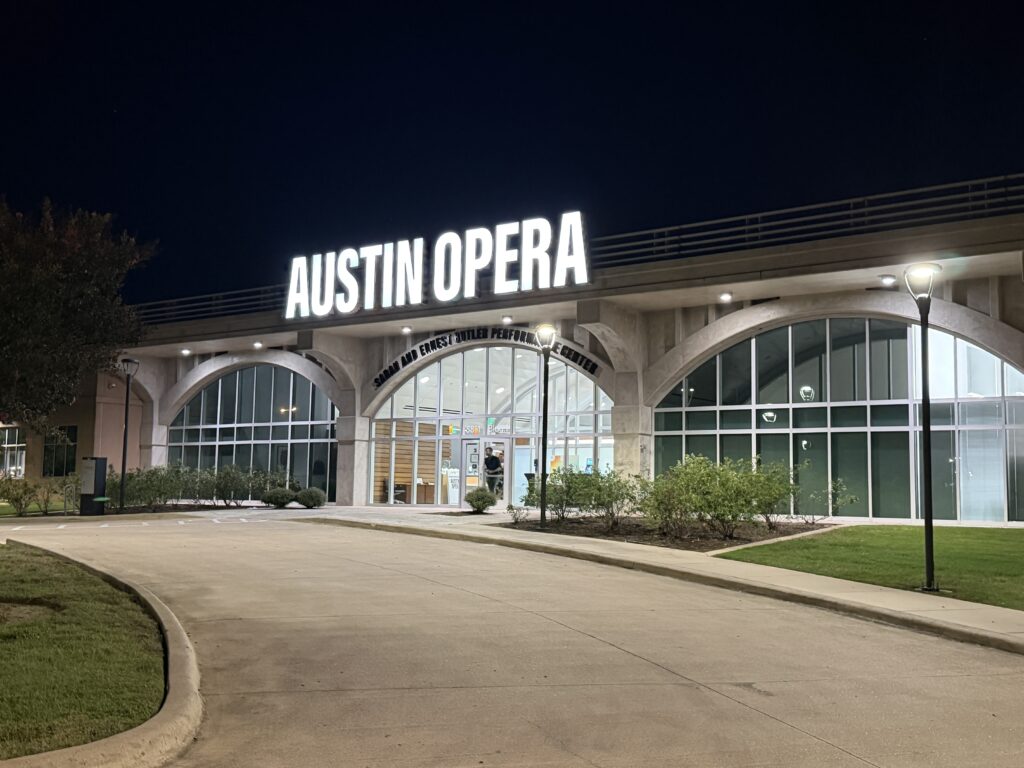
Premiering at the new home of Austin Opera, south of the river (Lady Bird Lake), is Ofrenda.
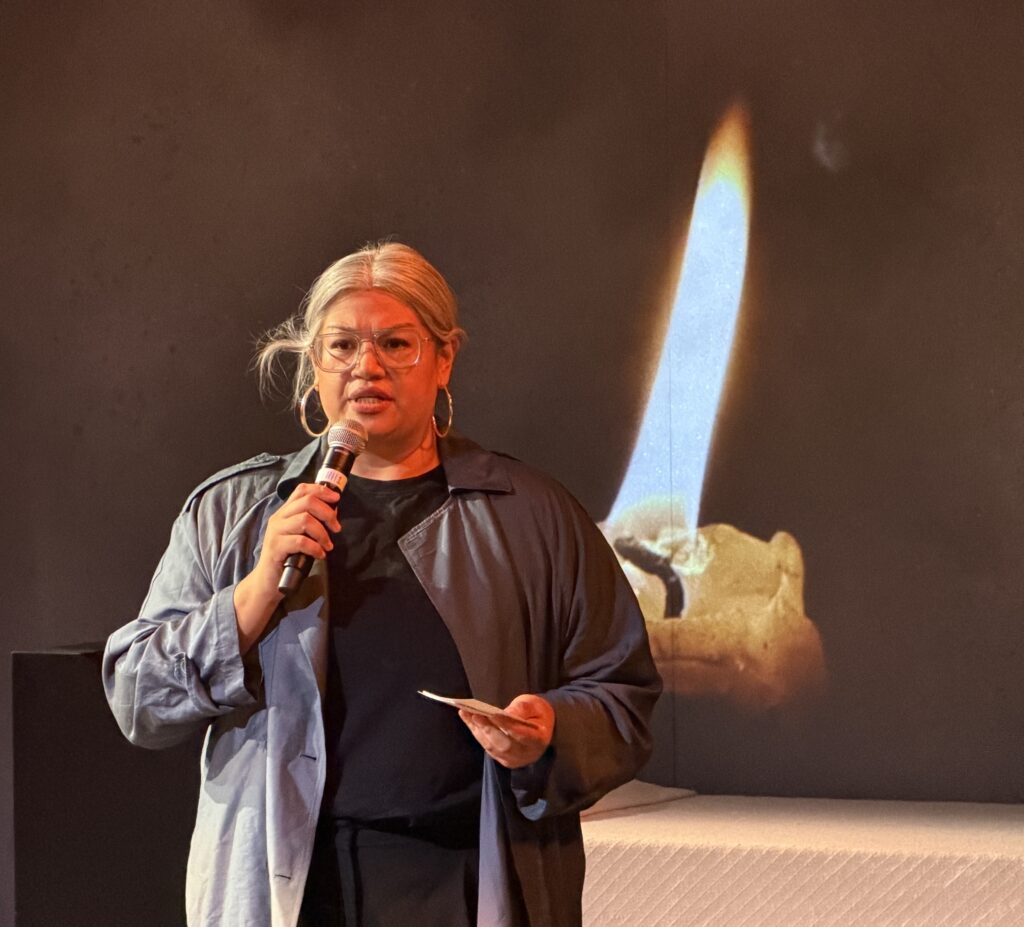
Claudia Chapa hosted an intimate gathering before a recent performance of the opera. Here are some excerpts from her remarks. Speaking of the Sarah and Ernest Butler Performance Centre, Chapa said
“We are an intimate space on this side of the river that’s dedicated for performance. And so, we’re really excited to be able to serve the community that we are in currently. And we’re just a couple of miles away from the Mexican consulate. Why is that important?
Well, I am the curator for Hispanic and Latinx programming, and I do these concert series at the consulate, and the whole point of them is to empower Latinx art.
BACKGROUND TO THE OPERA
“This is our first commission ever,” Chapa explained, “so you’re part of history by coming and watching this beautiful opera.
“But how did we get here? About three years ago, we got a $3.3 million endowment by Sarah and Ernest Butler. This endowment was made so that we can cement our relationship with our community as well as the Latin community here. With it, I was appointed as the first Hispanic and Latinx curator for Spanish language programming.
“Why is that important? In order for someone to advocate for a group of marginalized people, one must come from that background. Now in no way do I speak for the entire Latinx community. But I definitely have a perspective that’s important and that I am very honored to shepherd. I’m a border town kid, and was then raised in Laredo. I know what it is to navigate two worlds, two cultures at the same time bilingually.
“There are a couple of operas out there that are in Spanish language, but not all the creators are Latin. So, from our Spanish language initiative, we went ahead and opened up the Latinx residency for creatives. This residency is to empower Latinx creatives to make opera for us, by us, by our own point of view.
“So we had this nationwide residency open up and received sixty entries. The particular duo of Jorge Sosa composer and John de los Santos (libretto) were selected.
“They met during the pandemic. And there was a lot of talk about healing, essential workers, healing healers, hospitals, and they started thinking, what, how can we make an opera with these elements?
“And they combined and remixed and were inspired to make this story, which is Ofrenda. They decided to centre the story on a custodian at a hospital who is working there trying to provide for her daughter. As the story unfolds, she meets this really cool entity that gives her this really great gift. But it comes with a lot of strings attached!”
MEXICAN INFLUENCE
The 1960 film Macario is one that she suggested audience goers might find valuable. It was the first film to put Mexico on the map, and was nominated for an Academy Award for Best Foreign Film.
“It’s also good to see the visuals because a lot of the inspirations that you’re going to see on our projections are inspired by the movie Macario as well as the surrealist Mexican surrealist photographer Gabriel Figueroa.”
Ofrenda itself is part of Mexican culture: an indigenous celebration where they honour the dead. “I will say for the most part, Mexican culture has a really beautiful relationship with death. It’s not an all-time scary situation: It’s part of life, a continuation of a journey for us.
“And ofrenda is a perfect time for us to recognize, to remember the loved ones that we are always with us but not physically here with us. A character in the play represents death. And you’ll see her come in and she speaks in Spanish, but she is whatever you want her to be ultimately.
“An interesting thing is that you hear the characters them navigate between Spanish and English, which is really common with most households in Texas. So that’s great thing that I liked about this opera.” The opera also includes a few words from Nawat language, the last surviving indigenous language of El Salvador.
She summed up the opera in one line. “It doesn’t matter where you’re from, even though it is so specific to being Mexican and Mexican-American, it’s still a very relatable human story.”
THE OPERA
The performance was held in the Sangeeta Teresa Mai & Hai Nguyen Theatre, and these two valuable patrons were attendance on the night I saw it. Seating in the theatre is an issue: one row of seats is directly behind the ones in front, not ‘staggered seating’ as is usual. Not an issue, you might think? The two ladies seated to my left got up from their seats because they could not see above the tall heads in front on them. They moved elsewhere, so it was fortunate the performance was not entirely sold out.
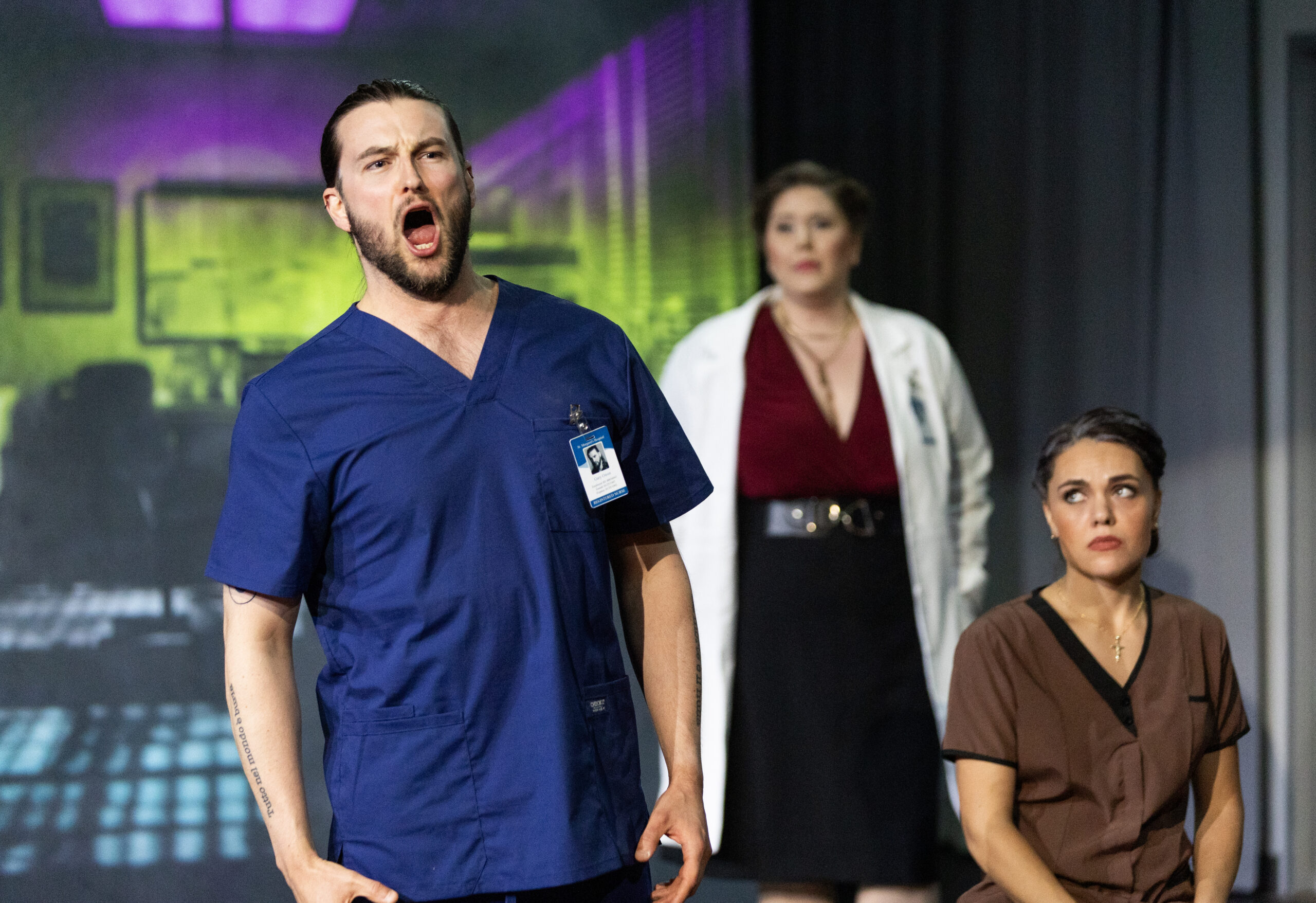
The 80-minute production benefitted from two screens that provided English translation. In this small space, the booming voice of tenor Kyle White literally shook the walls! His angst-ridden performance (lead photo) was superb.
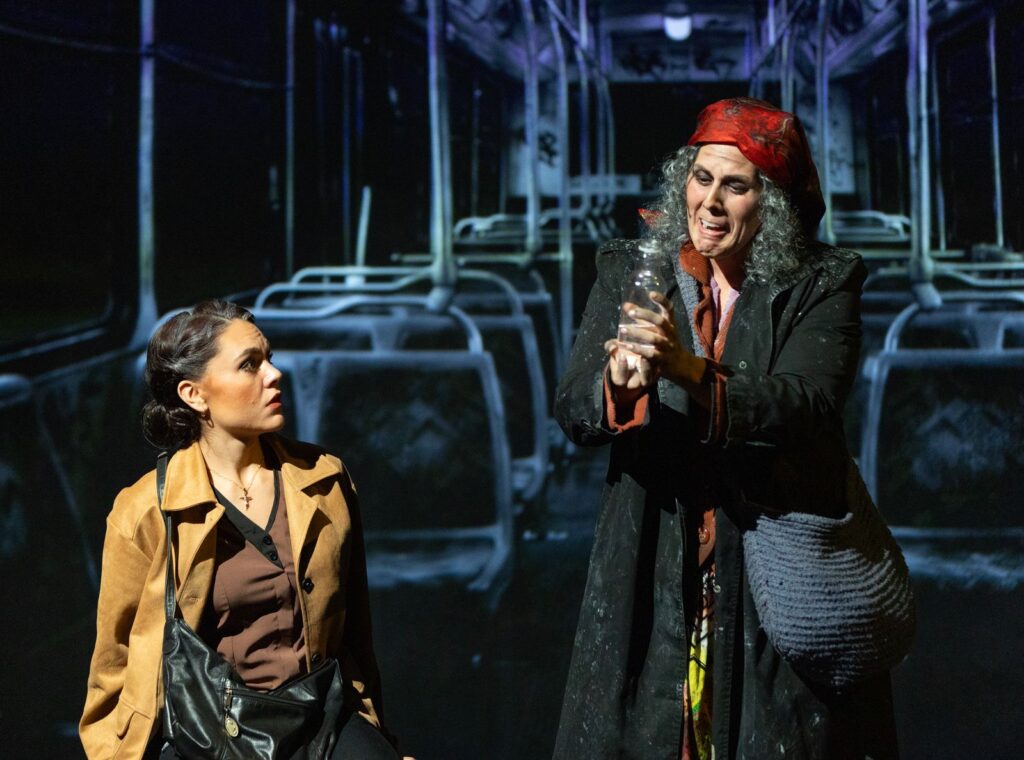
The other singers consisted of two sopranos and two mezzo-sopranos. Victoria Vargas (at right in 2nd photo) offered a dramatic and somewhat terrifying image of Death in Ofrenda. A pitch-perfect performance. Singers Kelly Guerra, Maia Aramburu and Kristin Bilodeau each bring their personal interpretation to the roles they have been assigned. It is this binding to both the libretto and the music that makes for a fine and satisfying experience. All performed beautifully.
Space limitation restricted the music to a chamber orchestra, conducted by Timothy Myers. Personally, I found this intimacy to be exactly what was required. I feel Ofrenda will lose something when finally performed on the usual grand opera stage.
While its run has concluded in Austin, it will surely be performed again both here and elsewhere. Highly recommended.
production photos by Erich Schlegel
photo of Chapa shows a flickering candle, one of the visual elements that often formed a backdrop to the action. This and other imagery was, as Chapa said, inspired by the 1960 Mexican film. The imagery was an integral part of the opera, and was brilliantly conceived. (image by C. Cunningham)
A view of the impressive Austin Opera building at night. (image by C. Cunningham)
Tickets for future performances: www.austinopera.org