
The Cultural Savior to the French Expat Community in America
I discovered French Premiere at AFS Cinema while laughing my way through a French comedy. Having lived in Vence in the south of France, I recognized something beyond the language: the pleasure of watching people behave badly, expose their contradictions and make a glorious mess of their assumptions. My sarcastic sense of humor felt quite at home.
There is something lovely about sitting in an Austin theater and seeing a foreign film that might otherwise never reach your local multiplex. For a couple of hours, another country’s preoccupations take over the screen. Its jokes, social tensions, and ways of looking at the world become available to us without being repackaged for American consumption, thank goodness!
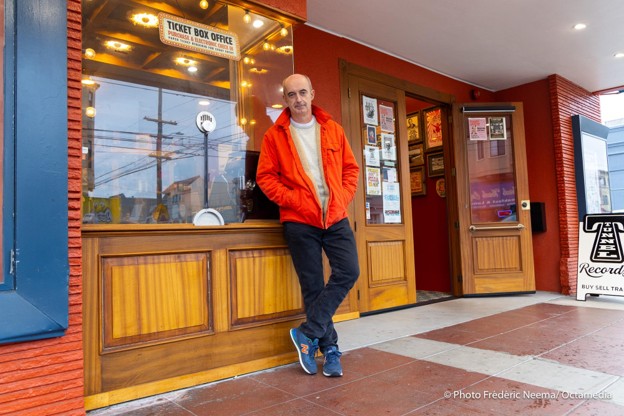
That experience prompted me to speak with Arnaud de Fontenay, the founder of French Premiere, whose business brings recent French films to American audiences. Behind the screenings is a familiar expat dilemma: knowing what is happening back home and having little opportunity to participate.
Born and raised in Le Havre, de Fontenay spent much of his adult life in Paris, working for 25 years in the French film industry, principally on the legal side. His last position before moving to America was at the Pathé Foundation. In 2017, his wife’s work with Google brought the family to San Francisco. Their two children enrolled at the Lycée Français, where he began organizing French film screenings.
The audience was enthusiastic, but access dictated the selections. Available films could be several years old, he recalled during our interview. What people wanted was the new movie their friends in France were discussing.
French Premiere, launched in January 2024, grew out of that frustration. Its monthly screenings present new French films in their original language with English subtitles, making them accessible to viewers who do not speak French.
I understand the appetite. After years of living abroad, including a year in France, I know how strange it is to remain mentally engaged with one country while living in another. You follow its cultural news, hear about a film or an exhibition, and want to be part of the conversation. Knowing about something, however, does not mean you can see it. By the time you return, the film may have left theaters and the exhibition may have closed. Your connection survives; but your access does not.
De Fontenay described French expats who follow newsletters and cultural coverage closely, yet miss the very events they are reading about. Returning for summer or Christmas does not solve the problem, since summer is when France closes down for holidays and Christmas is when families or friends gather. Culture has its own calendar, inconveniently indifferent to your airline reservation.
His response is practical. He licenses a film, rents theaters and brings the screening to audiences in several American cities. He said the operation had expanded to eight cities and was selling approximately 12,000 tickets a year. Some locations perform better than others which is to be expected, depending on how large or small the French expat community is in a city or region. Expansion depends on finding both an audience and an appropriate venue.
“The business case is simple,” he told me. “Booking the movie, booking the theater.”
Simple in outline, perhaps. Finding the people who will buy the tickets takes considerably more work. Before entering a city, de Fontenay looks for French schools, cultural organizations, and community networks, then considers whether the theater is somewhere people will actually go on a weekday evening. His outreach includes Alliance Française, French consulates, Villa Albertine, French-American Chambers of Commerce and international schools.
Although the French community provides a starting point, he wants a broader audience. A survey of his newsletter readership surprised him: respondents were approximately 60% French, 30% American, and 10% other nationalities, he said. Those figures describe the survey respondents, but they suggest an interest extending beyond homesick compatriots.
His programming also challenges a familiar assumption about French cinema. He favors accessible contemporary films, including comedies and family stories, rather than concentrating on experimental or specialist art-house work. French audiences sometimes want to enjoy themselves without submitting a dissertation afterward. Personally, I have room for both.
Living in France gave me an appreciation for differences that can be difficult to explain until you hear them in a conversation or see them play out on screen. To my ear, American social exchanges often lean toward upbeat (but unrealistic) reassurance and enthusiasm, while the French exchanges I enjoyed left more room for skepticism, disagreement, and irony. These are impressions from experience, not rules governing two entire populations. Still, with my disposition, I appreciate humor that allows a little sting.
A comedy can reveal those differences more effectively than a solemn explanation of national character. The pause before a reply, an argument over something apparently trivial, or the puncturing of someone’s self-importance can carry as much cultural information as the plot. Subtitles help us follow the words; performances let us feel the attitude.
For Austin, AFS Cinema makes that encounter possible. De Fontenay was enthusiastic about the venue, praising its welcome, staff, and projection support. He described it as an especially good fit for the spirit of his project, which benefits from a theater already committed to international film.
I am grateful that it is here. AFS Cinema, operated by the Austin Film Society, is Austin’s only nonprofit art house theater. Its programming makes space for international films, independent releases, documentaries, restorations, and repertory screenings—work that gives audiences reasons to venture beyond the familiar.
An independent venue can show a film that is mainstream in France but unfamiliar in Texas. That distinction matters. We are seeing another country’s popular culture, including the stories ordinary audiences there choose for an evening out. The experience can be funny, moving, or uncomfortable, and occasionally all three.
For an expat, such a screening offers a way back into a cultural conversation. For the rest of us, it opens one. Either way, there is pleasure in sharing a room with strangers and discovering that another country’s absurdities bear a suspicious resemblance to our own.
Austin is fortunate to have a place for that discovery. I would like us to keep it.
For French Premiere screening dates, tickets, and the Austin newsletter, visit www.frenchpremiere.com. Choose Austin when subscribing, or contact contact@frenchpremiere.com.
Find AFS Cinema’s calendar at www.austinfilm.org/afs-cinema. To support its work and join the Austin Film Society, visit www.austinfilm.org/join-or-renew. Membership questions can be directed to membership@austinfilm.org, or call 512-322-0145, extension 1. Benefits vary by membership level and include screening discounts and member events.
Photo: Arnaud de Fontenay, Founder of French Premiere