
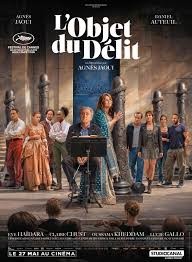
Opera has always accommodated oversized egos, wandering hands, and people convinced that their desires deserve an entire orchestra. Agnès Jaoui’s Crescendo brings those appetites into the present, where an accusation of sexual assault sends a production of Mozart’s The Marriage of Figaro into a tailspin. Somewhere between artistic entitlement and collective indignation, everyone thinks themselves a conductor.
Hilarious, poignant, and occasionally cringeworthy, this French comedy-drama gave me plenty to laugh about and even more to argue with. Watching it through French Première’s monthly screening series at AFS Cinema in Austin, I found myself drawn into a familiar French cinematic pleasure: a roomful of people dissecting human behavior while demonstrating its contradictions.
Released in France by StudioCanal on May 27, 2026, Crescendo, titled L’Objet du délit in French, premiered out of competition at Cannes in May. Jaoui directs, leads the screenplay credits, and appears as Hannah, alongside Daniel Auteuil as Igor in the opera, and Eye Haïdara as Cora. Claire Chust, Oussama Kheddam, Tiphaine Daviot, and Vincenzo Amato are among the ensemble navigating this increasingly combustible artistic undertaking.
Behind the scenes of the operatic production in southern France, generational differences become ideological battle lines. Older attitudes toward flirtation and artistic privilege collide with younger colleagues’ insistence on consent, accountability, and a reconsideration of inherited conventions. Each camp arrives carrying convictions that grow heavier as the discussion which leads to outright argument, proceeds.
Amato plays Piazzoni, the star singer performing Count Almaviva, whose sense of entitlement extends into his treatment of a female colleague. During the encounter that drives the dispute, physical liberties become the flashpoint for a much larger reckoning. Talent, status, and habit have evidently supplied this man with considerable confidence in what he defines as his permissions.
Daviot’s Sophie, who performs Susanna, struck me as withdrawn and hesitant to speak for herself. Which led me to question her own morals. Did she mind being touched on her well-padded breast, or was it offensive to her? More forceful colleagues move into that space, determined to address what happened and establish a collective response. Their intervention raises a question that becomes increasingly uncomfortable: who gets to decide what support should look like?
Having called myself a feminist since the 1970s, I approached that question with considerable personal investment. Women’s autonomy includes authority over their own experiences, their own words, and the choices that follow. Solidarity becomes complicated when the people offering it direct the person they intend to defend.
What troubled me most was the group’s vote, and the recorded confrontation surrounding the accusation. To my eye, the process felt skewed, with social pressure shaping a gathering presented as an exercise in collective judgment. Recording the session added another audience, another layer of exposure, and another reason for everyone to perform a position.
Public humiliation has a history, and the scene brought Mao-era Gang of Four struggle sessions to mind. That association concerned the ritual of denunciation: the assembled group, the moral certainty, and the pressure to shame an individual before an audience. Within this comedy, the resemblance made me squirm.
Piazzoni’s arrogance supplies ample reason to challenge him. Accountability, however, deserves a process capable of examining behavior, hearing responses, and establishing consequences. Here, I saw the possibility of acknowledgment and repair recede as the spectacle gathered momentum.
And that is the problem in today’s overly regulated and extreme environments. Where does law begin and where does social examination end?
Jaoui finds rich comic material in that escalation. Conversations about fairness become contests over who possesses the most authoritative definition of it, while professional anxieties mingle with political conviction. Beneath the arguments sits an opera production whose participants still have to work together.
Attempts to update Figaro supplied another source of both laughter and irritation. Mozart’s opera already contains sexual maneuvering, abuses of rank, and servants challenging their social superiors; its conflicts offer fertile ground for contemporary interpretation. The company’s determination to translate everything into today’s ideological terminology struck me as increasingly labored.
Instead of deepening my engagement with the work, those interventions left me anticipating the next explanation of its relevance. Art can provoke recognition through a gesture, a relationship, or a musical phrase. Subjecting every element to a committee’s vocabulary risks making the commentary heavier than the material it seeks to illuminate.
Knowing that a woman wrote and directed this examination sharpened my discomfort with its portrayal of feminist intervention. My own history made me especially attentive to the women’s competing ideas about agency and solidarity. Jaoui’s willingness to expose those tensions also helps make the film so funny: recognition and irritation frequently arrive together.
Ultimately, Crescendo keeps the argument alive beyond the screening. Its humor emerges from people trying to reconcile their principles with their appetites, loyalties, and professional interests. Leaving the cinema, I carried both the laughter and the uncomfortable spectacle of people becoming thoroughly absorbed in their own righteousness.
French Première lists De Gaulle – Résistance as its November selection, followed by De Gaulle – Liberté in December. You can check Austin screening dates and tickets at https://www.frenchpremiere.com where audiences can also subscribe for announcements.
Separately, Austin Film Society’s New French Cinema Week runs November 12–15, 2026, opening with Valéry Carnoy’s Wild Foxes and an appearance by the filmmaker. Festival passes, individual tickets, and the full lineup are available through AFS’s festival page. AFS Cinema is at 6259 Middle Fiskville Road, Austin, TX 78752; visit austinfilm.org for its wider screening calendar.