
Who wrote the longest play to survive from antiquity? Answer: we don’t know! But we do know it is 1,996 lines long. In comparison, Shakespeare’s Hamlet is 4,024 lines.
The name we call this play is Hercules on Oeta, and this book by George W. M. Harrison (Carleton Univ. in Canada) is a compact study that, the author writes, will hopefully “awaken interest in a play that is immensely interesting, swaggering sometimes to the edge of self-parody, and deserving of a broad and large audience.”
First, I must level a criticism. The actual text of the play is not here, and Harrison does not offer us an easy way to find it. After some searching, I found an English translation online (the link is printed below).
It is an old Loeb Classical Library book from 1929. It appears in the 2nd volume of Senecan Tragedies, in the mistaken assumption the play was by Seneca. This translation was done by Frank Miller (1858–1938), professor of Latin at the Univ. of Chicago. Remarkably, his translation is not included in Harrison’s bibliography!
As for the play itself, it is not dated, but according to recent research “A date of composition early in the reign of the Emperor Trajan (98-117) is now generally accepted making the author a contemporary of Pliny the Younger, Plutarch, Suetonius and Tacitus.” This era is known to scholars as Early Imperial (Silver) Latin: the author of Oeta, Harrison tells us, “shows all the typical features” of Silver Latin tragedies.
Harrison makes the important point that “It is the modern preference that Hercules is in his twenties, which the text and ancient tradition do not support.” He points to the fact that Hercules’ son, Hyllus, is in his twenties, so Hercules in the Oeta play must be in his forties. Seneca did write a Hercules play, entitled Hercules furens. In that one he is “positioned as at least a decade younger than in this play but still beyond his twenties.”
Those looking for another view of the gay life of Hercules will be disappointed here. “Hercules and women is given prominence because this facet of his personality is central to his death in Oeta. Hylas, Hercules’ homoerotic companion in the story of the Argonauts, does not feature in Oeta.”
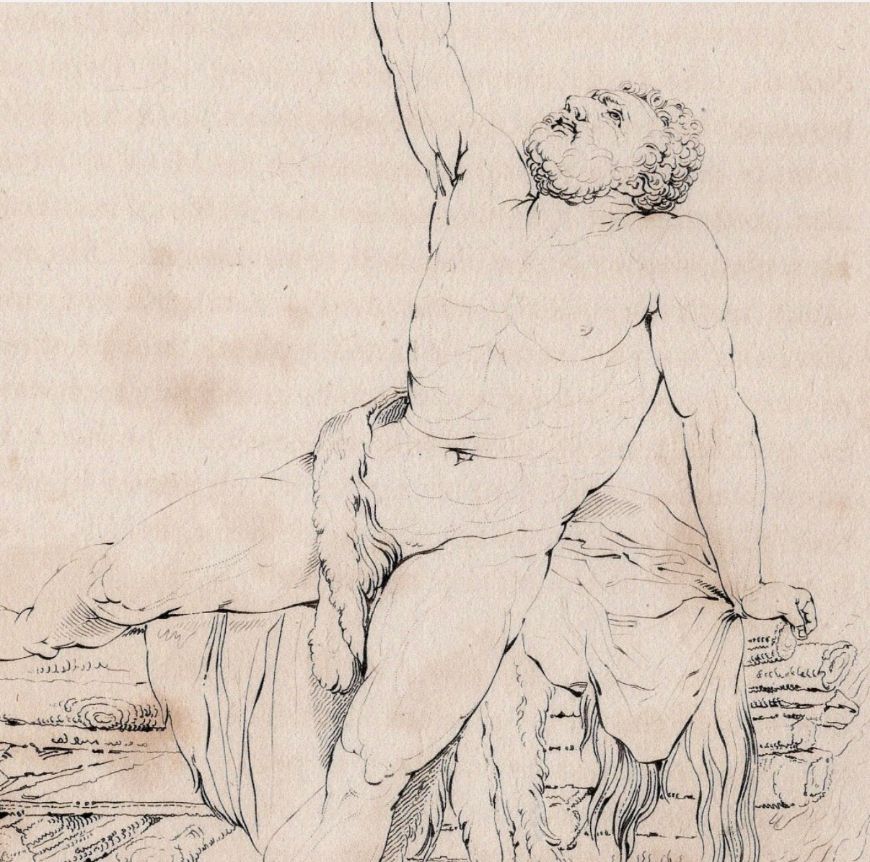
Likewise, the backstory of the young Deianara, who became the wife of Hercules, “is largely missing from Oeta.” But we do see her here giving Hercules a cloak suffused with poison: the blood of the centaur that Hercules killed. By line 1356 of Oeta, Hercules “knows that the garment was infused with poison,” but his Mother Alcmena, unaware of the deception that Deianara has perpetrated “tends to believe that Hercules’ labours have worn him down.” The engraving with this review depicts Hercules wearing the poisoned robe.
The portrayal of Alcmena in this play “is close to unique in all of Greek and Latin literature.” Her role is “greatly expanded from other treatments in which she features.” This comes in a chapter on ‘Contemporary Contexts,’ where Harrison shows us what else was being written and performed about Hercules in the Imperial period. Nothing astonishes more than to learn that the Emperor Nero “acted on stage the ‘insane Hercules.’” It happened in Greece in 67 CE. If I could go back in time to see any stage performance, that would be it!
The following chapter examines Oeta itself: its meter, style, and cast of characters. The third chapter in this careful study of the play highlights various themes, such as marriage and infidelity, the Labours of Hercules, his paternity, and ‘Responsibility (not guilt) of Deianara.’
As the last written of the surviving Latin tragedies, Hercules on Oeta certainly deserves to be more widely known. This excellent book, that puts the play in context and highlights key elements of its composition, should certainly be read in conjunction with reading Miller’s translation. I personally prefer Miller’s Victorian-style prose to John G. Fitch’s contemporary verse published in a new Loeb edition of 2004. The slightly updated Fitch version of 2018 unfortunately adopts American English spelling, instead of proper British English. Honour is spelled with a ‘u’ whether you like it or not!!!
There is a typo on page 111: “again the heavens” should be “against the heavens.”
Image: Death of Hercules as depicted in 1809. An engraving after Guido Reni. With one arm raised toward the heavens and his body tense with suffering, the scene captures the tragic instant when the poisoned robe of Nessus drives him to end his own life, fulfilling one of antiquity’s most powerful legends.
Link to English translation of the play:
https://archive.org/details/tragedieswitheng02seneuoft/page/n7/mode/2up
This book is part of Bloomsbury’s Companions to Greek and Roman Tragedy series. There are more than 30 titles in the series.
Pseudo-Seneca: Hercules on Oeta, is by Bloomsbury. It lists for $59.85