
Let’s go on a road trip!
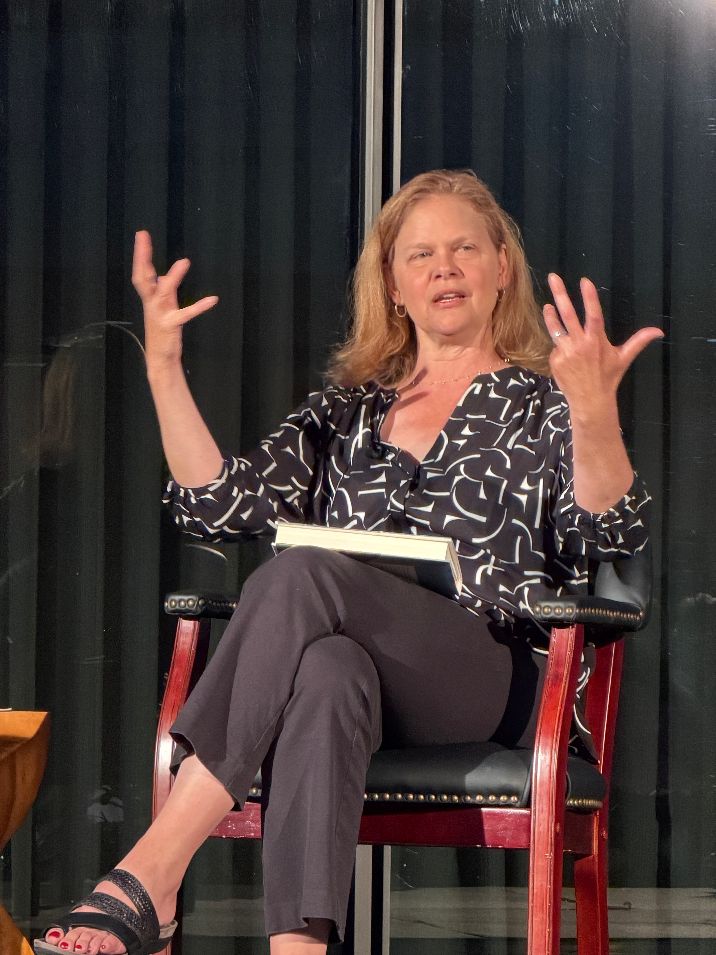
Professor Beverly Gage, who teaches U.S. history at Yale, did just that starting in 2023 in preparation for her new book. This article is based on her remarks in the LBJ Library here in Austin, on June 30, 2026.
“I knew I wanted to write a book that was about road trips because I love road trips!” Her book is the ultimate roadtrip, and a homage to America.
“I wanted to find a way to write a book that would give a sense of the dynamism and the changes of American history, and also that would cover all 250 years of American history for this moment because as people in Texas well know, most of the country wasn’t in the country in 1776, and so you’ve got to figure out what to do with moments like this.
“So the book is 13 chapters, and each one of those chapters is both a place and a moment in American history. It begins in Philadelphia, which was my hometown. Also, you might know, it is the birthplace of the nation, so that was convenient!
“It ends like good road trips must on the other coast in Southern California in the late 20th century with trips to Disneyland, the Reagan Library, the Nixon Library, and really looking at the culture of Southern California in the late 20th century and the way that influenced the rest of the nation. And then in between each of these chapters hops around between different places.
“I knew when I started out I wanted to try to cover all of American history and to do it pretty efficiently. I started doing this in early 2023 and I had to make this deadline of having a book between covers by the spring of 2026.
“The United States is this big, diverse, sometimes incomprehensible place, and so at many historic moments, people really focus on some set of actors, some community that seems to say something important about the country. So those were the places that I was looking for, and then they also had to be places that were still active: engaged in thinking about representing, memorializing, narrating their own history.
“And once I really had that pairing in mind, these places really just emerged almost; it felt a little bit mystical in the sense that they were the places that wanted to be written about them.”
On her previous visit to the LBJ Library, in 2023, Gage discussed her book on the former FBI Director J. Edgar Hoover.
“I’m very glad I wrote the book on Hoover, but I knew that I wanted to do something else: I wanted to challenge myself actually to try to write in a different voice. I wanted to get away from the things that I had been so focused on and had a chance to be the student rather than the teacher for a change.
“And so, the challenge of this book was not only coming up with deciding which places I was going to visit, but then trying to develop a writerly voice that is so different from the kind of authoritative expert voice that one often brings out in more traditional works of history.
“This is a work of history, and I think of it a little bit as a stealth American history survey course because there’s a lot of it packed in there, but it is also a travelogue, it’s also a memoir, and so I had to move between these different registers. There was a real writing challenge that I wanted to set for myself in thinking about this very weird way of doing this history. I wanted to write something shorter and honestly, I just wanted to get out of the office and away from my desk and talk to some actual living human beings!”
TEXAS
In the epilogue of the book, Gage quotes President Lyndon Johnson, who described American history as “the excitement of becoming – always becoming, trying, probing, falling, resting, and trying again.”
In her talk at the LBJ Library, where those words are inscribed on a wall, Gage said “What I found really inspiring and meaningful about that quote is that it gives a sense of dynamism that is American history, the sense of mobility and of experimentation.
“And I do want to say that I gave a talk here a few years ago that was at the very beginning of working on this book. So, this library played an important part in the story of the book itself, the Texas chapter in particular.”
In the book she concentrated her attention on Texas to the 1830s and 40s.
“It was the Texas rebellion, this moment when Texas was its own country, then its incorporation into the United States, the war with Mexico.
“I guess the person who comes to mind on Texas visits was when I went to Washington on the Brazos and got a tour from a tour guide whose name tag said “volunteer” and so in my book he is known as “volunteer” and “volunteer” immediately said ‘I just want you to know, I’m a storyteller, most of this history I’m going to tell you is true, but I can’t guarantee that all of it is going to be true.’ And he was a great storyteller.
“It was a fascinating history, in part because that chapter of Texas history resonates so strongly with some of the places that I have been. That is the Philadelphia of Texas. This is the place where the Declaration of Independence and the Constitution are written, so there’s a lot of kind of referencing the Texas story in relation to the rest of the country.
“So this book has a lot of very serious history in it but I also tried to have some fun, be funny when I could be.”
DISNEY
“I also think that places like Disney are really interesting to think about their historic origins in the 1950s. This was a direct intervention by Walt Disney in the American story. He was extremely self-conscious about it. He really, really wanted to put his own stamp on American history.
“There’s a bit of a running theme in this book about rich guys who are good at one thing and then decide that they can talk about everything else, put their stamp on everything else. John D. Rockefeller, who decided to fund Colonial Williamsburg, or Henry Ford, who decided to build his own strange and wonderful version of American history in museums in Dearborn, Michigan, or Walt Disney, deciding that he was going to tell his story.
“And so, I think part of it is just to engage these places with a certain kind of curiosity, to try to puzzle out what stories they’re telling, what stories they’re leaving out.”
THE NATURE OF HISTORY
Gage made some cogent remarks on the nature of historical studies.
“There was a danger that the 250th was going to be only about the American Revolution and that we were going to think about the founding as this fixed experience, something that we’re supposed to venerate, something that has its own place in time, and it’s been all decline ever since.
“I really think of history not as a set of facts that you have to learn, although I’m a fan of facts, which is apparently less and less popular these days. I do believe that they matter. But history is a method for understanding the world around you. So, you can look at your own community and say, why is it like this? And history is the story of human decisions that made the world the better. And so, if you think about it that way as just a set of questions about the world and questions that you can answer, then it opens up lots and lots of possibility.
“This book is about local places and it’s based in part on the idea that these local places have a national story to tell that they are connected. And so that’s part of what the book is about, trying to link the national and the local.”
The book has 324 pages but only a few B&W photos; it would be a more enticing read to be beautifully illustrated in lots of colour images. It has 12 pages of recommended reading and 13 pages of terse notes.
This Land is Your Land: A road trip through U.S. history, is by Simon & Schuster. It lists for $30.
Photo by C. Cunningham